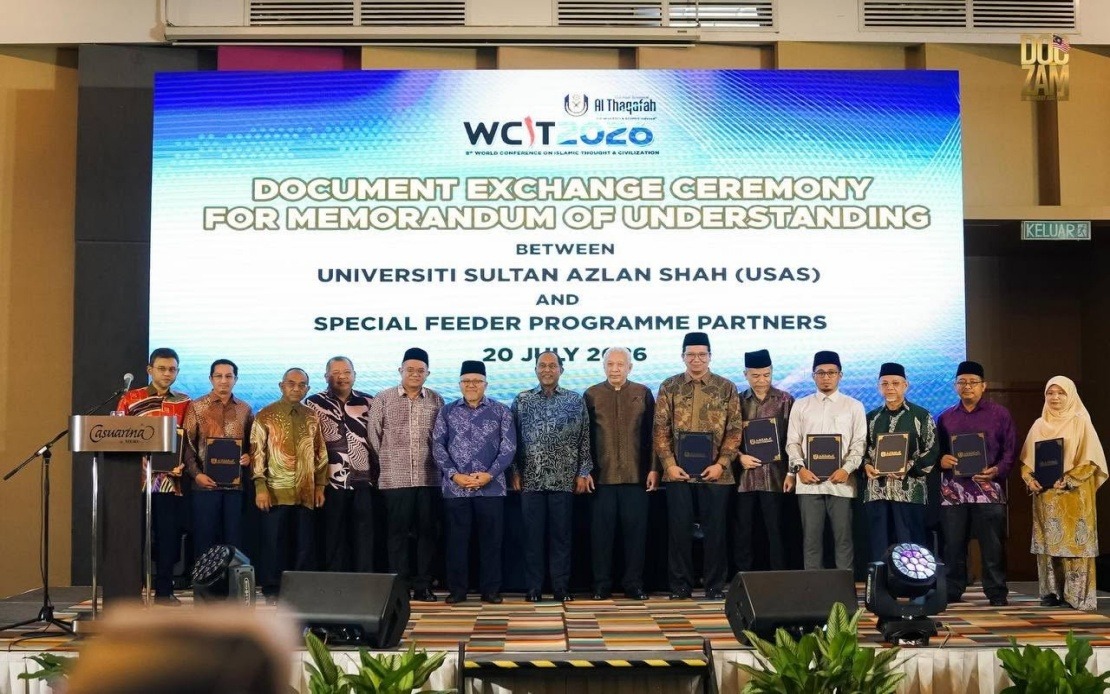
Malaysia is positioning itself as a critical hub for intellectual exchange and educational advancement in the Islamic world, with Higher Education Minister Datuk Seri Dr Zambry Abdul Kadir articulating the nation's broader vision for fostering knowledge-driven collaboration across international boundaries. His remarks, made during a preparatory gathering in Ipoh, underscore Malaysia's ambition to transcend regional limitations and emerge as a trusted intermediary for advancing complex conversations on civilisational challenges, technological disruption, and the future direction of Islamic scholarship.
The 8th World Conference on Islamic Thought and Civilisation (WCIT2026) represents a significant undertaking for Malaysia's higher education sector, drawing scholars, researchers, and intellectuals from over 180 countries to deliberate on pressing contemporary issues. Universiti Sultan Azlan Shah organised the preliminary dinner that brought these participants together, establishing networks and setting intellectual foundations for the main conference proceedings. This gathering reflects Malaysia's capacity to convene diverse stakeholders—a soft power asset that distinguishes the nation within regional and global academic landscapes.
Zambry's articulation of Malaysia's role extends beyond mere hospitality; it reflects a strategic calculation about the nation's positioning in an era of intensifying geopolitical competition and ideological fragmentation. By framing the nation as a "centre of excellence in higher education" and a partner committed to building an "inclusive, progressive, and values-based knowledge ecosystem," Malaysia signals its intention to compete for intellectual leadership alongside established academic powers. This positioning carries particular significance for Southeast Asian nations seeking to establish independent voices in global discourse.
The minister's emphasis on knowledge as humanity's shared inheritance—transcending national and civilisational boundaries—addresses a critical tension within contemporary Islamic scholarship. While acknowledging the distinctive contributions of Islamic civilisation, Zambry's framing avoids narrow parochialism, instead advocating for openness to cross-cultural learning and collaborative problem-solving. This approach resonates with Malaysia's own experience as a multi-religious society where intellectual discourse must accommodate diverse perspectives.
Zambry's invocation of historical destruction—Baghdad, Granada, Sarajevo, and Palestine—serves a dual purpose in his argument. Beyond commemorating losses to Islamic heritage, these references underscore a contemporary thesis: that institutional collapse during conflict disproportionately damages civilisational continuity. When universities and libraries fall, the minister argued, societies lose not merely physical structures but accumulated wisdom and future potential. This framework positions higher education as fundamentally linked to civilisational resilience, elevating educational investment beyond bureaucratic necessity to existential importance.
The timing of WCIT2026 intersects with broader regional trends shaping Southeast Asia's knowledge economy. Malaysian universities increasingly compete for international faculty and students, while the nation positions itself as a hub for Islamic finance, halal certification, and faith-based innovation. Hosting this conference amplifies Malaysia's profile as a destination for serious intellectual work, potentially attracting research partnerships, student enrollments, and institutional collaborations that strengthen the nation's competitive position.
Zambry's assertion that education must transcend "the boundaries of politics, conflict, and technology" acknowledges contemporary pressures threatening academic autonomy. Universities worldwide face mounting pressure to align with national interests, military applications, or political ideologies. By insisting on knowledge's universal character, Malaysia advocates for intellectual spaces insulated from such instrumentalisation—a position increasingly difficult to maintain as governments worldwide tie funding to strategic priorities and security concerns.
The conference's three-day format suggests ambitious agenda-setting, with expectations that participating scholars will produce concrete resolutions and innovative frameworks addressing Islamic world development. These outcomes carry significance for Malaysia as a convening power; successful conferences generate publications, recommendations, and continued networks that enhance the host nation's intellectual standing. Conversely, outcomes perceived as vague or disconnected from practical challenges risk diminishing impact and limiting follow-up engagement.
For Malaysian higher education institutions, WCIT2026 presents opportunity to demonstrate capacity for international-standard scholarly programming and facilities management. The conference success—judged by participant satisfaction, media coverage quality, and subsequent scholarly output—contributes to institutional rankings and attracts future international events. This virtuous cycle builds Malaysia's ecosystem capacity while generating economic activity through accommodation, catering, and professional services.
The broader context involves Malaysia's strategic positioning within competing visions for Islamic thought's future direction. Some currents emphasise traditionalism and cultural preservation; others prioritise technological adaptation and contemporary problem-solving. By hosting inclusive dialogue, Malaysia avoids prescribing particular intellectual outcomes while demonstrating commitment to process. This pragmatic approach reflects Malaysia's own internal balancing between religious traditionalism and modernising ambitions.
Zambry's framing of higher education excellence as foundational to "ummah" (Islamic community) advancement reflects how religious identity intersects with knowledge production in Malaysia's policy discourse. Unlike secular Western frameworks separating religious and educational domains, this positioning integrates spiritual and intellectual development, appealing to constituencies valuing faith-centred approaches to learning and scholarship.
The conference ultimately tests whether Malaysia can translate diplomatic hospitality and institutional capacity into substantive intellectual leadership. Success requires not only logistical competence but genuine contribution to scholarly conversations—positioning Malaysian researchers and thinkers as significant participants rather than merely gracious hosts. This distinction matters for establishing lasting influence and attracting subsequent international academic initiatives.

