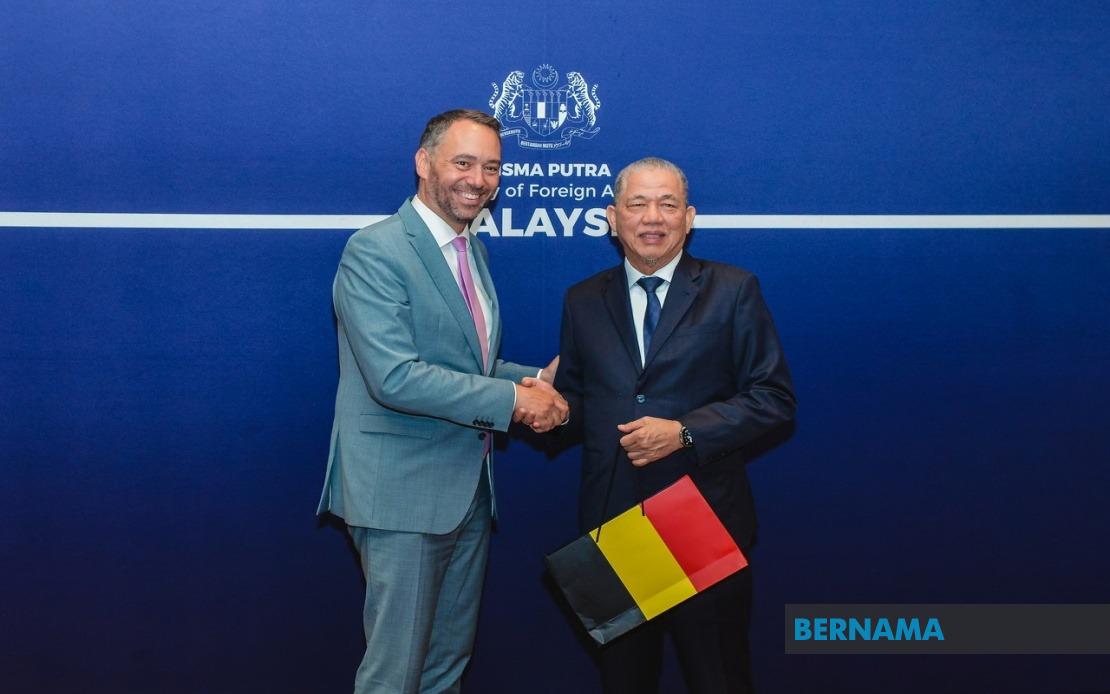
Malaysia has moved to reassure Belgium that maritime routes through the South China Sea will remain accessible and secure, reflecting broader regional anxieties about potential disruptions to international shipping corridors. The assurance came during high-level talks between Deputy Prime Minister Datuk Seri Fadillah Yusof and Belgium's Deputy Prime Minister and Foreign Minister Maxime Prévot, underscoring Malaysia's position as a key voice in Southeast Asian diplomacy on questions of regional security and freedom of navigation.
Fadillah conveyed the pledge in emphatic terms, stating that ASEAN member states guarantee unobstructed passage through the strategically vital waterway. The commitment reflects the association's broader philosophy of maintaining peace and stability in an increasingly contested region, principles that form the ideological foundation of ASEAN's collective approach to geopolitical challenges. By framing the guarantee in terms of ASEAN solidarity rather than Malaysia alone, Fadillah signalled the bloc's unified position on keeping sea lanes open to international traffic, a stance critical to global commerce and the interests of distant trading partners like Belgium.
The timing of Belgium's concerns carries particular weight in the current geopolitical climate. Prévot's questions about potential disruptions comparable to incidents in the Strait of Hormuz suggest European anxieties about supply chain vulnerabilities and the possibility of regional tensions spilling over into broader economic consequences. The Strait of Hormuz, through which roughly one-third of seaborne traded oil passes, has experienced periodic tensions that have rattled global energy markets. Similar concerns about the South China Sea reflect fears that great-power competition in Asia could eventually constrain commerce or create chokepoints affecting economies far beyond the region.
The bilateral engagement also served to deepen Malaysia-Belgium relations across multiple dimensions of statecraft and commerce. Beyond security assurances, both governments explored opportunities for expanded government-to-government collaboration alongside business-to-business and people-to-people exchanges, the classic tripartite framework through which modern bilateral relations are typically structured. Prévot's commitment to reviewing Belgium's travel advisory for Sabah signals practical movement toward facilitating increased mobility between the nations, a concrete step that can unlock tourism and business opportunities for Malaysian businesses and workers seeking European markets.
One particularly noteworthy dimension of the discussions centred on Malaysia's halal ecosystem, a sector in which the country has cultivated genuine expertise and infrastructure over decades. Belgium's interest in exploring Malaysia's halal standards as a potential model for European Union adoption reflects the growing commercial and regulatory importance of halal certification in global trade. For Malaysia, this represents an opportunity to position itself as a thought leader and standards-setter in an increasingly significant niche market, potentially opening doors for Malaysian halal-certified products and services to gain easier access to European consumers and regulatory frameworks.
Energy transition emerged as another area of substantial bilateral potential, with Belgium offering technological and materials expertise that Malaysia might leverage in its own transformation agenda. This reflects a pragmatic recognition that even as nations compete geopolitically, they possess complementary strengths worth harnessing. Belgium's advanced materials and renewable energy technologies could support Malaysia's energy transition objectives, while Malaysian investments and market access could benefit Belgian companies seeking to expand their footprint in Southeast Asia, a region experiencing rapid industrialisation and infrastructure development.
Prévot's visit marks his first to Malaysia since assuming office in February 2025, making it a significant moment for establishing the tone and trajectory of bilateral relations under new leadership in Belgium. The Deputy Prime Minister's willingness to prioritise Malaysia as a destination early in his tenure, and his engagement with substantive policy questions rather than mere ceremonial courtesy visits, suggests Belgium views the relationship as strategically important. For Malaysia, hosting senior European figures and successfully addressing their concerns about regional stability and security reinforces the country's standing as a responsible regional actor capable of providing reassurance to international partners.
The inclusion of Foreign Ministry Secretary-General Tan Sri Amran Mohamed Zin and Belgium's Ambassador to Malaysia Peter Van Acker at the official luncheon underscored the diplomatic weight accorded these discussions. Such high-level participation ensures that both governments' foreign policy establishments are aligned and invested in the outcomes, lending institutional heft to whatever commitments emerge from such meetings. This level of engagement also facilitates follow-up mechanisms and sustained dialogue beyond the immediate visit.
For Malaysia, navigating between great powers increasingly preoccupied with strategic competition in Asia requires careful diplomacy that affirms commitment to rules-based international order while maintaining relationships across the geopolitical spectrum. By providing explicit reassurances about South China Sea access to a significant European power, Malaysia reinforces its rhetorical commitment to regional stability and open commerce—positions consistent with ASEAN's stated principles and Malaysia's own interests in a secure, prosperous region. The conversations also allow Malaysia to position itself as a bridge between European and Asian interests, a valuable role in an increasingly multipolar world where nations seek reliable partners capable of honest dialogue and balanced perspectives on contentious regional issues.

