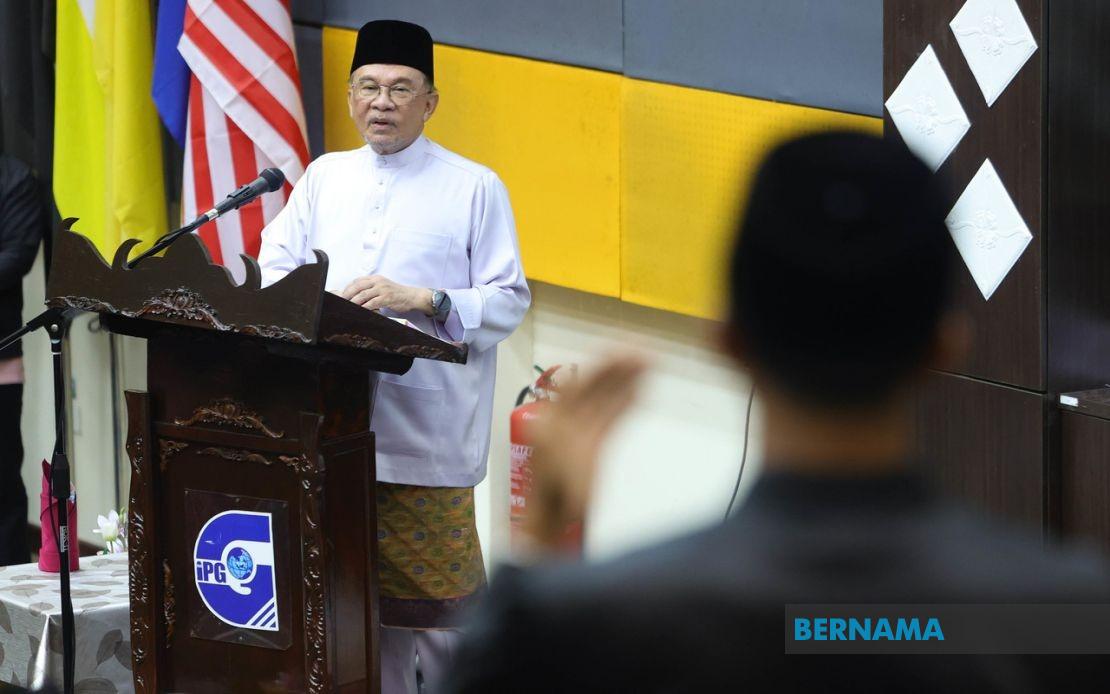
Prime Minister Datuk Seri Anwar Ibrahim has outlined a vision for Malaysian education that demands educators master cutting-edge technologies while remaining deeply rooted in moral and human values. Speaking at an event in Nilai, the PM emphasized that the nation cannot afford to rest on traditional curricula and methods as global competition intensifies. Instead, the education sector must evolve dynamically to keep pace with rapid technological change, particularly in fields like artificial intelligence, robotics, and digital innovation that are reshaping economies worldwide.
The challenge facing Malaysia's teaching profession, Anwar suggested, extends far beyond acquiring technical competence. While proficiency in Science, Technology, Engineering and Mathematics (STEM) disciplines is essential for national competitiveness, this expertise becomes meaningless if divorced from ethical reasoning and cultural understanding. The Prime Minister articulated this balance through a memorable phrase: "reach for the skies while keeping our roots on the ground." This encapsulates the central tension in contemporary education—the need to embrace technological advancement without abandoning the cultural, religious, and moral anchors that define Malaysian society.
For Southeast Asia's third-largest economy, this dual emphasis carries particular weight. Malaysia's aspirations to become a high-income nation and position itself as a regional technology hub depend on having educators who can train the next generation of engineers, data scientists, and digital innovators. Yet the country's defining characteristic—its multicultural, multireligious composition—creates unique vulnerabilities if education becomes purely utilitarian. The PM's remarks suggest that policymakers recognize how technological progress, without accompanying moral development, can exacerbate rather than bridge social divides.
Anwar placed education at the top of Malaysia's development priorities, followed immediately by the capacity to adapt swiftly to global shifts. This hierarchy reflects a pragmatic understanding that competitive advantage depends not merely on infrastructure or capital, but on human capital trained in both technical and adaptive skills. Teachers, in this formulation, are not simply content deliverers but architects of national resilience. Their ability to integrate emerging technologies with timeless values determines whether Malaysia advances as a unified or fractured society.
The Prime Minister issued a stark warning about the perils of allowing educational spaces to become forums for racial or religious animosity. He argued that no nation, regardless of its power or prosperity, can maintain security or progress while cultivating hatred between communities. This represents a direct acknowledgment of how education can either reinforce or mitigate the tensions inherent in plural societies. Malaysian teachers, therefore, carry responsibility not just for imparting knowledge but for modeling and reinforcing the tolerance, mutual respect, and commitment to human dignity that the PM identified as prerequisites for genuine progress.
The emphasis on diversity as a potential strength rather than weakness signals an important reframing of how Malaysia should approach its multicultural composition in educational contexts. Rather than treating different races and religions as complications to be managed, Anwar's statement suggests they should be understood as assets that, if properly cultivated through thoughtful pedagogy, can enrich learning environments and prepare students for an increasingly diverse global economy. Teachers skilled in facilitating such cross-cultural understanding become invaluable architects of social cohesion.
Education Minister Fadhlina Sidek's presence at the event, alongside IPGKPT (Institut Pendidikan Guru Kampus Pendidikan Tun Hussein Onn) director Dr Kartini Abdul Mutalib, underscores the alignment between political leadership and educational institutions on this agenda. The involvement of teacher training bodies suggests that curricula and professional development programmes may soon reflect greater emphasis on ethical reasoning alongside technical skills. For Malaysia, this represents a deliberate choice to resist the model of education as purely economic preparation in favour of a more holistic approach.
The timing of these remarks reflects broader global conversations about technology's role in society. As artificial intelligence and automation reshape labour markets across Asia, policymakers increasingly recognize that technical skills alone cannot ensure meaningful employment or social stability. Teachers who understand both the possibilities and pitfalls of new technologies—who can discuss AI ethics, data privacy, and digital citizenship alongside programming and data analysis—position students for navigating a complex future rather than merely occupying roles within it.
For Malaysia's regional standing, this approach offers competitive differentiation. While neighbouring countries pursue similar technological capabilities, Malaysia's emphasis on integrating values education into STEM training could yield educators and graduates with distinctive capabilities in managing technology's social implications. In a region facing rapid urbanization, growing inequality, and digital transformation, this integration may prove increasingly valuable.
Implementing this vision, however, presents substantial challenges. Teacher training institutions must themselves model the integration of technical and ethical expertise. Curriculum designers must resist the temptation to treat values education as peripheral to "real" learning. Educational leaders must ensure that the principle of non-discrimination based on race or religion extends from policy documents to actual classroom practice and teacher behaviour. These are not merely aspirational goals but operational requirements for realizing the PM's vision.
The Prime Minister's remarks ultimately reflect a conviction that education represents Malaysia's most powerful tool for simultaneously achieving economic dynamism and social stability. Teachers who master emerging technologies without grounding in ethics risk creating capability without wisdom. Conversely, moral education disconnected from technological literacy leaves students unprepared for the world they will actually inhabit. The challenge for Malaysian policymakers lies in translating Anwar's vision into concrete reforms that genuinely transform how teachers are recruited, trained, and supported throughout their careers.

