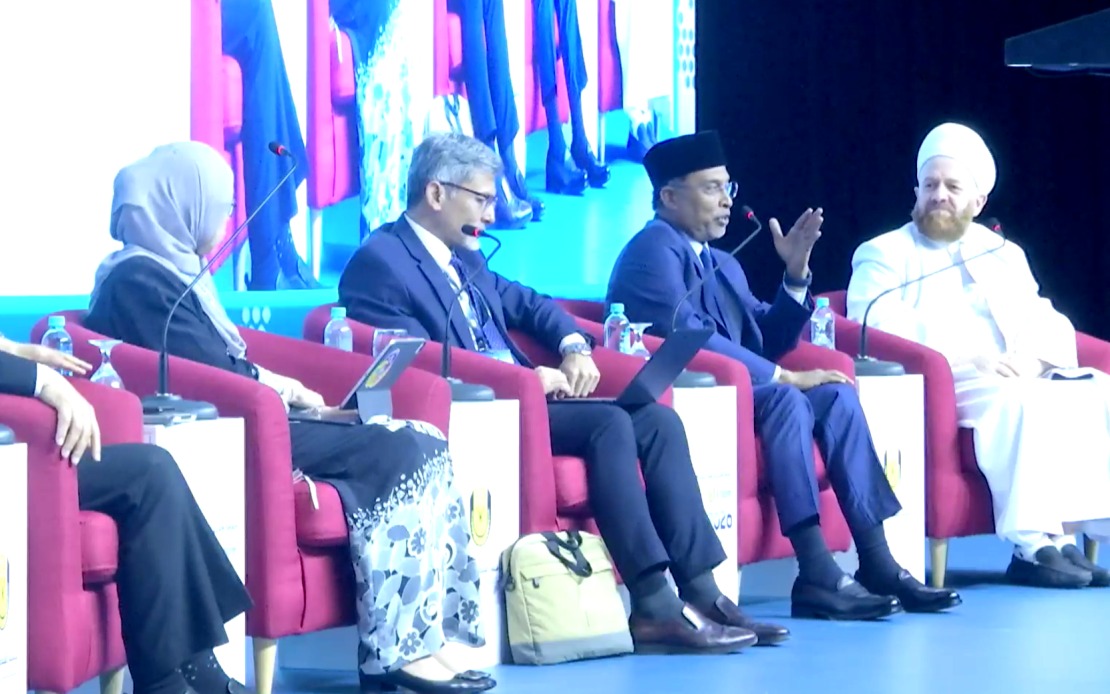
Malaysia's push to harness artificial intelligence and emerging technologies in higher education must be anchored firmly in ethical frameworks and moral values, according to Higher Education Minister Datuk Seri Dr Zambry Abd Kadir. Speaking at the 8th World Conference on Islamic Thought and Civilisation in Ipoh, Zambry underscored the urgency of preparing the nation's human capital to navigate an increasingly complex global landscape shaped by rapid technological change and uncertainty. His remarks reflect growing recognition within Malaysian policymaking circles that technological prowess alone cannot sustain competitive advantage without corresponding development of character and integrity.
The ministry has charted an ambitious roadmap for the coming decade, launching a comprehensive 10-year blueprint spanning 2026 to 2035 that attempts to reconcile three seemingly competing imperatives: accelerating technological progress, cultivating skilled human resources, and preserving moral grounding. This strategic framework represents a deliberate departure from purely technocratic approaches to higher education reform that have dominated policy discussions across the region. By positioning moral and ethical development as co-equal pillars alongside innovation, Malaysia's education ministry signals a philosophical shift that many Southeast Asian nations are now contemplating as they grapple with AI's transformative potential and risks.
The challenge of embedding ethics into AI curricula has become increasingly pressing as algorithms begin mediating consequential decisions across healthcare, criminal justice, employment and finance. Zambry articulated this tension clearly: while artificial intelligence can deliver precision, speed and scalability in problem-solving, it cannot independently generate the wisdom, compassion or moral discernment that societies require from educated citizens. This observation carries particular weight for Malaysia, which aspires to develop not merely technically competent graduates but leaders capable of steering institutions and communities through ethically complex terrain. The minister's emphasis reflects concerns shared by educators and technologists globally that purely instrumental education produces skilled operators rather than reflective practitioners equipped to question whether technologies should be deployed at scale.
A pivotal conceptual reorientation underpins the ministry's strategy: transitioning from the established STEM framework (Science, Technology, Engineering, Mathematics) toward STEAM, which incorporates the Arts. This expansion acknowledges that disciplines traditionally categorised as humanities—philosophy, history, literature, cultural studies—furnish essential resources for ethical reasoning and contextual understanding. Zambry illustrated this principle through the example of Universiti Teknologi Petronas, where engineering programmes deliberately require students to undertake coursework beyond their discipline, deliberately cultivating breadth alongside depth. Such interdisciplinary architecture enables students to perceive technology not as neutral tools but as interventions embedded within social, cultural and moral frameworks that demand critical examination.
The intellectual foundations for this pedagogical shift rest on a growing body of evidence from education research and industry practice. Engineers and computer scientists who have studied philosophy, literature or history demonstrate greater capacity for anticipating unintended consequences of technological systems and for recognising blind spots in their own reasoning. By contrast, narrowly specialised technical training can inadvertently encourage overconfidence in quantitative metrics and algorithmic outputs while atrophying the reflexive capacities necessary for ethical judgment. For Malaysian universities serving as regional talent pipelines, this curricular reorientation positions graduates as more sophisticated participants in technology governance, capable of contributing not just implementation expertise but critical perspective to policy discussions.
Critical thinking—repeatedly invoked by Zambry as education's central aim—emerges as a distinctive capability increasingly difficult to automate or outsource. While artificial intelligence excels at pattern recognition within structured datasets and optimisation within defined parameters, humans remain superior at recognising when problem formulations themselves require revision, at detecting ethical tensions obscured by technical framing, and at imagining alternative futures. Educational institutions that cultivate these capacities prepare students not for technological obsolescence but for meaningful engagement with AI as a tool to be directed toward human flourishing. This represents a meaningful reframing of the university's role from credentialing specialist technicians toward developing integrated thinkers capable of navigating ambiguity.
For Malaysia specifically, this strategy addresses several structural vulnerabilities. As a middle-income nation competing for talent and investment against both higher-income peers and lower-cost competitors, Malaysia's distinctive advantage lies in producing graduates who combine technical competence with sophisticated understanding of cross-cultural contexts and ethical frameworks. The region's growing economic and political influence means Malaysian-trained professionals increasingly shape technology deployment decisions affecting hundreds of millions of people. Universities that graduate only narrow specialists squander opportunities to influence how emerging technologies are governed and adapted to serve local values and priorities.
The 10-year blueprint also carries implications for Malaysia's research ecosystem and innovation trajectory. Nations that institutionalise ethical reasoning throughout higher education, rather than quarantining it in ethics committees, tend to develop more robust innovation pipelines less vulnerable to reputational and regulatory shocks. When researchers habitually interrogate assumptions and consider downstream impacts from early stages of project conception, they reduce costly late-stage pivots and build institutional credibility with policymakers and publics. This matters substantially for Malaysia's ambitions to become a regional technology hub; companies and governments increasingly demand assurance that their partners have embedded responsible innovation practices into operational culture.
The minister's framing also responds to specific concerns within Malaysia's Muslim-majority society regarding technology's potential misalignment with Islamic values. Rather than treating religious and ethical traditions as obstacles to technological adoption, the ministry's approach suggests their integration as resources for navigating technology's complex implications. This positioning enables Malaysian institutions to contribute distinctive perspectives to global conversations about responsible AI, drawing on Islamic jurisprudential traditions concerning justice, equity and human dignity. Educational programmes grounded in such traditions produce graduates capable of articulating technology policy arguments that resonate across Malaysia's diverse communities.
Implementing this vision demands substantial institutional change within universities. Faculty development programmes must help established academics from technical disciplines engage seriously with ethical and humanistic frameworks rather than treating such content as peripheral decoration. Curriculum redesign requires sustained consultation across departments and faculties to identify genuine intellectual integration rather than superficial cross-listing. Recruitment strategies must prioritise hiring scholars capable of teaching simultaneously with rigour and accessibility to students from varied backgrounds. These logistical challenges explain why the ministry's decade-long timeline, while requiring patience, provides a realistic horizon for systemic transformation.
The broader context shaping Malaysia's educational priorities includes accelerating regional competition. Singapore, South Korea and increasingly Vietnam have invested heavily in developing AI ecosystems, attracting international talent and capital. Malaysia's distinctive contribution lies not in attempting to outpace competitors in raw technical capability but in building educational and governance infrastructure that harnesses AI toward inclusive development while maintaining ethical grounding. This positioning appeals to international partners concerned about AI governance and to domestic constituencies demanding that technological change serve equitable development.
Moving forward, the credibility of Malaysia's 10-year blueprint depends substantially on translating ministerial rhetoric into concrete resource allocation and institutional accountability mechanisms. Universities require incentives and support systems that reward comprehensive education alongside research productivity narrowly measured by technical publication metrics. Quality assurance frameworks must verify that ethics permeates curricula rather than appearing in isolated electives. Industry partnerships should be structured to reinforce rather than undermine liberal education dimensions. With such enabling conditions, Malaysia can position its higher education system as a distinctive asset in navigating artificial intelligence's transformative challenges.

