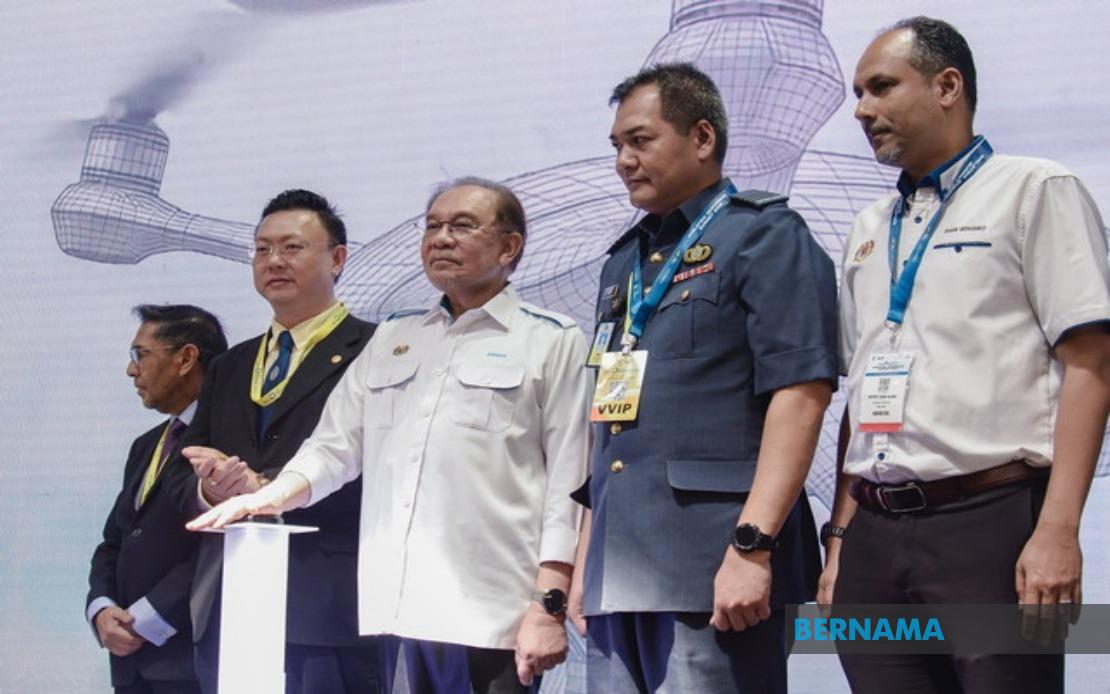
Prime Minister Datuk Seri Anwar Ibrahim has stressed the urgent need for Malaysia to quicken its pace in adopting and developing advanced technologies, with particular emphasis on the unmanned aerial vehicle sector, to enhance the nation's standing in the global economy. Speaking at the closing ceremony of MyDrone Expo 2026 in Sepang, Anwar framed the drone industry not as a niche specialisation but as a transformative field intersecting with artificial intelligence and broader digital transformation initiatives—positioning it as a fundamental driver of innovation, operational efficiency and sustainable economic expansion across multiple sectors.
The MyDrone Expo 2026, jointly organised by the World UAV Federation Malaysia Chapter and the Malaysia UAV Development Association, demonstrated substantial industry momentum and regional interest. The three-day event exceeded organisers' projections, drawing more than 100 exhibiting companies and welcoming thousands of industry professionals and delegates representing 46 countries. This international attendance underscores the competitive landscape Malaysia faces and the importance of positioning itself as a regional hub for unmanned systems technology and innovation.
Anwar's comments reflect growing recognition of the economic scale at stake. The global unmanned aerial vehicle market is projected to surpass USD55 billion by 2030, a figure that encompasses diverse applications far beyond traditional defence and surveillance roles. Alongside this expansion, the low-altitude economy—encompassing airspace utilisation for commercial, agricultural and logistical purposes—is emerging as an increasingly significant investment frontier. For a nation seeking to diversify its economic base and reduce dependence on traditional sectors, the timing of strategic intervention in this field carries particular significance.
The Prime Minister's directive to Cabinet ministers, policymakers, scientific research institutions and relevant government agencies signals a whole-of-government commitment to supporting the sector's development. This approach acknowledges that technological advancement requires coordinated effort across multiple institutional domains rather than market forces alone. By explicitly tasking officials with extending regulatory and ecosystem support, Anwar has effectively elevated drone technology from a peripheral industrial concern to a core national development priority.
The government's commitment extends to practical policy implementation across several dimensions. Regulatory framework improvements are essential to enable companies to operate efficiently while maintaining necessary safety and security standards. Enhanced research funding will support the academic and institutional capacity required to develop locally-relevant technologies and applications. Testing and certification infrastructure represents another critical gap, as companies require accessible facilities to validate drone systems before deployment. Together, these measures constitute a more comprehensive industrial policy than rhetorical support alone would suggest.
Anwar specifically highlighted civil applications as deserving equal policy attention alongside military and defence uses. The application of drone technology to plantation management and agricultural productivity reflects Malaysia's economic heritage while modernising traditional sectors. Large-scale agricultural operations, particularly in palm oil and other commodity production, face persistent challenges in monitoring vast areas, managing resources efficiently and addressing environmental concerns. Drone-based solutions offer tangible productivity gains that could strengthen Malaysia's agricultural competitiveness in global markets while improving sustainability metrics that increasingly influence trade and investment decisions.
The emphasis on building a robust talent pipeline through collaboration between private enterprises, government research institutions and universities addresses a fundamental constraint in emerging technology sectors. Malaysia has begun developing academic infrastructure in artificial intelligence and quantum computing, establishing educational pathways for specialised technical expertise. A similar approach applied to unmanned systems would create not merely a supply of workers but a cadre of researchers and innovators capable of developing proprietary technologies rather than merely adopting foreign solutions.
The convergence of drone technology with artificial intelligence represents a particularly significant strategic consideration for Malaysia's technology ambitions. Autonomous systems, machine vision, data analytics and intelligent decision-making capabilities collectively enhance the utility and economic value of unmanned platforms across applications from precision agriculture to logistics optimisation. By positioning itself at this intersection, Malaysia could potentially develop integrated solutions that generate higher value-added returns than basic hardware manufacturing or service provision.
Regional dynamics further underscore the strategic relevance of Anwar's initiative. Vietnam, Thailand and Indonesia are developing domestic drone industries with varying levels of government support. Singapore has established itself as a technology and testing hub for unmanned systems in Southeast Asia. A proactive Malaysian approach could position the country as a significant regional player in manufacturing, innovation and services rather than remaining a peripheral market for imported technologies. The international participation at MyDrone Expo 2026 suggests receptiveness among global stakeholders to engaging with Malaysian industry players and institutions.
The policy framework Anwar has outlined requires careful implementation to succeed. Regulatory clarity that balances innovation encouragement with legitimate safety and security concerns will prove essential. Funding mechanisms must reach not only large established companies but also startups and research teams capable of developing disruptive innovations. Collaboration between public and private sectors often faces coordination challenges; effective mechanisms for knowledge transfer and technology commercialisation will determine whether academic research translates into commercial applications.
For investors and industry participants, the Prime Minister's explicit high-level endorsement provides important policy signal certainty. Government backing for regulatory modernisation and funding support reduces commercial uncertainty and creates conditions more favourable for long-term capital commitment. This confidence effect can itself accelerate industry development by encouraging both domestic entrepreneurship and foreign direct investment in Malaysian drone and related technology ventures.
The broader context of Malaysia's technology diversification strategy positions drone development within a wider transformation agenda. Alongside existing initiatives in semiconductor manufacturing, digital finance and advanced manufacturing, the drone sector represents another avenue for creating high-value employment and technological capability. Success in this field would demonstrate that Malaysia can compete in sophisticated technology domains, potentially opening doors to engagement in other emerging technological frontiers.
The timeframe implicit in Anwar's remarks suggests urgency without specifying precise implementation deadlines. The window for establishing early-mover advantages in a rapidly scaling global market is limited. Companies and institutions committing to Malaysian drone ecosystem development in the coming months stand to benefit from first-mover advantages in a competitive regional landscape. Conversely, extended delays in establishing supporting infrastructure and clear regulatory pathways risk allowing competitors in neighbouring countries to consolidate advantageous positions that become difficult to displace.

