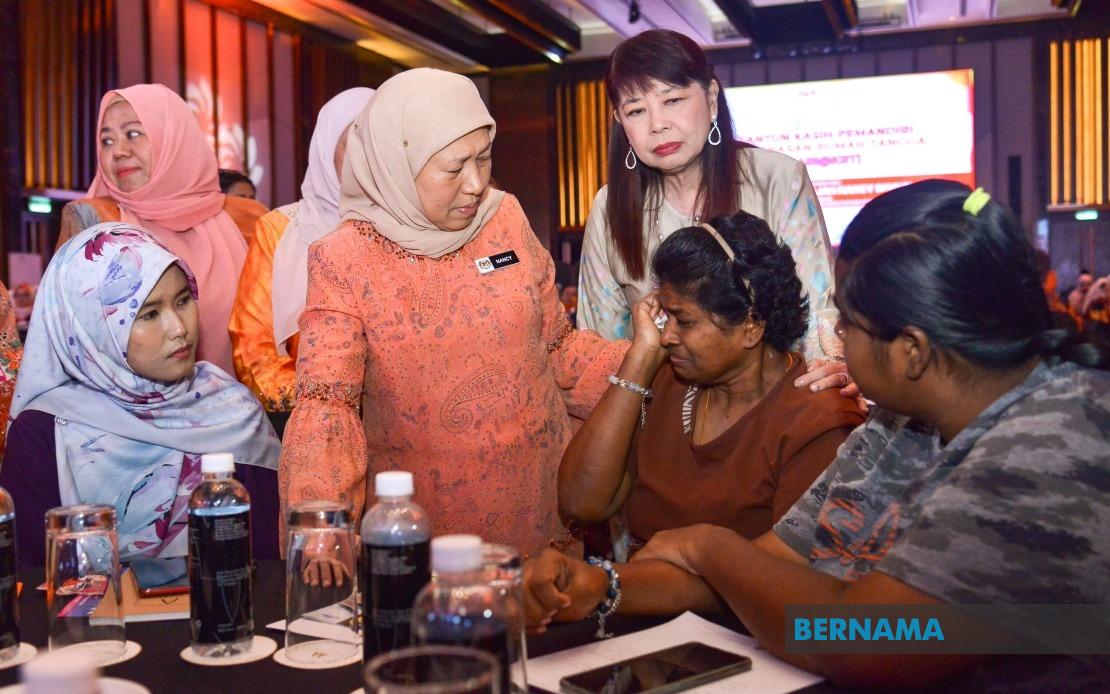
Malaysia has unveiled an ambitious national initiative aimed at transforming the lives of domestic violence survivors through a multi-faceted support framework. The SARI@KRT: Road to Eliminate Violence Against Women (EVAW) 2026 programme was officially launched by the Ministry of Women, Family and Community Development (KPWKM), with Datuk Seri Nancy Shukri, the ministry's leader, emphasising the government's determination to move beyond awareness-raising toward concrete intervention. The initiative targets approximately 1,400 survivors nationwide, with a structured deployment of at least 100 participants across each state, reflecting a commitment to equitable geographic coverage of this vital social support infrastructure.
The programme's architecture rests on three foundational pillars designed to address the multifaceted nature of domestic violence recovery. Psychosocial support forms the cornerstone, recognising that trauma survivors require professional counselling and emotional rehabilitation to rebuild their sense of security and self-worth. Legal assistance constitutes the second pillar, ensuring that women navigating the judicial system for protection orders, divorce proceedings, or custody arrangements have access to professional guidance. The third dimension focuses on economic empowerment, acknowledging that financial independence often represents the pathway to genuine autonomy and reduced vulnerability to continued abuse. Together, these elements represent a sophisticated understanding that escaping domestic violence requires simultaneous attention to psychological healing, legal protection, and material security.
Recent statistics underscore the urgency of such interventions. Royal Malaysia Police data reveals that domestic violence cases surged to 4,014 incidents during the first half of 2024, compared to 3,678 cases in the corresponding period of the previous year—a concerning upward trajectory of approximately nine percent. Johor emerged as the state with the heaviest caseload, recording 721 documented incidents, whilst Selangor followed with 614 cases and Perak with 405 cases. This geographic distribution suggests that urban and semi-urban regions, characterised by higher population density and greater economic pressures, experience elevated rates of domestic conflict, though the phenomenon clearly spans the entire nation.
Understanding the root causes of domestic violence reveals patterns that inform both prevention and intervention strategies. Misunderstandings and communication deficits accounted for nearly half of all incidents, totalling 1,967 cases, indicating that relationship breakdown frequently originates from inadequate conflict resolution mechanisms within families. Substance abuse emerged as the second-largest driver, responsible for 444 cases, reflecting how addiction can destabilise household dynamics and trigger violence. Financial stress contributed to 378 cases, exposing the vulnerability of families operating under economic strain, where resource scarcity intensifies interpersonal tensions. These causative factors are neither mutually exclusive nor random—they interact within family systems where poverty, addiction, and communication breakdown often coexist and reinforce one another.
Minister Shukri offered a nuanced interpretation of rising case numbers that deserves consideration. Rather than interpreting the uptick as a worsening crisis in isolation, she framed increased reporting as a potential indicator of heightened public awareness and growing willingness among survivors to seek official intervention. This reframing is analytically significant for Malaysian policymakers and civil society: the visibility of domestic violence, whilst alarming, also suggests that previous awareness campaigns and community outreach efforts may have succeeded in reducing stigma and encouraging help-seeking behaviour. Nevertheless, the absolute figures remain troubling and demand sustained policy attention and resource allocation to break cycles of abuse.
A particularly illuminating dimension of the minister's remarks concerns financial abuse, a form of domestic violence that often remains invisible in casual discourse but exerts profound control over victims' lives. The ministry's framework explicitly recognises scenarios in which a husband possesses financial capacity but deliberately withholds household support, effectively weaponising economic dependency. Such conduct, which leaves wives solely responsible for family expenses whilst other adults in the household retain income, constitutes systemic financial abuse that erodes autonomy and perpetuates vulnerability. By naming this pattern explicitly, the government signals that economic control ranks alongside physical and emotional abuse as a serious violation of marital obligations and human dignity.
The programme's inclusion of special allowances enabling survivors to attend court proceedings related to child maintenance claims represents practical acknowledgment of a structural barrier facing many victims. For economically marginalised women, the combined costs of transportation, lost wages, and legal representation can render formal justice system participation impossible despite severe need. By subsidising court attendance, KPWKM removes a material obstacle to legal recourse and demonstrates how targeted financial support can facilitate access to fundamental rights. This provision reflects understanding that formal institutional protections remain inaccessible to those lacking resources to navigate them, a reality particularly acute in developing and middle-income economies where judicial systems lack pro bono capacity.
The SARI@KRT initiative arrives at a critical juncture in Malaysia's broader social policy landscape. Southeast Asian nations increasingly grapple with tensions between rapid urbanisation, economic transformation, and traditional family structures—pressures that often intensify domestic conflict. Malaysia's relatively advanced institutional capacity and resource base position it to develop models of integrated violence survivor support that neighbouring countries might eventually adapt. The emphasis on psychosocial support, legal advocacy, and economic empowerment reflects international best practices whilst remaining contextually grounded in Malaysian realities, including the multi-ethnic and multi-religious composition of the nation.
The programme's success will depend on implementation fidelity, adequate funding, and integration with existing support ecosystems including police, social services, and non-governmental organisations. Minister Shukri's explicit commitment to guiding survivors "towards self-reliance and a safer new life" establishes an outcome-oriented framework rather than merely symptom management. For Malaysian civil society and international observers, the SARI@KRT initiative represents a significant institutional response to a persistent social problem that has historically received inadequate policy attention and resource commitment. The targeting of 1,400 survivors across all states, if sustained and properly resourced, could establish a meaningful precedent for how middle-income countries address domestic violence through comprehensive, multi-sector intervention rather than isolated crisis response mechanisms.

