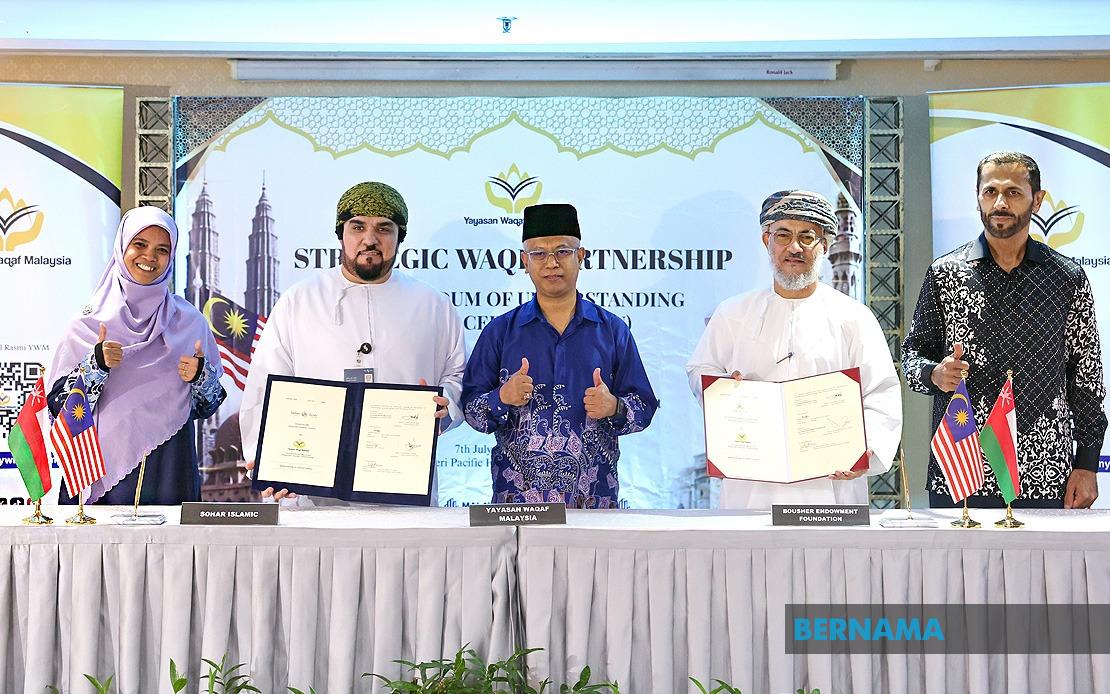
Malaysia has moved to consolidate its standing as a centre for Islamic social finance by formalizing a strategic partnership with institutions in the Sultanate of Oman. The Malaysian Waqf Foundation (YWM) signed a memorandum of understanding with Sohar Islamic and the Boushar Endowment Foundation on July 7, establishing a framework for sustained collaboration on waqf development, technology transfer, and governance practices. The accord marks a significant inflection point in how Malaysia positions itself within the global Islamic finance ecosystem, shifting from primarily importing international expertise to exporting homegrown knowledge in this critical sector.
The three-way partnership emphasizes knowledge exchange and the adoption of best practices in waqf management, an area where Malaysia has built considerable institutional capacity over the past two decades. Waqf, the Islamic concept of perpetual charitable endowments, has emerged as a powerful mechanism for generating sustainable community wealth and addressing social inequality across Muslim-majority nations. By formalizing ties with Omani counterparts, Malaysia is effectively offering its tested frameworks to other Gulf states seeking to deepen their Islamic social finance infrastructure. This arrangement carries particular weight given the structural similarities between Malaysia's regulatory environment and those in the Gulf Cooperation Council states.
Deputy Minister in the Prime Minister's Department (Religious Affairs) Marhamah Rosli characterized the collaboration as international validation of Malaysia's systematic approach to waqf ecosystem development. She emphasized that the partnership transcends bilateral economic interest, instead reflecting recognition of Malaysia's capacity to construct integrated, innovation-driven solutions within Islamic social finance. Her remarks suggest the government views this agreement as conferring soft power benefits, demonstrating to other Muslim nations that Malaysia possesses the technical expertise and institutional maturity to lead regional discussions on waqf modernization and asset optimization. This positioning aligns with Malaysia's broader narrative of serving as a bridge between developed markets and Islamic finance principles.
A particularly noteworthy dimension of the partnership involves the appointment of Dr Ridzwan Bakar, YWM's chief executive officer, as Waqf Adviser to the Sultanate of Oman. This personal mandate underscores the confidence both Sohar Islamic and the Boushar Endowment Foundation have placed in Malaysian expertise. Marhamah seized upon this detail to highlight the symbolic reversal it represents: whereas Malaysia has traditionally relied on foreign advisory capacity, it is now in the position of providing strategic counsel to fellow Muslim nations. The shift carries implications for Malaysia's labour market in Islamic finance, potentially creating demand for consultants and specialists capable of translating local successes into implementable models for export.
Dr Ridzwan disclosed that the Oman engagement represents one component of YWM's broader international expansion strategy, which already encompasses active partnerships with counterparts in Kuwait, Qatar, and the United Arab Emirates. These multiple simultaneous relationships suggest Malaysia is pursuing a coordinated approach to market penetration rather than opportunistic engagements. The strategic visits undertaken in 2023 and 2024 appear to have functioned as preliminary reconnaissance missions, establishing trust and identifying genuine alignment before formalizing commitments. This methodical approach may serve as a replicable template for Malaysian institutions seeking to expand regionally in other sectors.
The foundation of the Oman partnership rests partly on YWM's capacity to attract international capital for waqf-backed investments. Ridzwan indicated that productive waqf asset development holds considerable appeal to investors from Arab countries, particularly when structured through regulated Malaysian platforms. He noted that YWM currently offers three investment products through Kenanga Investors, positioning these vehicles as conduits for international capital into Malaysian Islamic finance markets. This architecture creates mutual benefit: foreign investors access vetted Islamic investment opportunities, while Malaysian institutions and communities benefit from expanded asset bases and enhanced returns on waqf endowments.
The economic philosophy underpinning the partnership emphasizes asset accumulation as a prerequisite for sustainable community benefit distribution. Rather than viewing waqf purely through a charitable lens, Ridzwan articulated a development-oriented vision wherein waqf resources are deployed to generate economic returns that subsequently reach vulnerable populations. He articulated expansion of the beneficiary pool beyond traditional asnaf categories to encompass broader segments of Malaysia's lower-income cohorts, including B40 and M40 households. This broadened conception of waqf utility reflects evolving understanding within Malaysia's Islamic social finance sector regarding how traditional instruments can address contemporary inequality.
The timing of this partnership carries strategic significance within the broader context of Gulf states' increasing interest in diversifying Islamic finance hubs beyond traditional centres. Malaysia's partnership with Oman suggests the sultanate is seeking technical assistance in modernizing its waqf governance architecture, potentially to compete more effectively with more developed Islamic finance sectors in the region. For Malaysia, the arrangement provides entry into Omani and potentially broader GCC markets, sectors with substantial capital resources and growing sophistication in Islamic finance products. The partnership may also generate contractual opportunities for Malaysian consulting firms, legal practitioners, and financial technology companies specializing in Islamic finance compliance and asset management.
From a policy perspective, the agreement validates Malaysia's previous investments in building institutional capacity for waqf development and Islamic social finance. The International Islamic University Malaysia, Bank Negara Malaysia's Islamic finance regulatory framework, and the proliferation of waqf-focused research institutions have collectively created an ecosystem capable of attracting international partnerships. This infrastructure, accumulated over years of deliberate policy focus, now generates tangible returns in the form of advisory mandates and strategic partnerships with institutions in high-income Muslim-majority nations. The success may encourage Malaysian policymakers to deepen support for other knowledge-intensive Islamic finance sectors where Malaysia possesses competitive advantages.
Looking forward, the partnership structure with Oman potentially establishes a template for scaling Malaysia's Islamic finance expertise across the Muslim world. Successful implementation in Oman could generate case studies demonstrating the effectiveness of Malaysian waqf governance models, facilitating expansion to additional markets in Southeast Asia, South Asia, and Africa. The appointment of Malaysian advisers to guide waqf development in multiple jurisdictions may gradually position Malaysia as the default reference point for Islamic social finance best practices within the developing world. Such positioning would reinforce Malaysia's broader strategic objective of emerging as a leader in sustainable, inclusion-oriented finance within Muslim-majority regions.

