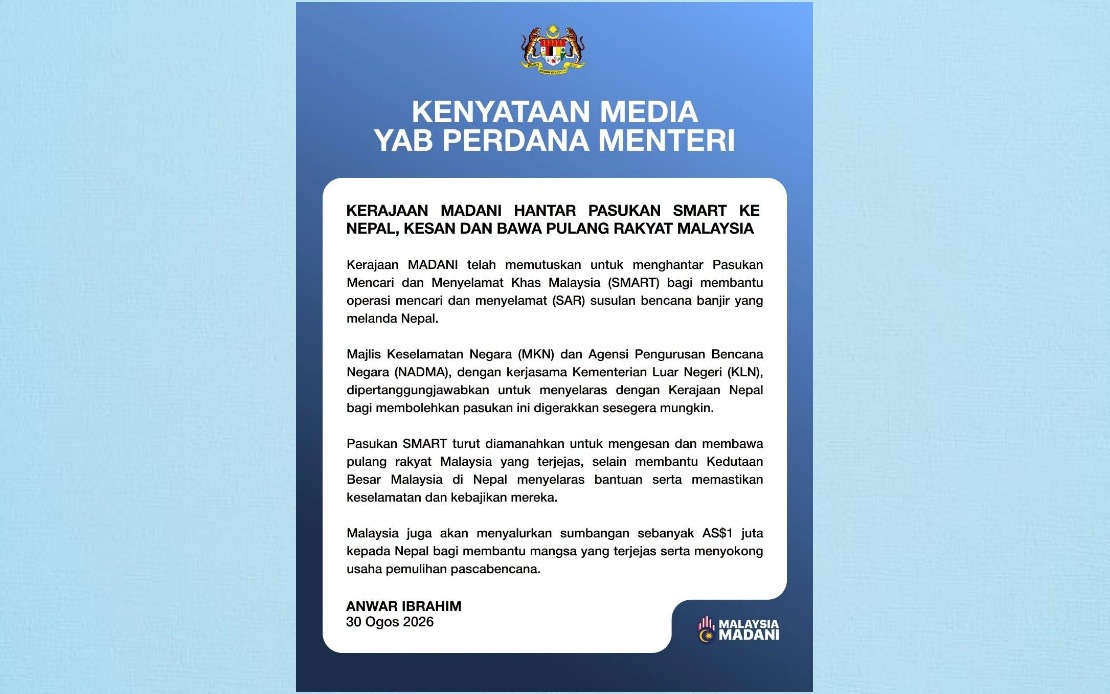
Malaysia is mobilizing its specialized disaster response capabilities to assist Nepal following devastating floods and landslides that struck Rasuwa district on August 26, with Prime Minister Datuk Seri Anwar Ibrahim authorizing the immediate deployment of the Special Malaysian Disaster Assistance and Rescue Team (SMART) to support ongoing search and rescue operations in the affected region.
The decision reflects Malaysia's commitment to regional humanitarian cooperation during natural disasters. Anwar outlined that the National Security Council (MKN) and the National Disaster Management Agency (NADMA), working alongside the Foreign Ministry, have been empowered to coordinate directly with Nepalese authorities to expedite the deployment and ensure smooth operational integration with local rescue efforts already underway in the devastated areas.
Beyond the deployment itself, the SMART team carries a dual mandate focused on addressing both immediate rescue needs and Malaysia-specific concerns. The unit has been specifically instructed to conduct active search operations for Malaysians caught in the disaster, with orders to facilitate their return home and provide essential welfare support during the recovery period. This reflects a growing practice among regional governments of embedding their own personnel to protect citizens while also contributing to broader humanitarian operations.
The Malaysian Embassy in Nepal will work closely with the SMART contingent to coordinate the distribution of incoming aid and maintain communication channels with affected Malaysian nationals and their families. This coordination structure ensures that Malaysian relief efforts are integrated efficiently with the embassy's existing networks and diplomatic relationships, maximizing the impact of assistance reaching those in need.
Simultaneously, Malaysia is providing substantial financial support through a US$1 million contribution aimed at alleviating immediate suffering and supporting longer-term reconstruction efforts. This monetary commitment addresses the mounting costs associated with emergency response, medical treatment, and the eventual rebuilding of infrastructure damaged by the catastrophic weather event that brought landslides and flash flooding to the mountainous Nepali district.
The Foreign Ministry previously disclosed that fifty-five Malaysians remain uncontactable following the August 26 disaster, raising significant concerns among families and prompting the government to accelerate its response mechanisms. This figure underscores the scale of Malaysian interest in the affected region, likely reflecting the presence of workers, tourists, and students who were in Nepal when the floods struck, disrupting communication networks and creating uncertainty about their status.
The severity of the flooding and associated landslides demonstrates the vulnerability of mountainous terrain to extreme weather events, a pattern increasingly relevant across South and Southeast Asia as climate-related disasters become more frequent and intense. Nepal's position in the Himalayan foothills makes it particularly susceptible to such natural hazards, and the August 26 event joins a growing roster of major disasters affecting the region in recent years.
Malaysia's rapid response highlights the evolving role of the SMART team as a critical instrument of both humanitarian assistance and national interest protection in the region. The unit, which operates under established protocols developed through previous deployments, brings specialized expertise in locating survivors in challenging terrain and coordinating with international partners—capabilities particularly valuable in mountainous regions where access and communication prove difficult.
This deployment also strengthens Malaysia's position within regional disaster management networks. By contributing personnel and resources during crises affecting neighboring countries, Malaysia reinforces its standing as a reliable regional partner willing to share expertise and bear costs during humanitarian emergencies. Such initiatives build reciprocal relationships that may benefit Malaysia if similar disasters occur domestically.
The financial contribution, while substantial in absolute terms, represents Malaysia's assessment of both its moral obligation and practical interest in supporting Nepal's recovery. The timing of the announcement suggests coordination with other international relief efforts, positioning Malaysia as one voice in a broader international response to the disaster.
From a broader policy perspective, this intervention demonstrates how the MADANI Government frames disaster response as an integral component of regional diplomacy and national security, recognizing that humanitarian crises can generate political consequences and affect bilateral relationships. The decision to deploy personnel specifically tasked with locating Malaysian citizens indicates recognition that unaccounted nationals can become domestic political concerns if mismanaged.
The coordination between multiple Malaysian agencies—security, disaster management, and foreign affairs—reflects the complexity of modern disaster response, which requires simultaneous attention to rescue operations, diplomatic protocols, media management, and family welfare. This institutional coordination has become increasingly sophisticated as governments recognize that disaster response failures can damage credibility and public confidence.
As Nepal grapples with the immediate aftermath of the floods and begins contemplating reconstruction, Malaysia's visible engagement through the SMART deployment and financial aid represents a meaningful contribution to recovery efforts while simultaneously addressing legitimate domestic concerns about Malaysian citizens affected by the tragedy. The outcome of this deployment may influence how Malaysia approaches future regional disasters and shapes perceptions of Malaysia's reliability as a regional humanitarian partner.

