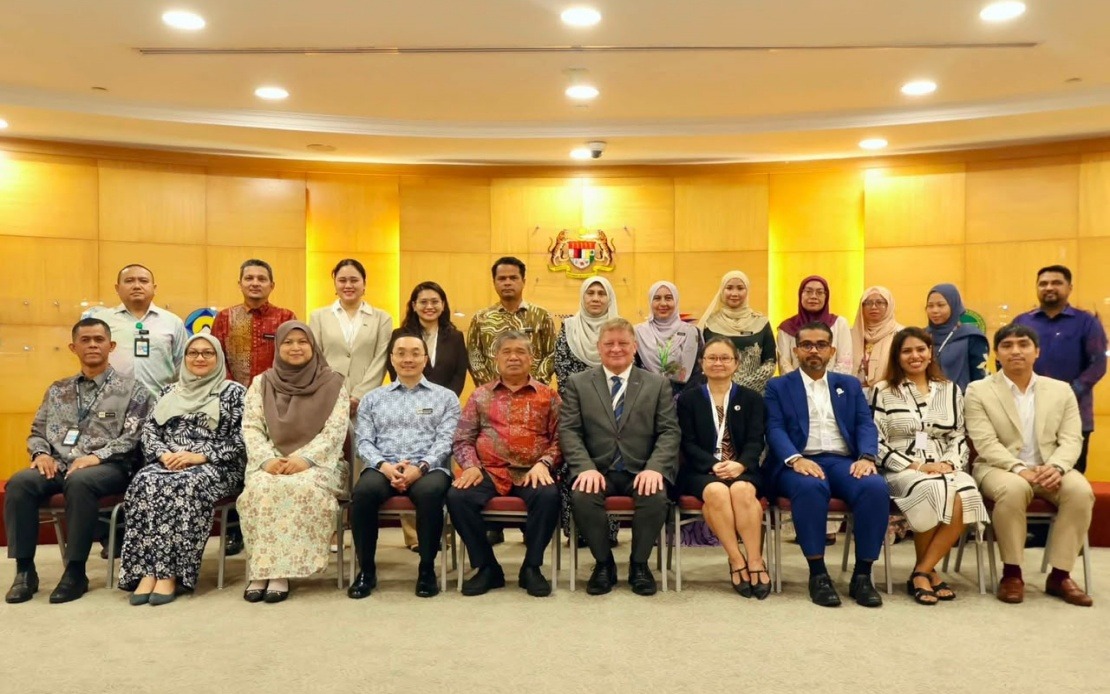
Malaysia's Minister of Agriculture and Food Security Datuk Seri Mohamad Sabu received EU-ASEAN Business Council (EU-ABC) executive director Chris Humphrey and accompanying officials at Wisma Tani in Putrajaya on Tuesday, signalling the nation's commitment to strengthening agricultural collaboration with Europe as both regions grapple with evolving food security challenges and climate pressures.
The bilateral engagement centred on four interconnected priorities that reflect contemporary challenges confronting global agriculture. Chief among these was advancing the National Agro-Food Policy 2.0 (DAN 2.0), Malaysia's flagship framework for ensuring domestic food sufficiency while simultaneously integrating cutting-edge agricultural technologies and artificial intelligence into farming practices. This policy framework addresses mounting concerns about supply chain vulnerabilities exposed by recent geopolitical disruptions and climate-related production volatility that have reverberated across Southeast Asia.
Beyond policy alignment, the discussions tackled the practical dimensions of agricultural modernisation. Strengthening Malaysia's domestic dairy supply chain emerged as a critical focus, recognising that local milk production remains insufficient to meet growing consumer demand and that technological upgrades could enhance productivity and sustainability. Equally significant were initiatives to fortify animal health standards and biosecurity protocols, areas where European expertise and regulatory frameworks offer valuable benchmarks for Malaysian agricultural producers seeking to meet international quality benchmarks and export market requirements.
Mohamad underscored the European Union's elevated standing within Malaysia's strategic economic calculations, positioning the bloc not merely as a trading partner but as a critical wellspring of technological innovation and commercial opportunity. For Malaysian policymakers, the EU represents an established market with rigorous consumer standards, substantial purchasing power, and a demonstrated commitment to sustainability—qualities increasingly demanded by modern agribusiness operations seeking to differentiate themselves in competitive global markets.
The minister articulated a vision of agricultural transformation grounded in sustainability, resilience, and technological sophistication. This framing resonates with international discussions about food security in an era of climate instability and resource constraints. For Malaysia, a nation already confronting agricultural land constraints and shifting climatic patterns, the imperative to increase yields through innovation rather than expanded cultivation becomes increasingly pressing. The emphasis on technology adoption, particularly artificial intelligence applications for crop optimisation and resource management, reflects recognition that future agricultural competitiveness depends on data-driven decision-making and precision farming methodologies.
Mohamad extended an explicit appeal to European enterprises to maintain robust engagement with Malaysia and the broader ASEAN region, particularly through capacity-building initiatives targeting smallholder farmers and livestock producers. The request specifically emphasised support for compliance with stringent quality standards and Sanitary and Phytosanitary (SPS) measures—regulatory requirements that frequently present formidable barriers for developing-country producers seeking access to lucrative European markets. By investing in local training and infrastructure upgrades, EU companies can simultaneously expand their market presence while facilitating Malaysian agricultural producers' integration into premium supply chains.
Trade facilitation and market expansion featured prominently in the bilateral conversation, with the minister highlighting agriculture's role in broader economic diversification. Access to European markets offers substantial commercial opportunities for Malaysian producers of specialty crops, processed foods, and value-added agricultural products, provided these meet exacting import standards. The discussion implicitly acknowledged that agricultural exports represent a critical pathway for rural income generation and rural development across Malaysia, making European market access strategically vital for regional prosperity and social stability.
Both parties reaffirmed their backing for the Malaysia-European Union Free Trade Agreement (MEUFTA) negotiations currently underway. This trade architecture carries profound implications for Malaysian agriculture, potentially opening pathways for preferential access to EU markets while establishing reciprocal commitments regarding standards and market disciplines. Successful MEUFTA conclusion would signal Malaysian openness to deep commercial integration with a developed economy, reinforcing the nation's positioning within global value chains and investor confidence in Malaysia's commitment to rules-based trade frameworks.
The delegation's discussion reflected a strategic pivot toward public-private partnerships in agricultural modernisation. Rather than relying solely on government initiatives, both parties recognised that sustained technological adoption and supply chain enhancement require active participation from commercial enterprises with the capital, technical expertise, and market connections necessary for transformative change. European agribusiness firms possess particular comparative advantages in sustainability technologies, traceability systems, and supply chain digitalisation—capabilities increasingly demanded by export markets and multinational retailers.
Mohamad leveraged the engagement to extend invitations to EU-ABC members for the Agriculture, Horticulture and Agro-Tourism Exhibition (MAHA) 2026, scheduled for late August through early September at the Malaysia Agricultural Expo Park in Serdang, Selangor. This high-profile industry gathering functions as a crucial networking platform where European suppliers can interface directly with Malaysian producers, policymakers, and agricultural associations. For European companies seeking Southeast Asian market entry, such events provide unparalleled exposure to potential clients and partners within Malaysia's agribusiness ecosystem.
The broader significance of this diplomatic engagement extends beyond bilateral Malaysia-EU relations. As Southeast Asian economies confront mounting pressure to enhance food security amid climate uncertainty and regional population growth, international partnerships offering technology transfer, market access, and expertise become increasingly valuable. Malaysia's proactive engagement with the EU demonstrates recognition that agricultural modernisation increasingly depends on transnational cooperation, pooled expertise, and access to capital and technology from advanced economies.
For Malaysian stakeholders—from smallholder farmers to agricultural enterprises to export-focused businesses—deepening cooperation with European partners represents tangible pathways toward adopting more efficient, sustainable production methodologies. The emphasis on standards compliance and quality enhancement directly addresses long-standing competitiveness challenges that have sometimes constrained Malaysian agricultural producers' ability to command premium prices in demanding export markets.
This engagement also underscores Malaysia's commitment to positioning agriculture as a technology-intensive sector rather than a declining or marginal economic activity. By attracting European investment, expertise, and commercial partnerships into agricultural modernisation, Malaysian policymakers signal that the sector merits strategic attention comparable to manufacturing or digital services. Such positioning carries implications for attracting talent, investment, and graduate-level expertise into agricultural pursuits, potentially revitalising the sector's appeal among younger generations and knowledge-economy professionals.

