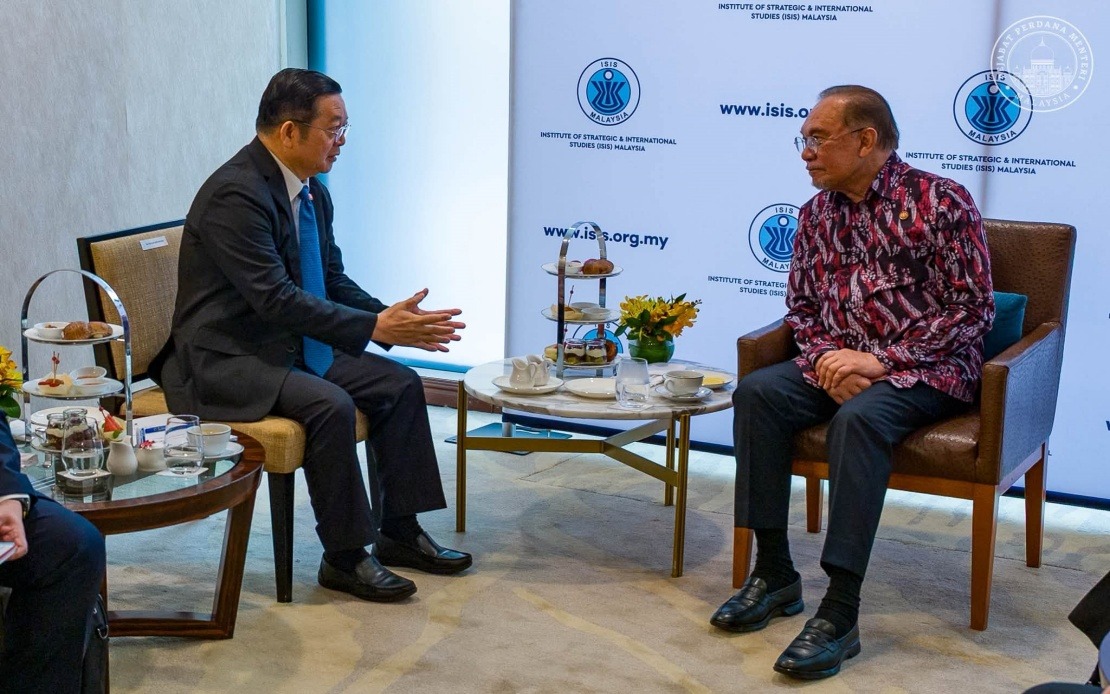
Malaysia remains steadfast in its commitment to nurturing ASEAN as a unified, inclusive regional bloc capable of delivering tangible benefits to its constituent populations, Prime Minister Datuk Seri Anwar Ibrahim declared during a high-level engagement in Kuala Lumpur. The statement underscores Kuala Lumpur's strategic positioning within Southeast Asia at a juncture when the region faces intensifying external pressures and internal policy divergences that threaten institutional cohesion.
Anwar articulated this position during a bilateral meeting with ASEAN Secretary-General Dr Kao Kim Hourn, which took place following his address and substantive participation in the 39th Asia-Pacific Roundtable. The gathering, a prominent forum for regional dialogue and strategic analysis, provided the Malaysian premier with an opportunity to signal the country's continued investment in multilateral frameworks at precisely the moment when questions about ASEAN's effectiveness persist across diplomatic circles.
The substantive agenda between Anwar and the ASEAN chief traversed several critical contemporary concerns shaping the region's trajectory. The Myanmar question, an increasingly intractable challenge that has fractured ASEAN consensus, featured prominently in discussions. The political and humanitarian crisis unfolding within Myanmar continues to strain ASEAN's principle of non-interference while simultaneously demanding greater engagement on stability and humanitarian grounds. Malaysia's approach to this dilemma reflects the broader tension many member states experience between traditional ASEAN orthodoxy and the practical necessities of regional peace.
Disputes in the South China Sea constituted another focal point of their exchange. As one of the region's major maritime powers with significant economic interests in freedom of navigation and resource security, Malaysia navigates a delicate diplomatic terrain. The country must balance its strategic partnership with China—a vital economic and security partner—against its alliance with other claimant states and broader international stakeholders invested in the rules-based maritime order. Malaysia's emphasis on constructive solutions demonstrates its commitment to de-escalation while maintaining its territorial and jurisdictional interests in contested waters.
The emergence of artificial intelligence as a transformative technology received specific attention during discussions, reflecting how rapidly technological disruption has become integrated into high-level diplomatic discourse. Southeast Asian nations grapple with both opportunities and risks as AI reshapes economic competitiveness, labor markets, and governance capacities. Malaysia's inclusion of AI advancement in its regional priorities signals recognition that ASEAN's relevance depends partly on its capacity to shape technological governance frameworks affecting the region rather than merely responding to developments orchestrated elsewhere.
Anwar highlighted the broader context of implementing ASEAN Community Vision 2045, the bloc's long-term strategic roadmap designed to enhance integration and prosperity. However, the vision remains aspirational in many respects, with implementation challenged by divergent economic development levels, governance standards, and strategic preferences among member states. Malaysia's emphasis on this agenda suggests Kuala Lumpur sees renewed momentum as essential to maintaining ASEAN's institutional credibility and practical effectiveness.
The recent admission of Timor-Leste as ASEAN's eleventh member represents a significant moment in regional architecture. Anwar's reference to navigating the post-accession phase acknowledges the practical challenges of integrating a newly full member with distinct security interests, developmental needs, and strategic vulnerabilities. Malaysia, as an established member with institutional experience and regional diplomatic heft, carries responsibility for facilitating Timor-Leste's integration while maintaining cohesion among existing members.
The spillover effects of regional conflicts, particularly developments in West Asia, received explicit consideration during the meeting. The ongoing Palestinian-Israeli conflict and broader Middle Eastern tensions create cascading implications for Southeast Asia through energy markets, maritime security, religious and communal dynamics, and great power competition. Malaysia, with its significant Muslim population and multifaith society, faces particular sensitivities around these geopolitical tremors. The country's ASEAN engagement must incorporate responses to these external shocks without allowing them to fracture internal unity.
Underscoring his remarks, Anwar emphasized the indispensability of maintaining what he termed ASEAN's foundational principles of unity, centrality, and collaborative engagement. These principles—tested repeatedly by competing strategic interests, sovereignty sensitivities, and divergent threat perceptions—remain theoretically uncontroversial yet practically challenging to uphold. ASEAN's centrality in regional architecture faces mounting pressures from bilateral arrangements, alignments within competing great power blocs, and the rise of minilateral frameworks like the Quad that operate outside traditional ASEAN structures.
Malaysia's reaffirmation of commitment assumes particular weight given the country's historical role as an ASEAN intellectual architect and persistent advocate for regional consensus-building. Kuala Lumpur has invested considerable diplomatic capital in maintaining the institution's viability precisely because Malaysian strategic interests depend fundamentally on a stable, prosperous, and unified Southeast Asia. The country's geographic position, economic interdependencies, and security architecture all hinge on ASEAN functioning as an effective mechanism for channeling intra-regional cooperation and providing collective voice in global affairs.
The Prime Minister's statements arrive at a moment when ASEAN faces credibility questions emanating from perceived ineffectiveness on Myanmar, persistent tensions over South China Sea governance, and growing doubts about the institution's capacity to shape its own destiny amid great power competition. Malaysia's insistence on ASEAN's resilience and inclusiveness serves partly as reassurance to regional partners and partly as clarification of Malaysian strategic preferences. By emphasizing these qualities, Anwar signals that Malaysia sees regional stability and institutional vitality as prerequisites for navigating the complex terrain ahead.
Looking forward, Malaysia's constructive engagement within ASEAN frameworks will likely emphasize pragmatic incrementalism over transformative institutional reform. The country recognizes that radical ASEAN restructuring would prove politically impossible while incremental improvements to operational effectiveness, transparency, and dispute resolution capacity could strengthen the institution's practical value. This approach reflects both Malaysia's diplomatic experience and its understanding that ASEAN, despite acknowledged limitations, remains superior to alternatives for managing Southeast Asian coexistence and prosperity.

