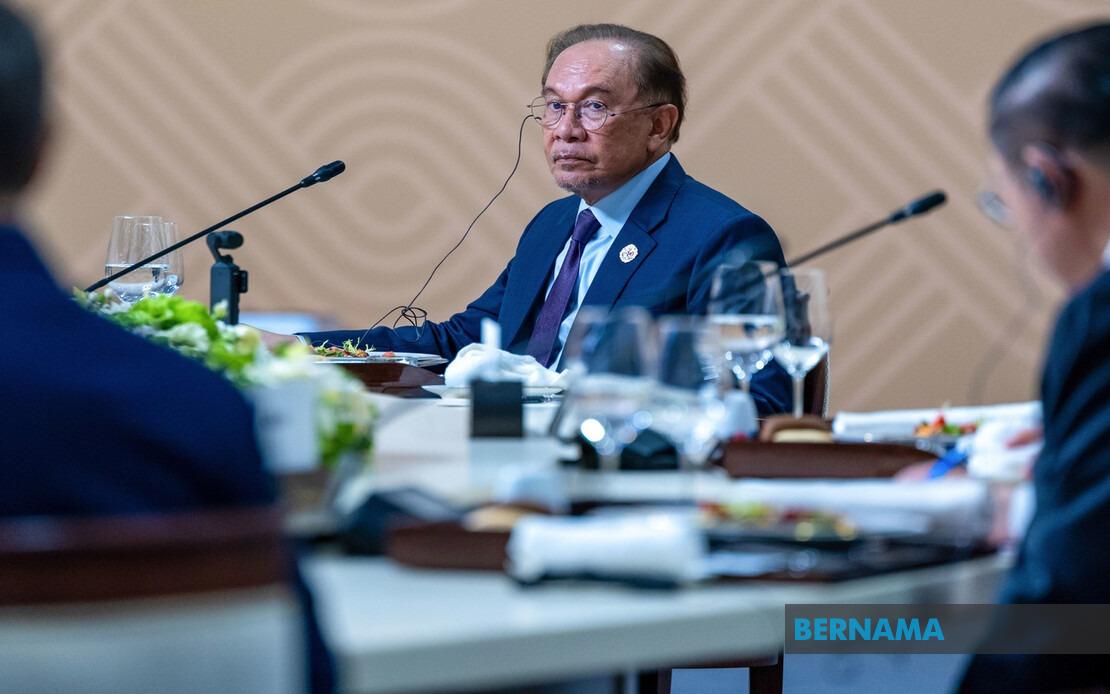
Prime Minister Datuk Seri Anwar Ibrahim's rapid-fire diplomatic mission across Tashkent, Kazan, and Ashgabat in June accomplished far more than routine courtesy calls. Within four days, the Malaysian leader orchestrated a series of engagements that reveal how the country is recalibrating its economic strategy in response to a fundamentally altered international landscape. The visits demonstrate a sophisticated understanding that in an era of intensifying great-power competition and protectionism, economic resilience demands breadth as much as it demands depth.
The timing of these missions could hardly be more significant. The global economic order is undergoing one of its most dramatic transformations since the Cold War's end. Major powers are wielding trade restrictions, sanctions regimes, and export controls with increasing frequency as instruments of statecraft. Industrial policy, once considered the domain of developing nations, has become fashionable among advanced economies. For a nation whose prosperity hinges on openness and connectivity, Malaysia faces a fundamentally different external environment than it did merely a decade ago.
This shifting landscape carries particular implications for middle powers like Malaysia. The challenge extends well beyond maintaining growth within a progressively contested global market. The real stakes involve preserving strategic autonomy, protecting critical supply chains, and maintaining access to diverse economic opportunities. In such conditions, countries cannot afford to concentrate their relationships narrowly. Instead, they must cultivate a broad network of partnerships that provides genuine optionality when circumstances change or crises strike.
The Tashkent stopover, initially planned as a perfunctory meeting with President Shavkat Mirziyoyev, evolved into substantive discussions on major economic cooperation initiatives. These conversations built directly upon work initiated during Malaysia's previous official visit in 2024, suggesting a pattern of sustained engagement rather than episodic contact. The discussions ranged across infrastructure development, trade expansion, and investment frameworks that will require months of detailed negotiation.
In Kazan, Malaysia's participation in the ASEAN-Russia Commemorative Summit placed the nation at the intersection of important geopolitical and economic currents. While Russia remains a relatively modest trading partner for ASEAN compared to traditional major economies, both sides recognize substantial unrealised opportunities. Agriculture, energy, digital technologies, advanced manufacturing, and food security emerged as priority sectors where cooperation could generate mutual benefits. More significantly, the summit reinforced ASEAN's commitment to engaging diverse external partners while maintaining strategic autonomy—a delicate balance that requires constant diplomatic attention.
The new ASEAN-Russia Strategic Programme on Trade and Investment Cooperation 2026-2035 articulated by both sides recognises that future competitiveness increasingly rests upon innovation, technological capability, and economic adaptability. Parallel discussions between Malaysian officials and leaders from the Republic of Tatarstan opened additional channels. Tatarstan, though frequently overlooked in analyses of Russian policy, has established itself as one of Russia's most dynamic industrial and technological hubs. Malaysian interest in biotechnology, halal industries, maritime capabilities, Islamic finance, and industrial cooperation with Tatarstan reflects a sophisticated approach to economic engagement that looks beyond federal governments to regional actors.
This dimension of contemporary economic diplomacy often escapes broader attention. National governments no longer monopolize international economic cooperation. Regions, provinces, cities, industrial clusters, and innovation hubs have emerged as consequential actors in global economic networks. Smart diplomacy recognises that relationships cultivated with these sub-national actors frequently yield practical opportunities that complement and amplify traditional state-to-state engagement. Malaysia's cultivation of connections with Tatarstan exemplifies this forward-thinking approach.
The Ashgabat leg of the journey addressed one of Malaysia's most critical strategic interests: energy security. Petronas has maintained a substantial presence in Turkmenistan for three decades, evolving from a foreign investor into a partner deeply woven into the nation's economic fabric. The company's approximately USD12 billion in cumulative investment has contributed to infrastructure development, technological advancement, and human capital formation. This represents patient relationship-building over decades rather than opportunistic repositioning in response to recent geopolitical shocks.
The landmark agreements concluded during the Ashgabat visit demonstrate that this partnership is entering what President Serdar Berdimuhamedov characterised as a "new critical phase." The deals grant Petronas expanded stakes in some of the world's largest gas fields and establish new production-sharing arrangements alongside expanded exploration activities. This represents a profound commitment by both parties to deepen hydrocarbon cooperation in ways that transcend purely commercial calculations. Recent global crises have exposed how quickly energy market disruptions ripple across regions, affecting prices, transportation networks, and production costs worldwide. Diversified energy partnerships therefore constitute an essential component of economic resilience and strategic flexibility.
Yet reducing these engagements to trade statistics and investment flows misses their essential character. Contemporary economic diplomacy necessarily operates across multiple domains simultaneously. Food security intersects with technological development. Energy cooperation overlaps with infrastructure investment and industrial advancement. Digitalisation simultaneously creates innovation opportunities while raising governance and technological dependence concerns. Building what leaders increasingly describe as "brotherly relations" has become central to economic diplomacy, establishing mutual trust and confidence where soft power—the intangible influence of personal relationships and shared vision—proves indispensable to clinching major agreements.
This reality explains why discussions across these three capitals extended well beyond commercial frameworks. Collaboration in education and research, development of halal ecosystems, and expansion of Islamic financial services featured prominently in bilateral conversations. These domains are becoming integral components of competitive advantage rather than peripheral considerations. A nation's soft power derives substantially from its ability to position itself as a reliable partner across these diverse dimensions, offering solutions to partner nations' multifaceted development challenges.
Malaysia's approach illustrates how middle powers can maintain relevance and influence amid great-power competition. Rather than viewing the multipolarising global economy as threatening, Malaysia is deliberately positioning itself to benefit from multiple economic networks. This diversification does not diminish relationships with existing major partners but rather supplements them. Countries that successfully cultivate broader relationship networks enjoy greater flexibility when external circumstances shift. For a trading nation dependent on openness and connectivity, resilience increasingly depends on maintaining access to a wide range of external partnerships.
The visits also underscore how geography, history, and cultural affinity create natural zones for economic cooperation. Malaysia's Islamic heritage, its expertise in halal industries, its technological capabilities in digital sectors, and its experience as a stable developing economy make it an attractive partner for nations seeking balanced development. The emphasis placed on these elements across Tashkent, Kazan, and Ashgabat suggests that Malaysia has identified concrete competitive advantages it can leverage in Central Asian and Caucasian markets.
Moving forward, the practical implications of these engagements will unfold gradually. Petronas's expanded activities in Turkmenistan require sustained capital investment and operational commitment. New trade and investment frameworks demand institutional development and regulatory harmonisation. Educational and research collaborations take time to generate tangible benefits. What matters now is that Malaysia has established platforms upon which these relationships can develop, and has demonstrated through high-level engagement that it views these partnerships as genuinely consequential to its long-term prosperity and security.
%22%2F%3E%3C%2Fpattern%3E%3C%2Fdefs%3E%3Crect%20width%3D%22100%25%22%20height%3D%22100%25%22%20fill%3D%22url(%23ph4oc6ig)%22%2F%3E%3Crect%20width%3D%22100%25%22%20height%3D%22100%25%22%20fill%3D%22url(%23ph4oc6ip)%22%2F%3E%3Ctext%20x%3D%2250%25%22%20y%3D%2250%25%22%20text-anchor%3D%22middle%22%20dominant-baseline%3D%22central%22%20fill%3D%22rgba(255%2C255%2C255%2C0.95)%22%20font-family%3D%22Georgia%2C%20'Times%20New%20Roman'%2C%20serif%22%20font-weight%3D%22700%22%20font-size%3D%22226%22%20letter-spacing%3D%22-0.02em%22%3EFormer%3C%2Ftext%3E%3C%2Fsvg%3E)
%22%2F%3E%3C%2Fpattern%3E%3C%2Fdefs%3E%3Crect%20width%3D%22100%25%22%20height%3D%22100%25%22%20fill%3D%22url(%23phx5hig)%22%2F%3E%3Crect%20width%3D%22100%25%22%20height%3D%22100%25%22%20fill%3D%22url(%23phx5hip)%22%2F%3E%3Ctext%20x%3D%2250%25%22%20y%3D%2250%25%22%20text-anchor%3D%22middle%22%20dominant-baseline%3D%22central%22%20fill%3D%22rgba(255%2C255%2C255%2C0.95)%22%20font-family%3D%22Georgia%2C%20'Times%20New%20Roman'%2C%20serif%22%20font-weight%3D%22700%22%20font-size%3D%22194%22%20letter-spacing%3D%22-0.02em%22%3EMALBATT%3C%2Ftext%3E%3C%2Fsvg%3E)
%22%2F%3E%3C%2Fpattern%3E%3C%2Fdefs%3E%3Crect%20width%3D%22100%25%22%20height%3D%22100%25%22%20fill%3D%22url(%23ph3iun0g)%22%2F%3E%3Crect%20width%3D%22100%25%22%20height%3D%22100%25%22%20fill%3D%22url(%23ph3iun0p)%22%2F%3E%3Ctext%20x%3D%2250%25%22%20y%3D%2250%25%22%20text-anchor%3D%22middle%22%20dominant-baseline%3D%22central%22%20fill%3D%22rgba(255%2C255%2C255%2C0.95)%22%20font-family%3D%22Georgia%2C%20'Times%20New%20Roman'%2C%20serif%22%20font-weight%3D%22700%22%20font-size%3D%22320%22%20letter-spacing%3D%22-0.02em%22%3EUS%3C%2Ftext%3E%3C%2Fsvg%3E)