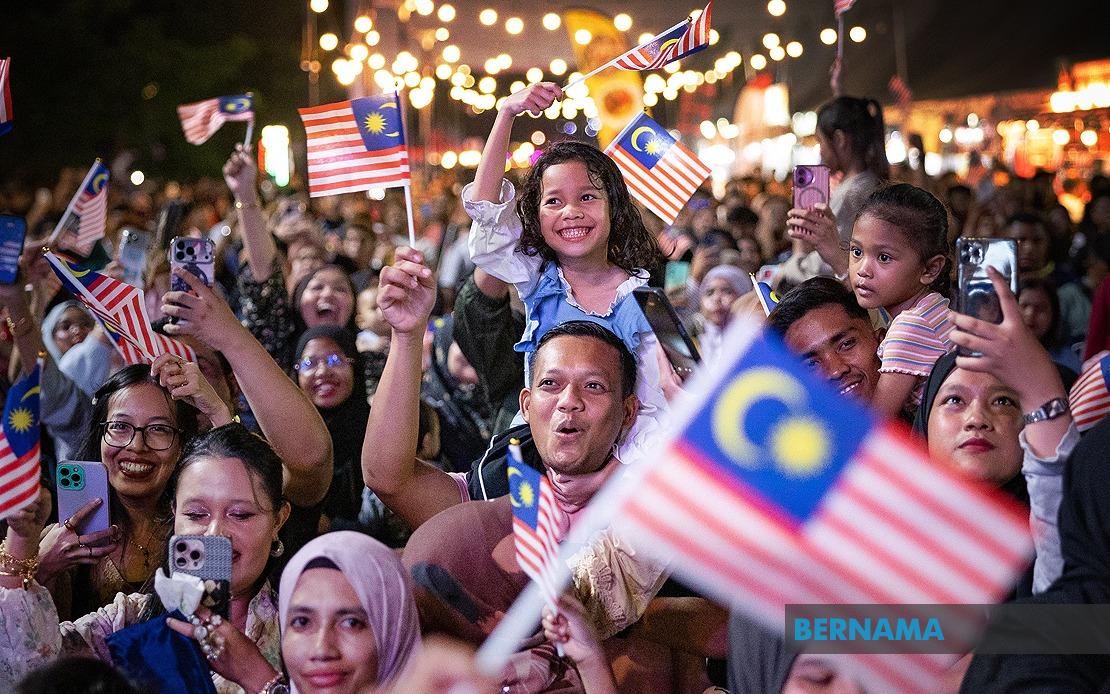
The eve of Malaysia's 69th National Day unfolded as a landmark moment of national pride, with commemorations occurring simultaneously across multiple states and drawing record-breaking attendance figures. The centrepiece of the evening was Dataran Merdeka in Kuala Lumpur, where organisers reported more than 100,000 visitors assembled to participate in the 'Kita Bagi Jadi @ Ambang Merdeka 2026' concert and the symbolic countdown to midnight marking the nation's independence milestone.
The historic square adjacent to the Sultan Abdul Samad Building transformed into a sea of Jalur Gemilang flags as crowds arrived early in the evening. A survey conducted throughout the night revealed that visitors of all demographic backgrounds—from young children to elderly citizens—had begun gathering by 8 pm, creating an atmosphere described as vibrant and deeply patriotic. The illuminated backdrop of the colonial-era building created a poignant visual metaphor, connecting Malaysia's modern celebration of independence with the physical structures that witnessed the nation's transition to sovereignty.
The centrepiece performance, a 90-minute concert, showcased the breadth of Malaysia's contemporary music and entertainment industry. Beyond the headline performers mentioned in official announcements, the programme integrated approximately 350 supporting performers who contributed to a multifaceted presentation combining music, choreographed dance sequences, and theatrical storytelling elements. This production strategy deliberately positioned the concert as more than entertainment—it functioned as a cultural narrative, with artists and performers collectively reconstructing Malaysia's historical journey and celebrating the multicultural foundations of the nation's identity.
Government representation at the event underscored official recognition of its significance. Hannah Yeoh, Minister in the Prime Minister's Department overseeing Federal Territories, and Kuala Lumpur Mayor Datuk Seri Fadlun Mak Ujud attended the proceedings, signalling federal and municipal commitment to the celebrations. The evening's programme was further elevated through the arrival of Menteri Besar Datuk Seri Amirudin Shari at 9.20 pm, whose attendance triggered a succession of spectacular military and civilian demonstrations designed to underscore national pride and institutional capability.
The military dimension of the celebrations reflected Malaysia's security establishment's participation in the nation's commemoration. The VAT 69 Commando unit executed a coordinated skydiving display that served both as entertainment and as a demonstration of the armed forces' professionalism and readiness. Interspersed with these displays were the national anthem Negaraku, a parade featuring contingents from various government and community organisations, and decorated vehicles that processed through the venue. The Fire and Rescue Department and police force conducted live safety and operational displays, creating a comprehensive representation of Malaysia's institutional infrastructure.
The midnight transition itself became the centrepiece of the evening's climactic sequence. As the clock approached 12 am, Menteri Besar Amirudin Shari led the assembled crowd in collective shouts of 'Merdeka,' a ritual that carries deep historical resonance, echoing the declaration of independence uttered decades earlier. This moment triggered a carefully choreographed finale: pyrotechnic fireworks illuminated the night sky, synchronized lighting displays transformed the square's visual landscape, and a succession of headline performers—including Datuk Ramli Sarip, Datuk Awie, and contemporary acts such as Gerhana Skacinta and Wani Kyrie—delivered performances that blended traditional and modern musical expressions of Malaysian identity.
Beyond Kuala Lumpur, celebrations resonated throughout the nation with comparable enthusiasm. The northern state of Perlis reported attracting more than 46,000 visitors to its celebrations at a sports complex, indicating that National Day observance transcended the capital and engaged citizens across Malaysia's diverse regions. These distributed celebrations, occurring simultaneously across multiple locations, created a sense of nationwide participation and collective national consciousness. The presence of state-level political leadership, including Chief Minister Datuk Seri Ab Rauf Yusoh and his wife Datin Seri Zuriyah Abd Aziz, ensured that state-level governance structures were visibly integrated into the commemorative process.
The broader programming at venues extended beyond ceremonial moments and performances. Organisers integrated complementary activities that served community welfare and engagement functions. The Bulatan Sultan Azlan Shah Run provided fitness-oriented participation, while Jualan Rahmah and thrift markets created commercial activity with community benefit. Free health screenings addressed public health needs, and diverse entertainment options—karaoke contests, the Tantirana Haunted House attraction, and continuous live performances—ensured that celebrations appealed to varied audience segments and extended participation across multiple hours.
The philosophical dimension of the commemoration was articulated through formal addresses by the nation's highest constitutional figure. In his royal address, Tuanku Syed Sirajuddin contextualised contemporary independence within historical consciousness, reminding the public that the sovereignty enjoyed in the present era emerged from extended struggles, substantial sacrifices, and the foundational unity established among Malaysia's diverse racial and ethnic communities. His emphasis on upholding independence through knowledge, integrity, unity, and civic responsibility projected a forward-looking perspective—one that positioned the 69th National Day not merely as retrospective commemoration but as a moment demanding renewed commitment to shared national values.
State-level leadership reinforced this narrative of responsibility and stewardship. Muhammad Sanusi, addressing the assembled crowds in Perlis after the state anthem and martial arts displays, similarly positioned the celebration within a framework of appreciation and active safeguarding. This repeated emphasis across multiple speakers—that independence represents not a historical achievement to be passively celebrated but an ongoing responsibility requiring conscious preservation and deliberate protection—suggested a coherent national messaging strategy aimed at connecting commemoration to contemporary civic consciousness.
The scale and coordination of these celebrations across Malaysia's geography and institutional structures reflected a society wherein National Day observance functions as far more than ceremonial duty. The massive attendance figures, the high-profile government participation, the integration of cultural programming with patriotic messaging, and the extension of celebrations through entertainment, commerce, and community services all indicated that independence commemoration constitutes a foundational ritual through which Malaysians collectively reassert national identity. For a nation navigating the complexities of multicultural coexistence and regional integration, such synchronised moments of national celebration serve crucial functions in reinforcing shared purpose and common citizenship across Malaysia's diverse population.

