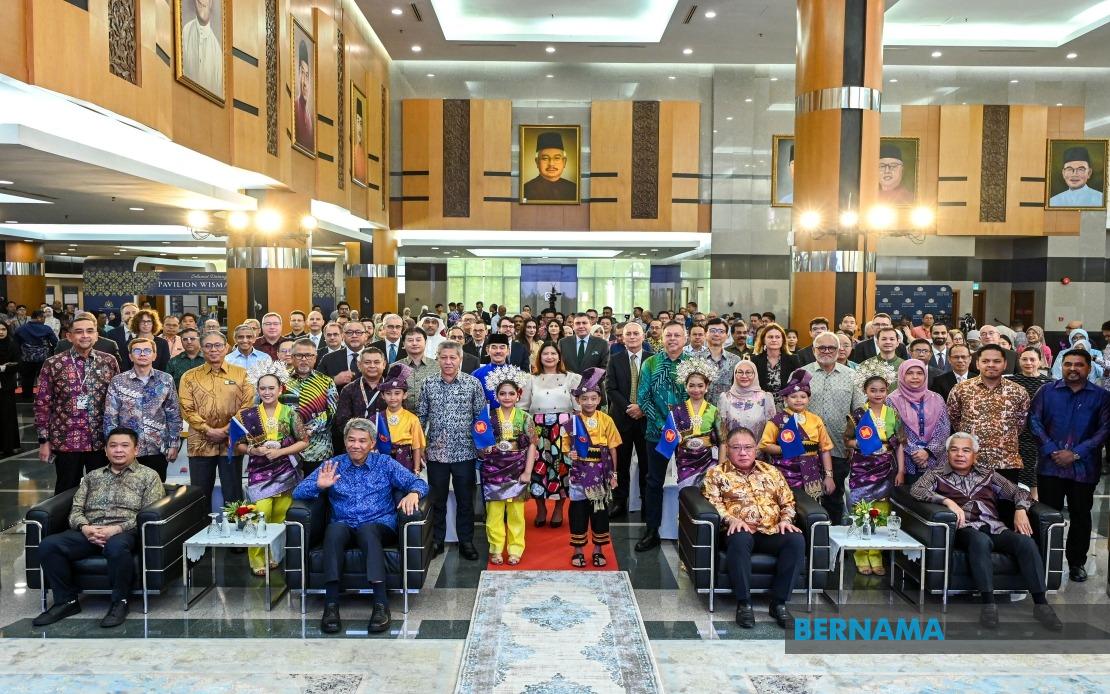
Malaysia marked nearly six decades of involvement in Southeast Asia's most significant regional grouping on Monday, as the nation joined ASEAN in celebrating the bloc's 59th founding anniversary. The commemoration, held at Malaysia's Foreign Ministry in Putrajaya, brought together roughly 300 guests for a day of reflection on the country's journey since ASEAN's establishment and its ongoing commitment to regional stability and prosperity.
Former Foreign Minister Datuk Seri Mohamad Hasan officiated the event, which carried the theme "59 Years of Navigating Together," a phrase that encapsulates ASEAN's approach to collective problem-solving across Southeast Asia's complex geopolitical landscape. The presence of Tourism, Arts and Culture Minister Datuk Seri Tiong King Sing, Deputy Foreign Minister Datuk Lukanisman Awang Sauni, and representatives from international organizations underscored the cross-sectoral nature of ASEAN engagement and the importance Malaysia places on the regional platform.
The celebration featured a specially produced video montage titled "ASEAN Journey: Navigating Our Future, Together - 59 Years of Malaysia in ASEAN," providing attendees with a visual narrative of Malaysia's evolution within the organization. This retrospective element proved significant, as it allowed participants to appreciate how far the region has come since the Bangkok Declaration was signed on August 8, 1967, by Indonesia, Malaysia, the Philippines, Singapore and Thailand—the five founding members who envisioned a framework for regional cooperation during a period of considerable Cold War tension.
Malaysia's Foreign Ministry statement emphasized that ASEAN's structure rests on three foundational pillars: political-security cooperation, economic integration, and socio-cultural exchange. These pillars have proven remarkably durable over nearly six decades, allowing the organization to adapt to shifting regional dynamics while maintaining its core principle of non-interference in member states' internal affairs. For Malaysia, these frameworks have been instrumental in mediating disputes and fostering dialogue across a region marked by competing interests and historical grievances.
The regional grouping has undergone considerable expansion since its inception, growing from its original five members to encompass eleven nations by 2023. Brunei's accession in 1984 represented the first significant widening of ASEAN's membership, followed by Vietnam's entry in 1995—a watershed moment that ended decades of Cold War isolation and drew Indochina into the regional integration project. The consecutive additions of Laos and Myanmar in 1997, Cambodia in 1999, and most recently Timor-Leste in October of the previous year, have shaped ASEAN into a more geographically comprehensive organization spanning from Thailand to the Pacific.
For Malaysia specifically, ASEAN membership has become central to its foreign policy architecture. The country has utilized the organization to advance its economic interests through regional trade agreements, enhance its security through dialogue mechanisms, and promote its cultural and diplomatic influence across Southeast Asia. Malaysia's hosting of numerous ASEAN summits and its active participation in subsidiary bodies demonstrate the country's commitment to making the organization work effectively for all members.
Timor-Leste's recent admission during the 47th ASEAN Summit in October represented a milestone in the organization's evolution, as it marked the first expansion in more than two decades. This development carried particular significance for Malaysia and other established members, as it demonstrated ASEAN's continued appeal to Southeast Asian nations seeking the benefits of regional integration and the framework's proven capacity to accommodate new entrants while maintaining organizational coherence.
The celebration also included a ceremonial cake-cutting led by Foreign Minister Mohamad, a symbolic gesture that underscored the festive yet substantive nature of the commemoration. Such rituals serve important functions within diplomatic contexts, creating moments of shared recognition and allowing participants to renew their commitment to collective undertakings in a relaxed setting. The attendance of diplomats and government officials from across the membership demonstrated that ASEAN anniversary observances remain occasions where member states collectively reaffirm their dedication to the organization's principles.
Looking forward, Malaysia's emphasis on navigating together carries particular resonance given contemporary regional challenges. From managing great power competition between the United States and China to addressing climate change, maritime security concerns, and pandemic preparedness, ASEAN faces pressures that demand cohesion and collective action. Malaysia, as a long-standing member with experience navigating diverse interests within the organization, continues to advocate for ASEAN centrality in regional affairs—a concept that places the organization at the center of regional security and economic architectures.
The Foreign Ministry's characterization of ASEAN as demonstrating "strength, solidarity and resilience" reflected an optimistic assessment of the organization's capacity to weather contemporary challenges. However, this characterization also acknowledges the real pressures ASEAN faces, including attempts by external powers to exploit divisions among members and the inherent difficulty of forging consensus among nations with vastly different development levels, strategic interests, and political systems. Malaysia's continued investment in ASEAN mechanisms and its celebration of these milestones suggest the country views sustaining and strengthening the organization as essential to its own long-term prosperity and security in Southeast Asia.

