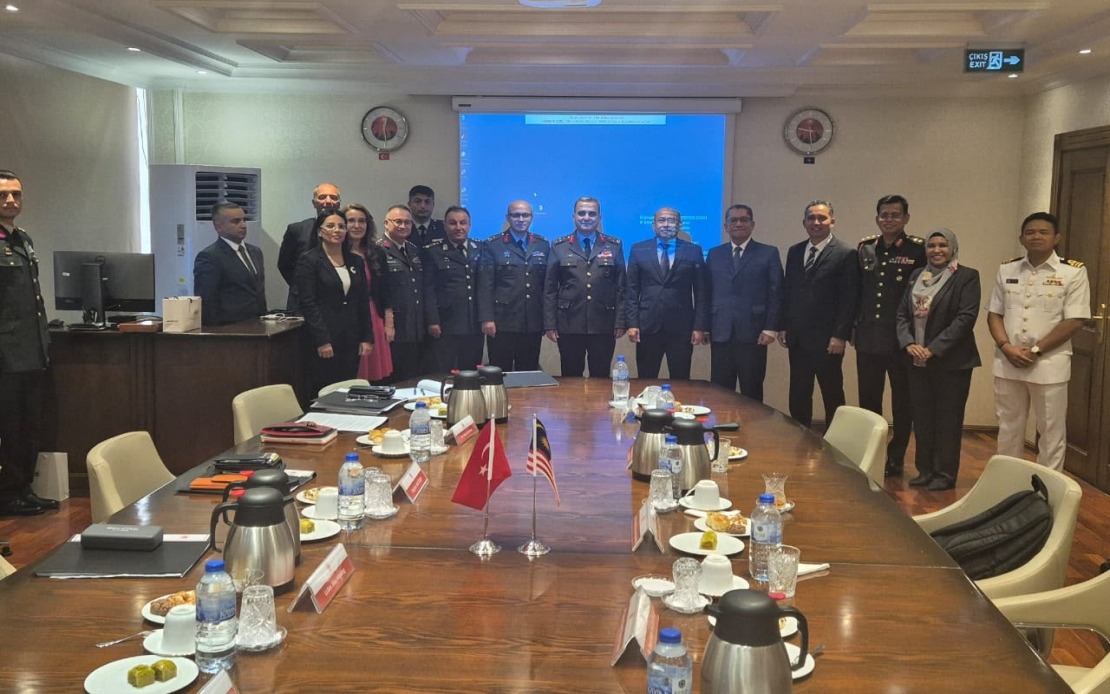
Malaysia and Türkiye have taken a significant step in broadening their bilateral defence relationship by conducting their inaugural policy talk at Türkiye's Ministry of National Defence headquarters in Ankara. The meeting, convened on Monday, represents a structured institutional approach to defence diplomacy that will allow both nations to deepen their engagement on matters of strategic importance to the broader Indo-Pacific and Middle Eastern regions.
The Malaysian delegation was led by Datuk Yani Daud, deputy secretary-general of policy at Malaysia's Ministry of Defence, while Lieutenant General Ilkay Altindag, director-general of defence and security at Türkiye's Ministry of National Defence, chaired the talks. This senior-level participation underscores the importance both governments attach to formalising defence exchanges, moving beyond ad-hoc military-to-military contact into a structured dialogue mechanism that can sustain institutional momentum.
The scope of discussions extended across multiple dimensions of defence cooperation, with particular emphasis on defence policy formulation, strategic military thinking, and contemporary geopolitical security dynamics. The two sides engaged in substantive exchanges designed to build mutual understanding of each nation's defence priorities and strategic worldview, recognising that alignment on regional security perspectives strengthens bilateral ties and enhances collective capacity to address transnational threats.
Among the substantive outcomes was formal Malaysian recognition of Türkiye's contributions to regional stability efforts, particularly through Türkiye's recent role in facilitating the Makkah Pact. This acknowledgment carries symbolic weight for Ankara, whose mediation initiatives in West Asia have positioned it as a significant player in Middle Eastern diplomacy. For Malaysia, expressing this appreciation signals an alignment of interests in promoting peaceful resolution mechanisms and regional de-escalation, values central to Malaysia's own foreign policy doctrine.
Both nations identified the maintenance of regional peace and stability as a foundational principle for their defence partnership. This shared commitment to stability extends beyond bilateral concerns to encompass broader regional architecture, reflecting each nation's interest in predictable security environments that facilitate economic development and prosperity. For Malaysia, which operates within a complex Southeast Asian security landscape, alignment with a regional power like Türkiye on stability principles offers additional diplomatic leverage and strengthens multilateral security dialogues.
A critical institutional development emerging from the meeting was the agreement to establish formal Terms of Reference governing future policy talks. This framework provides both nations with clear parameters for discussing defence cooperation instruments and identifying potential collaborative programmes. The establishment of TOR transforms the policy talk from a one-off engagement into a recurring institutional mechanism, allowing both governments to sustain momentum and progressively deepen cooperation through multiple dimensions—from personnel exchanges to joint training initiatives and technology partnerships.
Malaysia has formally extended an invitation for Türkiye to participate in the second policy talk, scheduled to take place in Kuala Lumpur during the following year. This reciprocal hosting arrangement demonstrates balanced engagement, ensuring both nations maintain equal footing in facilitating diplomatic processes. The location rotation signals that the dialogue is conceived as genuinely bilateral rather than hierarchical, allowing each country to demonstrate hospitality and commitment to the partnership through their role as host.
The timing of this defence policy dialogue reflects evolving regional geopolitics and Malaysia's strategic recalibration. Türkiye, as a NATO member with substantial military capabilities and demonstrated interest in Indo-Pacific affairs, represents a valuable partner for Malaysia as it navigates great power competition and seeks to broaden its strategic partnerships beyond traditional regional associations. The dialogue taps into Türkiye's experience managing complex security environments while contributing Malaysian perspectives on Southeast Asian stability challenges.
The defence ministry's linkage of this initiative to the Mid-Term Review of Malaysia's Defence White Paper indicates that the Türkiye engagement forms part of a comprehensive strategy for strengthening Malaysia's defence posture and international standing. Rather than representing isolated diplomatic gesture, the policy talk aligns with documented strategic priorities, suggesting this partnership development has undergone rigorous policy deliberation within Malaysian defence circles.
From a Southeast Asian perspective, the Malaysia-Türkiye defence dialogue introduces a non-regional power with considerable military expertise into frameworks that traditionally centre on intra-ASEAN and great power relationships. This diversification of defence partnerships reflects the increasingly interconnected nature of global security challenges, from counterterrorism cooperation to maritime safety concerns. Malaysian engagement with Türkiye potentially creates additional pathways for technology transfer, joint capacity-building, and intelligence sharing on matters affecting regional security.
The establishment of regular policy talks also creates opportunities for thematic cooperation on specific challenges affecting both nations. Shared concerns around maritime security, counterterrorism financing, and defence modernisation could become focal points for substantive programmes emerging from future dialogues. By institutionalising the relationship through recurring policy talks, Malaysia and Türkiye position themselves to identify concrete collaboration opportunities that deliver tangible benefits beyond diplomatic symbolism.
The success of this inaugural dialogue will likely influence Malaysia's approach toward defence partnerships with other non-traditional partners. If the Türkiye engagement generates meaningful cooperation and strategic advantages, it may encourage similar policy talks with other nations possessing relevant defence capabilities or strategic interests in regional stability. The mechanism thus potentially becomes a template for Malaysia's broader defence diplomacy strategy.

