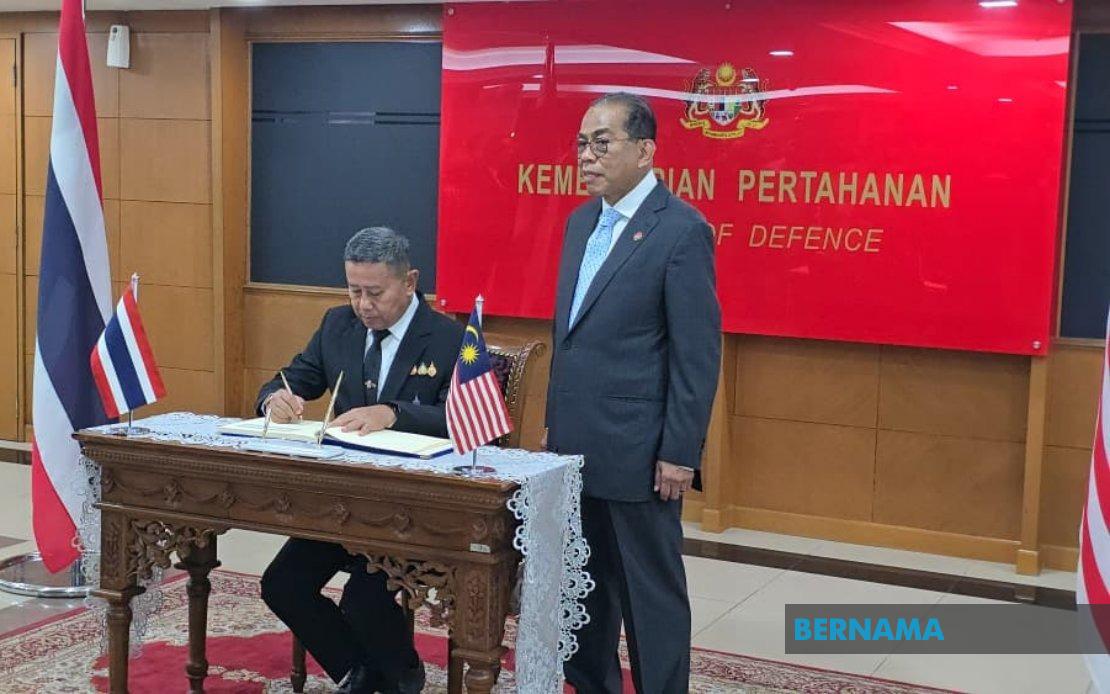
Malaysia and Thailand have reaffirmed their commitment to deepening defence cooperation and jointly tackling regional security challenges, marking a significant diplomatic engagement between two of Southeast Asia's most strategically important nations. The high-level meeting between Malaysia's Defence Minister Datuk Seri Mohamed Khaled Nordin and his Thai counterpart Lieutenant General Adul Boonthumjaroen underscores the two countries' determination to maintain stability across a region facing mounting transnational threats and geopolitical complexities.
Lieutenant General Adul's visit to Wisma Pertahanan in Kuala Lumpur served as his introductory engagement in Malaysia since assuming his position as Thailand's Defence Minister under Prime Minister Anutin Charnvirakul's government. The timing and nature of this visit signal Thailand's intention to prioritize regional partnerships at a moment when security concerns—from maritime disputes to transnational crime—demand coordinated responses from neighbouring states.
During their discussions, Mohamed Khaled extended formal congratulations to Adul on his ministerial appointment and expressed confidence in Thailand's trajectory under current political leadership. Such ceremonial gestures, while appearing routine on the surface, carry deeper significance in Southeast Asian diplomatic practice, where personal relationships between defence leaders often translate into substantive cooperation agreements and enhanced intelligence sharing. The establishment of strong interpersonal ties at this level creates foundations for more efficient decision-making when urgent regional crises demand rapid coordination.
Both ministers underscored their shared vision of promoting enduring peace and stability throughout Southeast Asia. This commitment reflects broader understanding among regional defence establishments that no single nation can effectively address contemporary security threats in isolation. Transnational criminal networks, maritime piracy, illegal weapons trafficking, and other illicit activities increasingly require multilateral responses that transcend bilateral frameworks. Malaysia and Thailand's emphasis on regional peace reflects their acknowledgment of these interconnected challenges.
Tailand's explicit backing for Malaysia's diplomatic initiatives regarding the Thailand-Cambodia border dispute demonstrates how defence cooperation extends beyond military matters into broader conflict prevention and mediation. Malaysia has positioned itself as a constructive facilitator in this longstanding territorial tension, leveraging its neutral standing and diplomatic experience to encourage dialogue between Bangkok and Phnom Penh. Thailand's recognition of these efforts validates Malaysia's role as a responsible regional actor and suggests openness to Malaysian-led initiatives addressing other bilateral disputes in Southeast Asia.
The Ministry of Defence statement highlighted the "closeness of friendship" between the two defence leaders, language that signals far more than ceremonial cordiality. In Southeast Asian diplomatic contexts, such expressions typically precede concrete arrangements for joint military exercises, defence technology transfers, and enhanced operational coordination. The historical relationship between Malaysia and Thailand includes established military-to-military protocols that facilitate rapid communication during crises, and this meeting likely strengthened those institutional channels.
Apart from diplomatic discussions, Adul's comprehensive itinerary included a visit to the National Aerospace and Defence Industries (NADI) Group of Companies, a strategically important Malaysian defence contractor. NADI operates across multiple domains including aerospace capabilities, naval systems, and advanced technologies relevant to regional security operations. The visit provided both delegations with opportunities to explore concrete cooperation possibilities in defence manufacturing, technology development, and industrial partnerships that could benefit both nations' armed forces.
MALAYSIA'S role in ASEAN defence architecture has expanded considerably in recent years, reflecting its geographic position and diplomatic credibility. Thailand, as a neighbouring kingdom with significant military capabilities and strategic interests in mainland Southeast Asia, represents a natural partnership for addressing shared security concerns. Cooperation between Kuala Lumpur and Bangkok can extend to maritime domain awareness initiatives, particularly in the Andaman Sea and adjacent waters where both nations maintain jurisdiction and where piracy and smuggling remain persistent challenges.
The bilateral engagement also occurs against a backdrop of evolving regional dynamics involving larger powers. Both Malaysia and Thailand maintain independent foreign policies while participating in ASEAN consensus-building mechanisms. Enhanced Malaysia-Thailand cooperation signals neither alignment with any external power nor withdrawal from regional frameworks, but rather deepening of bilateral ties within the broader ASEAN architecture. This approach allows both nations to strengthen capabilities and coordination while maintaining strategic flexibility.
For Malaysian readers and policymakers, this development carries implications for national security priorities and regional influence. Malaysia's ability to forge strong defence partnerships with neighbouring states enhances its voice in ASEAN deliberations and demonstrates practical commitment to regional stability beyond rhetorical gestures. Thailand's receptiveness to Malaysian facilitation in regional disputes and support for Malaysian defence industry partnerships suggests scope for expanding cooperation across multiple domains.
The practical outcomes of this bilateral engagement will likely manifest in coming months through increased military-to-military contacts, joint exercises, and possibly technology cooperation agreements. Defence ministers from both countries typically authorize technical working groups to develop specific implementation plans following such high-level meetings. These mechanisms gradually translate political commitment into operational capabilities that enhance regional security architectures.
Moving forward, Malaysia and Thailand can leverage this renewed partnership to address shared challenges including maritime security, counter-terrorism cooperation, and disaster response coordination. The region has demonstrated multiple times that coordinated responses to crises produce superior outcomes compared to unilateral action. By institutionalizing defence cooperation through regular dialogue, joint training, and integrated operational planning, both nations strengthen not only bilateral security but contribute meaningfully to broader Southeast Asian stability that benefits all regional states.

