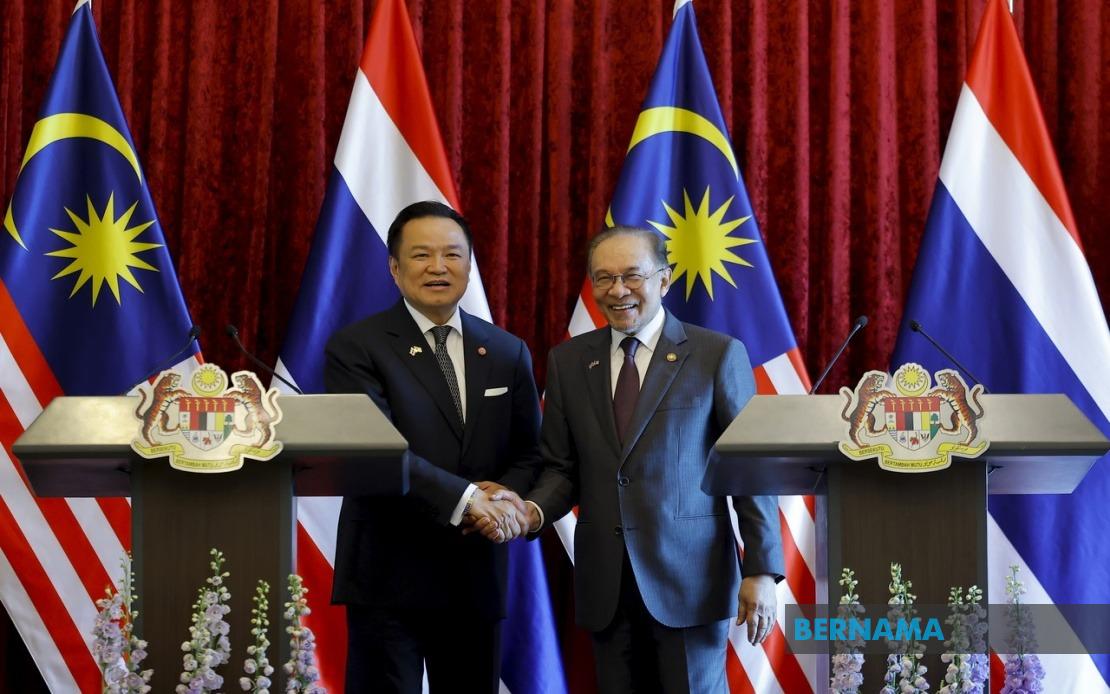
Malaysia and Thailand have committed to accelerating several cross-border infrastructure initiatives and establishing dedicated special economic zones along their shared frontier, with both nations setting an ambitious bilateral trade target of US$30 billion by 2027. The announcement came following substantive discussions between Prime Minister Datuk Seri Anwar Ibrahim and Thailand Prime Minister Anutin Charnvirakul in Putrajaya on July 9, signalling renewed momentum in deepening one of Southeast Asia's most strategically significant bilateral relationships.
At a joint press conference, Anwar characterised the discussions as producing tangible outcomes across multiple cooperation domains. He emphasised that Malaysia and Thailand, despite their geographical proximity and intertwined histories, recognise substantial untapped potential in expanding economic collaboration. The bilateral agenda extends beyond traditional trade metrics to encompass cultural, investment, and people-to-people dimensions that require deliberate policy coordination and institutional reform at the frontier.
Central to the partnership's trajectory are streamlined border procedures that would reduce friction in cross-frontier commerce. Both governments have committed to facilitating immigration and customs operations through technological modernisation and procedural harmonisation. Such measures directly address longstanding complaints from businesses operating across the border, where customs delays and administrative inconsistencies have historically created inefficiencies that suppress trade volumes and discourage regional investment.
The establishment of special border economic zones represents a more transformative initiative. These designated areas would offer preferential regulatory frameworks, tax incentives, and infrastructure investments designed to attract manufacturing, logistics, and services operations that serve both domestic markets and the broader Southeast Asian region. Such zones have proven effective in other bilateral contexts, particularly in generating employment in border communities and creating agglomeration effects that stimulate broader economic development.
The infrastructure acceleration programme encompasses several specific projects connecting Malaysian and Thai border towns. The planned visit to Bukit Kayu Hitam and Sadao following the formal bilateral talks underscores the government's intention to demonstrate tangible commitment to frontier communities often marginalised in national development strategies. Such political symbolism matters in regions where cross-border populations frequently experience infrastructure and service deficits relative to major urban centres.
Achieving the US$30 billion trade target requires sustained execution across multiple fronts. Current bilateral trade volumes fall substantially short of this ambitious figure, reflecting persistent structural barriers including inconsistent regulatory standards, infrastructure gaps, and limited integration of supply chains. The timeline to 2027 provides approximately three years to implement major initiatives, requiring rapid institutional coordination and sustained political commitment from both administrations.
Thailand's participation in these initiatives reflects broader strategic considerations within the ASEAN framework. Enhanced Malaysia-Thailand cooperation strengthens the entire region's economic resilience and reduces dependency on external partners. For Thailand, improved border connectivity enhances access to Malaysia's ports and developing southern industrial corridors. For Malaysia, deepened engagement with Thailand's northern economic zones creates opportunities for Malaysian firms to integrate into Thai production networks and expand market reach into Myanmar and Laos through Thai territory.
The special economic zones carry particular significance for Malaysia's northern states, where development trajectories have lagged compared to Selangor and other western corridor regions. Cross-border economic integration offers pathways for Kedah, Perlis, and Kelantan to transition from primary commodity dependence toward higher-value-added manufacturing and services. Thai investors possess proven expertise in food processing, automotive components, and electronics manufacturing that could transfer to Malaysian facilities, creating employment and tax revenue for state governments.
Charnvirakul's personal engagement in border region visits signals Thailand's seriousness in pursuing these initiatives beyond diplomatic rhetoric. Thai governments have periodically proposed cross-border development schemes, but inconsistent follow-through has generated scepticism among Malaysian officials and business stakeholders. This visit's structure, extending to frontier towns rather than remaining confined to capital-city protocols, demonstrates commitment to addressing practical implementation challenges rather than merely signing ceremonial agreements.
Regional observers note that Malaysia-Thailand cooperation gains additional importance amid evolving geopolitical dynamics in Southeast Asia. Stronger bilateral ties and integrated economic structures deepen ASEAN cohesion and provide counterweight to external pressures from larger powers. Cross-border infrastructure and economic zones create shared prosperity that reduces incentives for bilateral disputes and builds constituencies within both nations favouring continued cooperation.
Successful implementation will require navigating several practical challenges. Border communities along the Malaysia-Thailand frontier possess distinct characteristics including significant informal trade networks, cross-border employment patterns, and family connections that shape local economies in ways not always reflected in official statistics. Any formal economic zone development must accommodate these existing realities rather than displacing established relationships and livelihoods.
The ambitious timeline and specific numerical target suggest both governments recognise political benefits in demonstrating tangible achievements. Malaysian voters expect visible returns from foreign economic initiatives, while Thai stakeholders increasingly demand evidence that development benefits accrue to provincial regions rather than concentrating in Bangkok and central Thailand. The Bukit Kayu Hitam and Sadao visit provides platforms for both leaders to address these constituencies directly.
Longer-term success depends on embedding these initiatives within broader ASEAN integration frameworks and ensuring compatibility with existing trade agreements. The Regional Comprehensive Economic Partnership and other multilateral arrangements create opportunities for Malaysia-Thailand projects to generate spillover benefits throughout Southeast Asia. Conversely, integration failures could undermine confidence in regional cooperation mechanisms more broadly. Both governments clearly recognise that their bilateral success carries implications extending well beyond their respective borders.

