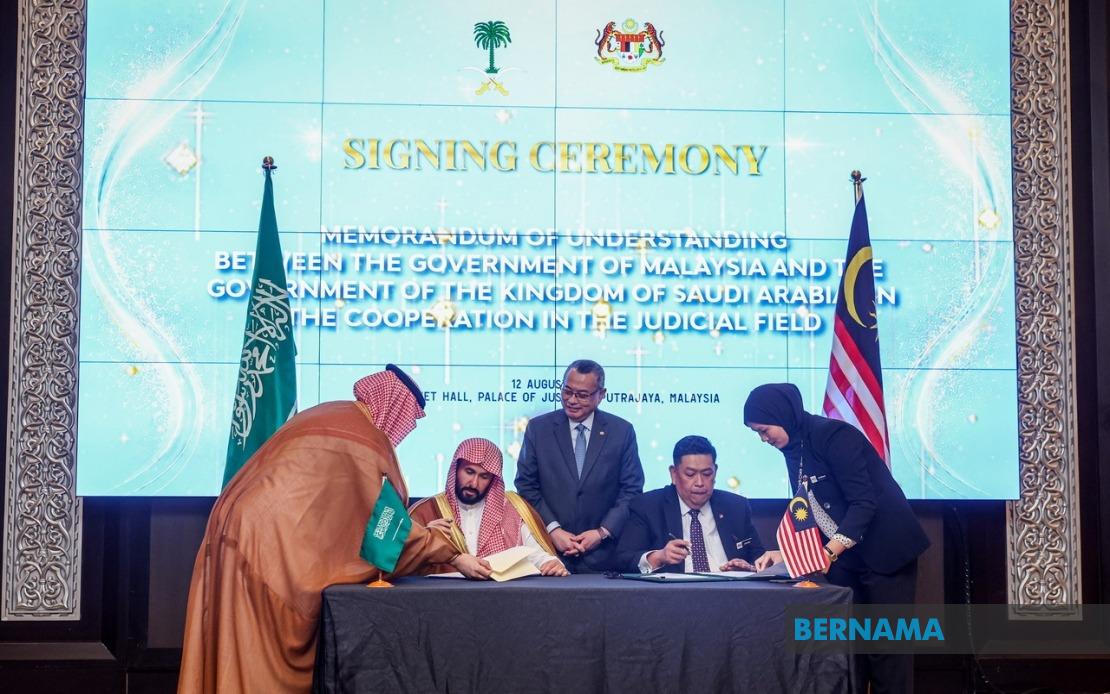
Malaysia and Saudi Arabia have formalised a landmark judicial cooperation agreement, with senior officials from both nations signing a memorandum of understanding at the Palace of Justice in Putrajaya on August 12. The accord represents a structured commitment to deepen institutional engagement between the two countries' court systems and legal frameworks, reflecting decades of diplomatic partnership and mutual interest in modernising justice administration across the region.
Chief Registrar of the Federal Court of Malaysia Azhaniz Teh Azman Teh and Saudi Arabian Minister of Justice Sheikh Dr Waleed Mohammed Alsmani affixed their signatures to the document in the presence of Chief Justice Tun Wan Ahmad Farid Wan Salleh. This ceremonial signing underscored the significance both nations attach to the agreement, positioning it as a milestone in bilateral relations rather than a routine administrative formality. The timing coincided with Sheikh Dr Waleed's official visit to Malaysia, providing an opportunity to discuss judicial matters at the highest levels.
The framework established by the MoU encompasses multiple dimensions of judicial cooperation. Civil case management practices will be shared, allowing both judiciaries to learn from each other's approaches to case flow, trial scheduling, and docket management. Judicial technology and digitalisation feature prominently, reflecting a global trend towards modernising court operations through electronic systems. Additionally, the agreement facilitates the exchange of practical experience, allowing judges and court administrators to observe how each country handles specific legal challenges. Regular institutional visits and ongoing dialogue sessions will maintain momentum in the relationship.
One particularly notable focus area is Malaysia's specialised approach to sexual offences against children. During Sheikh Dr Waleed's visit, Malaysian judicial officials presented insights into how the country's courts handle such sensitive cases, combining legal rigour with child-centred procedures designed to minimise trauma to young victims. This knowledge-sharing extends Malaysia's regional leadership on child protection jurisprudence and demonstrates the country's commitment to addressing one of the most pressing challenges facing modern justice systems across Southeast Asia and the Middle East.
The e-Court system emerged as another centrepiece of discussion during the visit. Malaysia's digital court infrastructure, which has steadily expanded over recent years, offers valuable lessons for Saudi Arabia's own modernisation efforts. The Malaysian judiciary's experience in transitioning paper-based processes to digital platforms—from electronic filing to remote hearings and virtual court sessions—provides a tested roadmap that could accelerate Saudi Arabia's technological advancement. Such digitalisation efforts not only improve efficiency but also enhance access to justice for citizens in geographically dispersed areas.
For Malaysia, the agreement reinforces the country's position as a thought leader in judicial administration within the Muslim-majority world and Southeast Asia more broadly. Regular engagement with Saudi Arabia's judiciary elevates Malaysia's profile internationally and creates opportunities for Malaysian judges and court professionals to participate in comparative law discussions at a higher diplomatic level. These exchanges build professional networks that can facilitate collaboration on other legal matters, from commercial disputes to cross-border enforcement of judgments.
The MoU's emphasis on knowledge-sharing and institutional development reflects contemporary challenges facing judiciaries worldwide. Both Malaysia and Saudi Arabia grapple with court congestion, the need for speedier case resolution, and the demand to leverage technology without compromising judicial independence or the quality of justice. By establishing formal mechanisms for dialogue, the agreement creates space for exploring solutions collaboratively rather than in isolation.
Saudi Arabia's interest in Malaysian judicial practices also carries implications for the broader Gulf region. The kingdom's Vision 2030 reform agenda includes substantial modernisation of legal and judicial institutions. Saudi officials' engagement with Malaysia's systems suggests the kingdom is actively benchmarking against diverse legal traditions, not only Western models. This openness to learning from Southeast Asian judicial experiences could influence how Saudi Arabia shapes its own court modernisation strategy, potentially impacting the entire Gulf Cooperation Council region.
From a diplomatic perspective, the MoU exemplifies how judicial cooperation can complement political and economic ties between nations. Malaysia and Saudi Arabia maintain substantial trade relationships, with Saudi investment in Malaysian projects and Malaysian workers employed across the Gulf. Judicial collaboration ensures that legal frameworks supporting these economic ties remain robust and mutually understood. Should commercial disputes or contract enforceability issues arise, stronger judicial relationships facilitate smoother resolution mechanisms.
The implementation phase will prove crucial to the agreement's success. Both nations will need to designate focal points, schedule regular dialogue sessions, and identify specific cases or judicial procedures suitable for study missions. The commitment to institutional visits suggests that judges and court administrators will have opportunities to observe court operations firsthand, a more effective learning method than mere documentation review.
Looking forward, this MoU could serve as a foundation for expanded cooperation. Future areas might include mutual legal assistance treaties, judicial training exchanges, or collaborative research on emerging legal issues affecting Muslim-majority nations. As Southeast Asia and the Middle East navigate digitalisation, cyber-crime, and transnational commercial disputes, deeper judicial cooperation becomes increasingly valuable.
The agreement signals Malaysia's maturation as a regional hub for judicial innovation and a credible partner for countries seeking to modernise their legal systems. It also demonstrates Malaysia's capacity to forge meaningful international partnerships based on shared professional interests rather than mere diplomatic protocol. For both nations, the MoU represents an investment in institutional excellence and mutual respect for each other's legal traditions.

