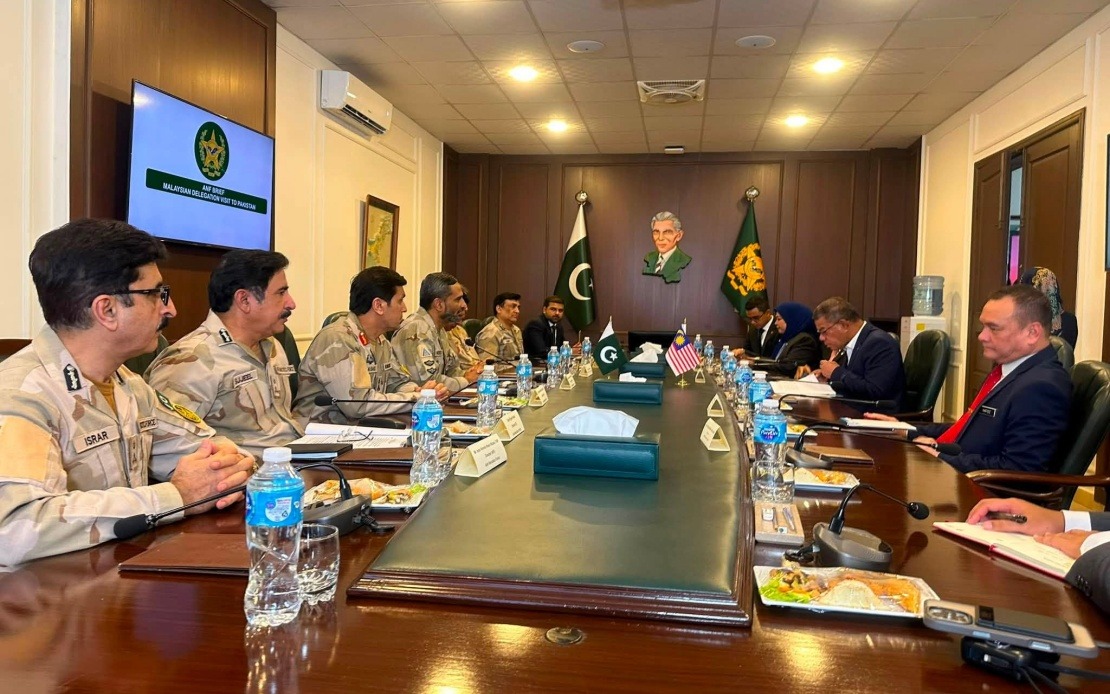
Home Minister Datuk Seri Saifuddin Nasution Ismail has signalled Malaysia's commitment to a formal Memorandum of Understanding with Pakistan designed to tackle the increasingly intricate challenge of international drug trafficking. During an official visit to Islamabad this week, Saifuddin Nasution engaged with Pakistan's Anti-Narcotics Force leadership, including Director-General Major General Abdul Moeed, to establish a structured framework that moves beyond conventional bilateral agreements and creates enforceable mechanisms for sustained cooperation.
The proposed MoU reflects a recognition that modern narcotics threats transcend geographical boundaries and demand coordinated responses at the international level. The proliferation of synthetic drugs, particularly methamphetamine, has fundamentally altered the nature of trafficking challenges faced by Malaysia and its regional neighbours. Unlike traditional heroin operations, which follow established supply routes, synthetic drug networks operate with greater flexibility and utilise more decentralised production and distribution methods. This evolution requires intelligence agencies and law enforcement bodies to adopt correspondingly sophisticated countermeasures that depend heavily on real-time information sharing and coordinated cross-border operations.
Pakistan's geographical position along trafficking corridors originating from Afghanistan gives it particular strategic importance for Malaysia's drug enforcement efforts. While Afghan narcotics have historically flowed westward toward Iran and Central Asia, increasing volumes now traverse Pakistani territory en route to South Asian markets and, crucially, onward to East and Southeast Asia. For Malaysia, which sits at the terminus of many such routes, understanding and disrupting supply chains at their earliest stages represents a more efficient use of enforcement resources than attempting interception within national waters or airspace. The MoU framework acknowledges that comprehensive drug control requires upstream intervention at source regions and transit hubs.
Saifuddin Nasution emphasised during his visit that effective cooperation cannot remain confined to diplomatic paperwork or high-level agreements that lack operational teeth. The proposed arrangement will establish mechanisms for intelligence sharing that go beyond formal requests and allow for rapid, real-time exchange of actionable information between law enforcement agencies. This intelligence-led approach enables both nations to coordinate operations targeting specific trafficking networks, rather than responding reactively to drug seizures. Historical precedent demonstrates the value of such arrangements: between 2012 and 2018, Malaysia and Pakistan jointly coordinated more than 28 cases, generating results that justified deeper institutional commitment.
The cooperation framework also encompasses training and expertise exchanges between Malaysian and Pakistani enforcement personnel. Such exchanges serve multiple purposes beyond simple knowledge transfer. They build personal relationships and trust between officers from both countries, establishing informal networks that facilitate faster communication during operational emergencies. They also allow Malaysian agencies to benefit from Pakistan's extensive experience in combating narcotics in a region bordering major production zones, while Pakistani counterparts gain insights from Malaysia's sophisticated port security and maritime interdiction capabilities. These reciprocal learning opportunities strengthen both nations' overall drug enforcement capacity.
Beyond narcotics control, Saifuddin Nasution's broader diplomatic agenda during his Islamabad visit addressed interconnected security and economic dimensions of bilateral relations. His meeting with Pakistan's Deputy Prime Minister and Foreign Minister Mohammad Ishaq Dar expanded the discussion to regional geopolitical challenges, reflecting Malaysia's understanding that security cooperation functions most effectively within a context of broader strategic alignment. The discussions acknowledged the role of dialogue and diplomacy in managing conflicts in the Islamic world and the specific importance of strengthening cooperation among Muslim-majority nations facing shared economic and security pressures.
The economic cooperation elements discussed during the visit, including potential agricultural imports and trade expansion, complement the security dimensions of the relationship. Food security through sourcing rice and meat from Pakistan addresses Malaysia's supply chain vulnerabilities while creating economic incentives for sustained partnership. Market access discussions and proposed visa facilitation mechanisms aim to deepen people-to-people connections, building civil society foundations that support official government cooperation. These broader engagement initiatives create resilience in bilateral relations, ensuring that cooperation persists even when political circumstances shift.
During separate meetings with Pakistan's Interior and Narcotics Control Minister Syed Mohsin Raza Naqvi, both sides agreed to establish a Joint Working Group that will coordinate security matters, narcotics control initiatives, and police training programmes. This institutional arrangement provides dedicated capacity for ongoing dialogue and problem-solving, rather than relegating bilateral issues to periodic high-level encounters. The Joint Working Group structure allows technical experts and operational commanders to develop detailed cooperation protocols, identify specific areas of mutual interest, and resolve implementation challenges that inevitably arise in cross-border operations. The signing of the International Transfer of Prisoners Agreement during this meeting further substantiates the commitment to practical cooperation, creating legal frameworks for managing individuals prosecuted under narcotics laws.
Saifuddin Nasution's visit to Pakistan's National Database and Registration Authority (NADRA) revealed Malaysia's interest in upgrading its own identity management and digital governance systems. NADRA chairman Lt Gen Muhammad Munir Afsar briefed the Malaysian delegation on biometric systems, digital identity solutions, and technology applications in border management and passport verification. Pakistan's experience in deploying these systems at scale, serving a population exceeding 230 million, offers instructive lessons for Malaysian authorities seeking to enhance security infrastructure while improving government service delivery. The intersection of digital identity systems and law enforcement represents a particular area of mutual interest, as biometric databases significantly enhance the ability to track transnational criminal suspects and prevent document fraud that facilitates drug trafficking.
Malaysia's MADANI Government initiative emphasises public sector digital transformation as a means of delivering direct benefits to citizens while enhancing security capabilities. The observations from NADRA's operations provide practical benchmarks for Malaysian agencies attempting to modernise legacy systems and integrate disparate databases. Enhanced digital identity verification particularly strengthens Malaysia's capacity to detect suspicious travel patterns and financial transactions associated with drug trafficking. When combined with the narcotics cooperation framework, improved digital systems create a comprehensive enforcement ecosystem that operates across borders while respecting the sovereignty of participating nations.
The timing of Saifuddin Nasution's Islamabad visit reflects Malaysia's strategic assessment that transnational narcotics threats demand sustained, high-level political engagement rather than routine bureaucratic coordination. The convergence of multiple cooperation initiatives—narcotics control, prisoner transfers, police training, and digital systems modernisation—demonstrates a holistic approach to bilateral security relationships. This comprehensive engagement strategy recognises that effective drug control requires complementary advances across multiple domains including intelligence collection, law enforcement operations, judicial processing, and international prisoner management.
For Southeast Asia more broadly, Malaysia's deepening cooperation with Pakistan signals that the region's drug enforcement challenges cannot be solved through intra-regional initiatives alone. The ASEAN approach to narcotics control, while important, addresses only the terminal stages of trafficking networks whose origins lie in distant production and transit zones. By establishing robust bilateral relationships with countries positioned along trafficking routes, Malaysia creates multiple enforcement layers that disrupt supply chains at various points. This strategy mirrors successful approaches in other regions where source countries, transit nations, and destination markets coordinate enforcement efforts through formal agreements and institutional mechanisms.

