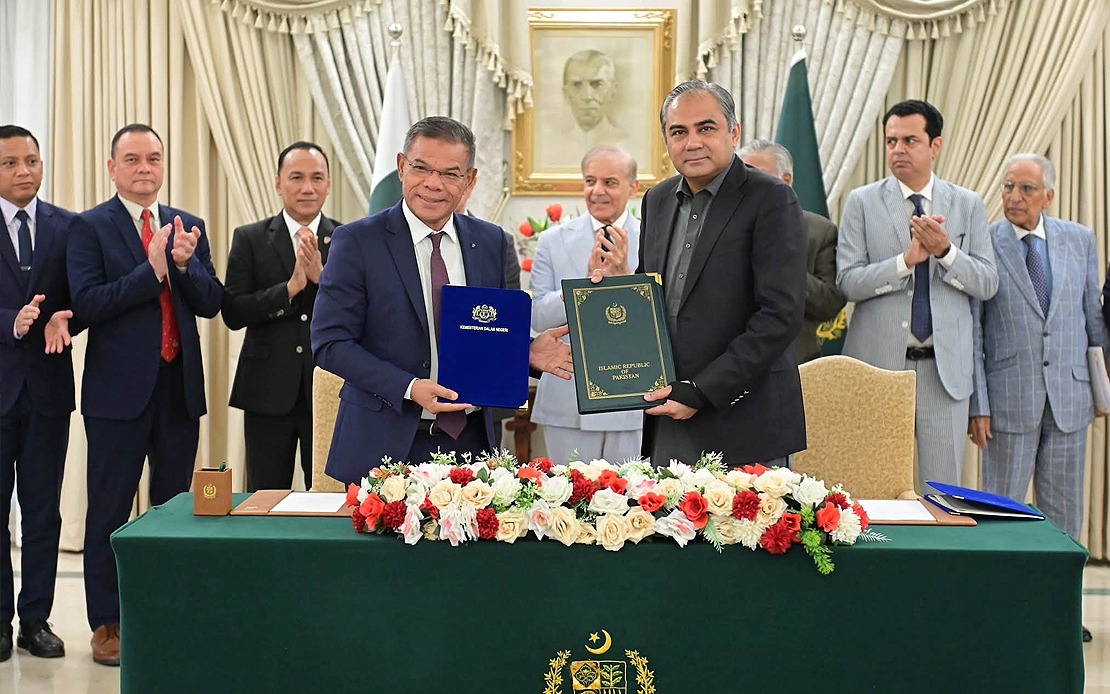
Malaysia and Pakistan have formalized a landmark agreement on prisoner transfers that will reshape how the two countries manage their incarcerated nationals, with Home Minister Datuk Seri Saifuddin Nasution Ismail signing the International Transfer of Prisoners (ITOP) Treaty in Islamabad on behalf of the Malaysian government. The treaty, executed in the presence of Pakistan Prime Minister Muhammad Shehbaz Sharif and signed by Pakistan's Interior and Narcotics Control Minister Syed Mohsin Raza Naqvi, represents a significant deepening of bilateral legal and security arrangements between nations that have maintained extensive people-to-people and institutional ties for decades.
The agreement emerged after five exhaustive rounds of diplomatic negotiations spanning from September 2025, involving multiple Malaysian agencies working in concert to produce a unified framework. The Home Ministry coordinated efforts alongside the Foreign Ministry, the Attorney General's Chambers, the Malaysian Prisons Department, and the Royal Malaysia Police, indicating the complexity and multi-dimensional nature of such accords. Cabinet approval arrived on May 13, demonstrating that the arrangement had secured backing from Malaysia's highest policy-making body before the formal signing ceremony took place at Pakistan's Prime Minister's Office.
At its core, the ITOP treaty establishes a reciprocal mechanism for prisoner repatriation that benefits nationals of both countries. Malaysian citizens currently serving sentences in Pakistani detention facilities will now have the legal pathway to return to Malaysia to complete the remainder of their sentences in their home nation's prison system. Conversely, Pakistani nationals incarcerated in Malaysia will gain equivalent rights to transfer back to Pakistan to serve out their remaining sentence duration within their domestic correctional infrastructure. This reciprocal framework underscores the principle of mutual benefit that characterizes modern bilateral agreements, ensuring neither country perceived itself as making unilateral concessions.
Beyond the mechanics of prisoner movement, the treaty addresses a humanitarian dimension that resonates across Southeast Asia and South Asia. By enabling prisoners to serve their sentences within their home countries, the arrangement acknowledges the profound psychological and social difficulties faced by foreign detainees separated from family networks, cultural contexts, and familiar institutional environments. Saifuddin Nasution emphasized that transfer to one's home nation allows prisoners to undergo rehabilitation within settings that align with their cultural values and personal circumstances, potentially enhancing the effectiveness of correctional programmes. This reflects a growing international recognition that rehabilitation outcomes often improve when prisoners maintain meaningful connections to their communities and cultures during incarceration.
The timing of this treaty carries particular significance for Malaysia, which like many Southeast Asian nations hosts a non-trivial population of foreign detainees in its prison system. Pakistani nationals represent a segment of this population, and the bilateral arrangement alleviates pressure on Malaysian correctional facilities while simultaneously reducing the humanitarian burden on Pakistani citizens serving time in Malaysia. For Pakistan, similar considerations apply, though Pakistan's interior and narcotics control focus suggests that narcotics trafficking cases likely constitute a meaningful portion of cases involving both nationalities.
The treaty's finalization also reflects the maturation of Malaysia-Pakistan relations beyond traditional diplomatic courtesies into substantive institutional cooperation. Home Minister Saifuddin Nasution characterized the signing as marking another milestone in a long-standing relationship, underscoring that security cooperation represents merely one thread in a broader tapestry of engagement between the two Muslim-majority nations. The emphasis on legal instruments suggests that both governments recognize the value of formal, binding frameworks that transcend individual government administrations and political cycles.
From a regional perspective, this agreement may serve as a template for other Southeast Asian and South Asian nations navigating the complexities of prisoner repatriation. Malaysia's experience managing diverse foreign national populations in its detention system, combined with the institutional frameworks already developed for cooperation with other nations, positions it as a potential model for bilateral prisoner transfer arrangements. The success of the Malaysia-Pakistan accord could encourage similar treaties throughout ASEAN and between ASEAN members and South Asian partners, contributing to a more cohesive regional approach to criminal justice administration.
The treaty also intersects with Malaysia's broader national security and law enforcement priorities. The involvement of the Royal Malaysia Police and Attorney General's Chambers in the negotiation process indicates that criminal prosecution standards, sentencing frameworks, and law enforcement cooperation protocols formed integral components of the discussions. This suggests the agreement encompasses not merely administrative prisoner movement but also dialogue on criminal justice principles and standards, potentially leading to enhanced cooperation on cases involving both nationalities that remain under active investigation.
Implementation of the treaty will require establishing detailed protocols governing prisoner assessment, transfer procedures, and the legal status of transferred individuals within their home systems. Questions around how sentences will be recognized, whether time served in one system counts fully toward the sentence in another, and dispute resolution mechanisms will all emerge during implementation phases. These practical details often prove as important as the treaty's headline provisions in determining its real-world impact on prisoners and the correctional systems of both nations.
Looking forward, the treaty signals both Malaysia and Pakistan's commitment to modernizing their bilateral relationship in ways that address contemporary transnational challenges. As populations become increasingly mobile and international criminal activity grows more sophisticated, prisoner transfer agreements become essential components of modern criminal justice cooperation. The Malaysia-Pakistan ITOP treaty positions both nations as progressive actors willing to engage substantive institutional reforms that benefit their citizens while strengthening their security partnership.

