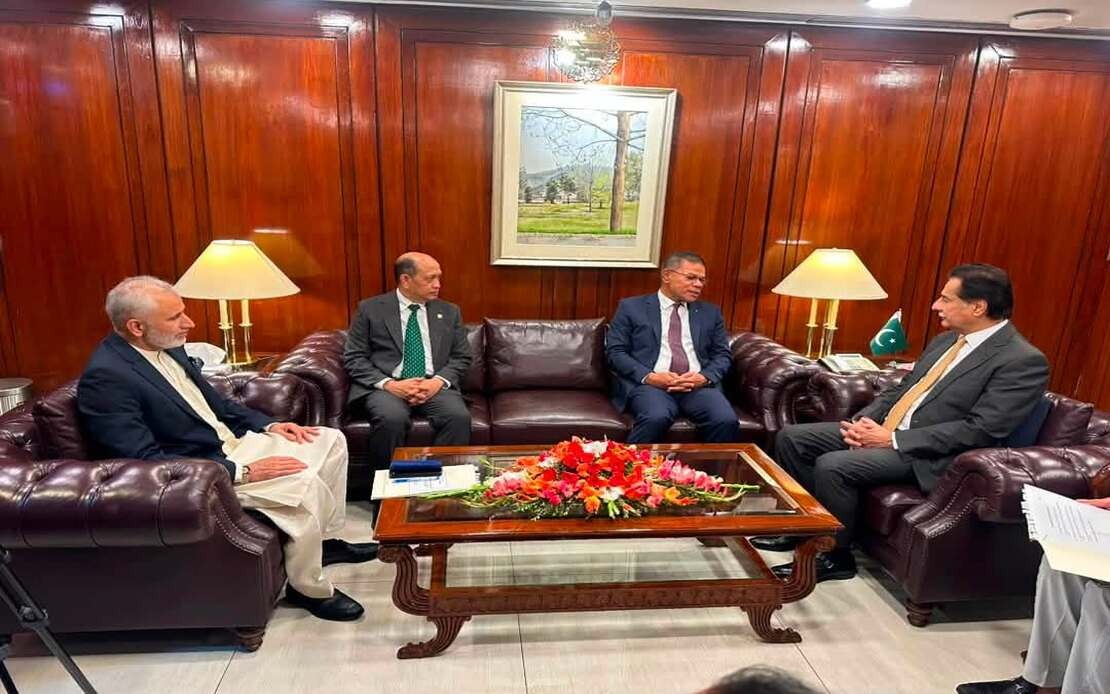
Malaysia and Pakistan have reaffirmed their mutual commitment to dialogue, diplomacy and peaceful conflict resolution as essential tools for navigating the complex geopolitical landscape confronting both nations and the broader region. The emphasis on these principles emerged during Home Minister Datuk Seri Saifuddin Nasution Ismail's official visit to Islamabad, where he engaged with senior parliamentary figures from the South Asian nation to explore areas of mutual strategic interest and strengthen institutional relationships.
During his discussions with Sardar Ayaz Sadiq, Speaker of Pakistan's National Assembly, and Syed Yousaf Raza Gilan, chairman of the Senate, Saifuddin Nasution highlighted Malaysia's approach to maintaining regional stability through coordinated engagement within ASEAN structures. This framework, built on extensive consultative mechanisms and respect for national sovereignty, has enabled Southeast Asian nations to address disputes without military escalation or coercive diplomatic tactics. The Malaysian Home Minister's message implicitly positions ASEAN's consensus-based model as a potential reference point for South Asian policymakers grappling with their own transnational security concerns.
The bilateral conversations focused substantially on strengthening parliamentary connections between the two countries, recognising that legislative institutions serve as important channels for sustained dialogue beyond executive-level engagement. Parliamentary diplomacy, as Saifuddin Nasution emphasised, creates sustained platforms for exchanging perspectives on contentious issues, building personal relationships among policymakers, and developing mutual understanding that transcends temporary political shifts. For Malaysia and Pakistan, whose relationship rests on shared Islamic heritage, historical trading networks, and complementary security interests, these institutional linkages provide continuity and stability to the partnership.
Saifuddin Nasution underscored the foundational elements underpinning Malaysia-Pakistan relations, pointing to the bedrock of trust, reciprocal respect and deep cultural connections binding ordinary citizens across both nations. These people-to-people connections, often rooted in educational exchanges, professional networks and family ties, form the bedrock upon which sustainable diplomatic relationships are constructed. When institutional friction or diplomatic disagreements arise, these civilian networks frequently provide the social capital necessary to prevent escalation and maintain constructive engagement at multiple societal levels.
The Malaysian delegation's visit to the Parliament Museum represented more than ceremonial courtesy. Saifuddin Nasution's engagement with Pakistan's parliamentary heritage—examining the constitutional development and institutional evolution that have shaped the nation's democratic processes—signals genuine interest in understanding the structural and philosophical foundations of Pakistani governance. This intellectual curiosity about comparative parliamentary systems reflects Malaysia's own experience navigating constitutional frameworks, federalism, and the balance between executive and legislative authority.
For Malaysia specifically, the emphasis on dialogue and diplomacy carries particular relevance given the nation's position as a moderate Muslim-majority country operating within a multipolar Southeast Asian environment. Kuala Lumpur has consistently advocated for multilateral approaches to regional security challenges, resisting pressure to align with any single geopolitical bloc. Pakistan, similarly, maintains strategic autonomy whilst managing complex relationships with neighboring powers and international stakeholders. The convergence of these diplomatic philosophies suggests both nations see value in a world order characterised by institutional mediation rather than spheres of influence.
The timing of this official visit reflects broader patterns in Malaysian foreign policy, wherein the government seeks to deepen engagement with key Asian partners beyond ASEAN's membership. Pakistan, as the world's most populous Muslim nation and a significant regional actor, occupies an important position in Malaysia's diplomatic architecture. Enhanced parliamentary and institutional connections with Islamabad align with Kuala Lumpur's long-term strategy of maintaining influential friendships across Asia whilst avoiding excessive dependence on any single power or alliance structure.
Saifuddin Nasution's articulation of Malaysia's commitment to constructive multilateralism through ASEAN provides a potential template for addressing contemporary security dilemmas that extend beyond Southeast Asia. In a world marked by great power competition, non-traditional security threats ranging from climate change to cyber-attacks, and transnational challenges including terrorism and human trafficking, the institutional frameworks and diplomatic practices that have enabled regional stability in Southeast Asia warrant consideration by policymakers elsewhere. Pakistan's capacity to benefit from such models depends on its ability to adapt ASEAN's consensus-building mechanisms to South Asian political realities and historical grievances.
The bilateral relationship between Malaysia and Pakistan extends into practical security cooperation, development assistance and commercial partnerships that complement diplomatic engagement at the highest levels. Enhanced parliamentary cooperation can facilitate discussion of these substantive issues whilst building support for bilateral initiatives among legislators responsible for authorising funding and ratifying agreements. When parliamentary bodies maintain active channels of communication, governments gain greater flexibility in implementing strategic decisions and addressing domestic political constituencies concerned about foreign policy directions.
Looking forward, the emphasis placed on dialogue and diplomacy during Saifuddin Nasution's Islamabad visit carries implications for Malaysia's broader regional role. As ASEAN seeks to maintain its centrality in an increasingly competitive Asia-Pacific environment, demonstrating successful models of peaceful cooperation and institutional diplomacy strengthens the bloc's soft power and moral authority. Pakistan's potential receptiveness to ASEAN-style approaches could enhance stability across South Asia and reduce risks of military escalation that might draw in regional or external powers whose involvement could destabilise the wider Asian system.
The meetings also underscored the enduring relevance of bilateral friendship in an era of shifting alliances and increasing strategic competition. Whilst formal multilateral organisations and security mechanisms command significant attention, sustained relationships between individual nations built on trust, cultural affinity and demonstrated commitment remain fundamental to international relations. For Malaysia and Pakistan, this visit represented an investment in continuity and deeper institutional embedding of their partnership, ensuring that diplomatic gains translate into concrete cooperation benefiting both societies.

