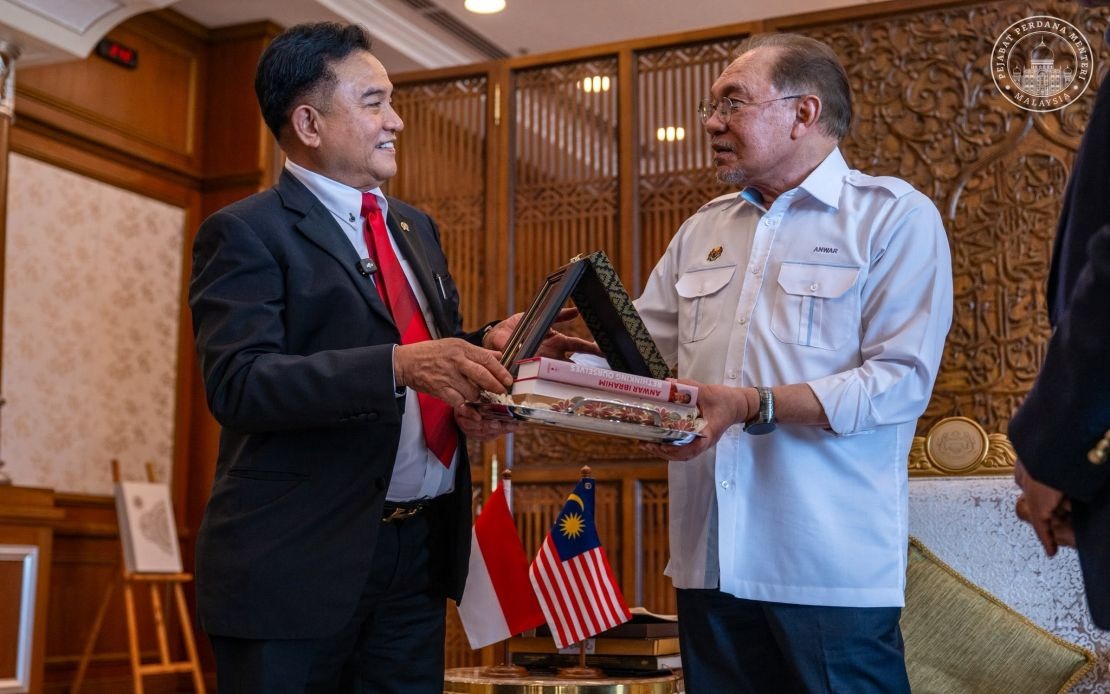
Prime Minister Datuk Seri Anwar Ibrahim has reaffirmed Malaysia's commitment to deepening institutional cooperation with Indonesia across legislative frameworks and governance structures, signalling a fresh momentum in bilateral relations between Southeast Asia's two largest Muslim-majority democracies. The commitment emerged following a high-level meeting at the Prime Minister's Office in Putrajaya, where Anwar received Prof Dr Yusril Ihza Mahendra, Indonesia's Coordinating Minister for Legal, Human Rights, Immigration and Correction, for discussions centred on expanding collaborative frameworks in areas of shared strategic importance.
The timing of this engagement reflects broader patterns in Malaysian-Indonesian relations, which have historically oscillated between periods of robust cooperation and occasional friction. By positioning legislative and governance matters as priority areas, both nations are addressing foundational institutional questions that undergird bilateral trade, security cooperation, and people-to-people connections. These conversations typically involve harmonising legal standards, improving regulatory coordination, and establishing mechanisms for expedited resolution of cross-border administrative matters that affect citizens and businesses in both countries.
Anwar, who holds the dual portfolios of Prime Minister and Finance Minister, underscored the importance of maintaining what he characterised as "close fraternal relations" between Malaysia and Indonesia. This language carries particular weight in Malaysian political discourse, where emphasis on Islamic brotherhood and cultural affinity with Indonesia has long formed a cornerstone of foreign policy rhetoric. However, the substance of such cooperation increasingly requires translating sentiment into tangible institutional mechanisms and legal frameworks that can withstand political transitions and administrative changes in either country.
The meeting between Anwar and Yusril Ihza Mahendra occurred within a context where both nations face overlapping challenges in governance modernisation. Indonesia, as the world's largest archipelago and third-most populous democracy, grapples with coordination challenges across its 34 provinces, while Malaysia manages complex federalist arrangements spanning 13 states and three federal territories. Experiences and best practices in legislative efficiency, anti-corruption frameworks, and digital governance infrastructure represent natural areas where knowledge-sharing could yield mutual benefits.
Cooperation in the legal and human rights sphere carries additional significance given regional geopolitical currents. As both nations engage with divergent international partners and navigate competing strategic interests, maintaining robust institutional channels serves as a stabilising force. The inclusion of immigration and correctional affairs in Yusril's portfolio highlights the practical dimensions of bilateral engagement—managing shared maritime boundaries, addressing transnational crime, and coordinating refugee and asylum policies require continuous diplomatic and bureaucratic coordination.
For Malaysia's business community and investors, improved governance cooperation with Indonesia translates into clearer regulatory pathways and reduced transaction costs. Malaysian companies operating extensively throughout Indonesia benefit from more predictable legal environments and streamlined administrative procedures. Similarly, Indonesian investment into Malaysia, particularly in sectors such as agriculture, manufacturing, and services, becomes more attractive when supported by transparent and harmonised governance standards.
The emphasis on legislation as a priority area suggests both governments may be exploring mechanisms for closer alignment on specific regulatory domains. This could encompass corporate law, intellectual property protections, or environmental standards—areas where harmonisation reduces compliance burden and facilitates smoother cross-border operations. Such technical cooperation, while less visible than high-profile political summits, often generates more tangible benefits for ordinary citizens and entrepreneurs than ceremonial declarations of friendship.
Yusril Ihza Mahendra's visit also carries symbolic value in reinforcing institutional channels outside of presidential or prime ministerial summits. By elevating engagement to the level of coordinating ministers responsible for legal affairs, both nations signal that bilateral cooperation is not merely a function of top leadership chemistry but embedded within bureaucratic structures designed to persist across political cycles. This institutional resilience proves especially valuable in Southeast Asia, where leadership transitions can sometimes precipitate shifts in foreign policy emphasis.
The discussion of "various strategic areas of mutual interest" deliberately remains somewhat vague in official statements, reflecting diplomatic convention that allows space for expanding the agenda without committing to specific timelines or resource allocations. However, such language typically encompasses considerations around maritime security, labour migration protocols, disaster management coordination, and potentially enhanced judicial cooperation on matters ranging from commercial disputes to cross-border criminal investigations.
For regional observers, this renewed emphasis on Malaysia-Indonesia bilateral cooperation reflects broader trends in Southeast Asian geopolitics. As major powers compete for influence and regional architecture becomes increasingly contested, ASEAN's two most populous member states have clear incentives to maintain strong bilateral ties as ballast against external pressures. Deepening legislative and governance cooperation serves this strategic purpose while creating practical benefits that transcend political cycles.
The sustainability of such initiatives depends ultimately on implementation mechanisms and adequate resource allocation. Previous bilateral agreements between Malaysia and Indonesia have sometimes languished due to bureaucratic inertia, competing domestic priorities, or insufficient dedicated personnel. This time, formalising cooperation through specific legislative amendments, joint committees, or institutional arrangements would signal serious commitment beyond rhetorical affirmation.
Moving forward, observers should monitor whether this declared commitment translates into concrete deliverables such as harmonised standards, joint research initiatives, or exchange programmes for civil servants and legal professionals. Such tangible outcomes would demonstrate that the meeting represented a substantive recalibration of bilateral priorities rather than routine diplomatic courtesy.

