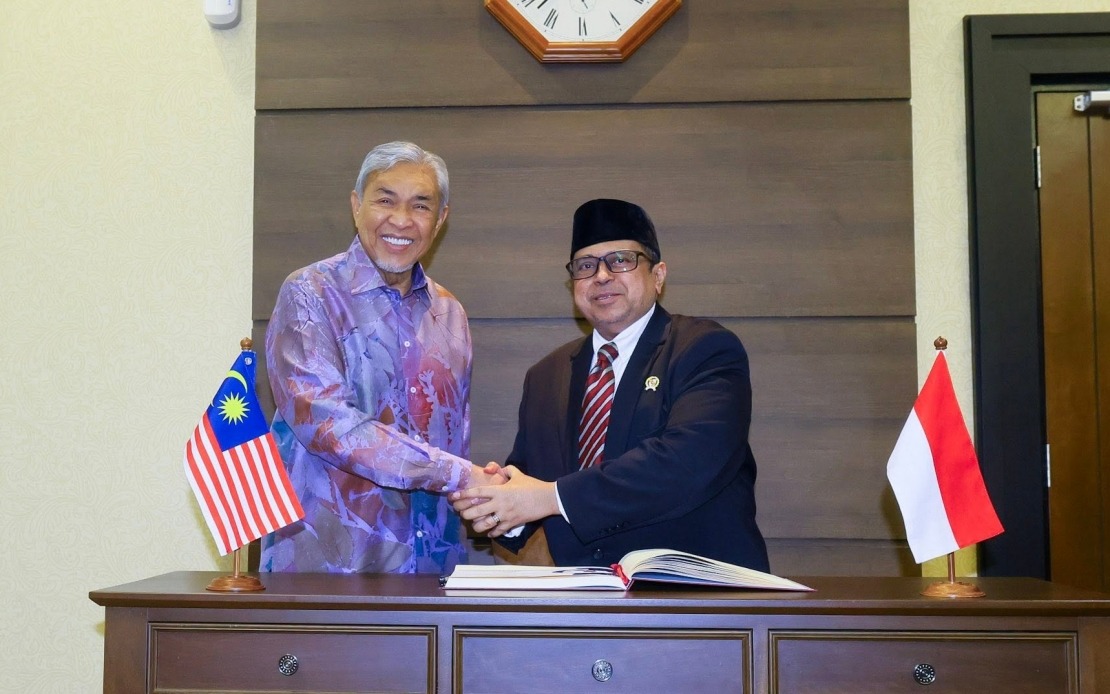
Malaysia and Indonesia have committed to intensifying their collaborative efforts across multiple economic fronts, with particular emphasis on advancing the halal industry, according to Deputy Prime Minister Datuk Seri Dr Ahmad Zahid Hamidi. The undertaking emerged from discussions held at the Parliament building between Malaysian officials and a high-level Indonesian delegation comprising the country's Ambassador to Malaysia, Raden Datuk Mohammad Iman Hascarya Kusumo, and the head of Indonesia's Halal Product Assurance Organising Body (BPJPH), Dr Ahmad Haikal Hassan. The bilateral engagement signals renewed momentum in leveraging shared Islamic values and economic interests to establish competitive advantages in one of the world's fastest-growing consumer segments.
During the courtesy meeting, both nations explored a comprehensive framework spanning halal ecosystem development, expanded bilateral trade, rural advancement initiatives, and workforce capability enhancement. The discussions extended beyond immediate commercial interests to encompass broader strategic architecture that could reshape how halal certification and trade operate across Southeast Asia and beyond. Ahmad Zahid, who chairs the Malaysia Halal Industry Development Council, underscored that the conversation reflected both nations' recognition of untapped potential within existing cooperative mechanisms and the necessity for more robust institutional structures.
Central to the partnership framework is the proposed establishment of three interconnected council structures designed to operate at different geographical scales. The Malaysia-Indonesia Halal Council (MIHC) would serve as the bilateral operational nucleus, facilitating direct commercial and regulatory coordination between the two largest Muslim-majority economies in Southeast Asia. This entity would handle immediate trade facilitation, standard harmonization, and investment promotion specific to the bilateral relationship. Beyond this, both countries envision the ASEAN Halal Council as a regional mechanism bringing together all ten Southeast Asian nations under unified certification and trading protocols, addressing the fragmented landscape that currently hampers intra-regional commerce in halal products.
The proposed World Halal Development Council represents the most ambitious dimension of the initiative, seeking to position the Malaysia-Indonesia partnership as a global standard-setter rather than merely a regional player. Such an institution would advocate for internationally recognized halal certification frameworks, potentially displacing existing ad-hoc approaches that vary dramatically across consumer markets in Europe, North America, and the Middle East. For Malaysian and Indonesian manufacturers and exporters, this elevation to global governance structures could translate into significant cost reductions and market access improvements, as businesses would no longer need to navigate incompatible certification regimes when entering diverse international markets.
The timing of this initiative reflects broader economic imperatives facing both nations. The global halal market was valued at approximately $1.9 trillion as of recent estimates, with projections suggesting continued double-digit annual growth as Muslim populations expand and purchasing power rises across Southeast Asia, Africa, and parts of Europe. Malaysia has long positioned itself as the halal industry leader in Asia through its Malaysia Halal Certification system and the Islamic Financial Services Board, but Indonesia's vast domestic market and manufacturing capacity represents a complementary asset. By formalizing institutional cooperation, both countries can consolidate their competitive position against emerging challengers from the Middle East and South Asia attempting to capture larger shares of the halal trade.
Harmonizing halal standards across Malaysia and Indonesia addresses a persistent irritant in bilateral commerce. Currently, products certified as halal in Kuala Lumpur sometimes face non-recognition or lengthy re-certification procedures in Jakarta, despite both nations following the same fundamental Islamic principles. This inefficiency creates unnecessary friction for manufacturers operating across borders and discourages investment in regional supply chain integration. A standardized framework would allow businesses to achieve single certification applicable across both markets, substantially lowering compliance costs and encouraging manufacturers to establish integrated production facilities that leverage comparative advantages in labor, raw materials, and logistics across the two countries.
The rural development component of the cooperation initiative carries particular relevance for smaller farmers and agribusinesses throughout both nations. Indonesia and Malaysia together produce substantial quantities of poultry, livestock, palm oil, spices, and processed foods destined for halal markets worldwide. By creating supportive infrastructure—including training programmes, technology transfer mechanisms, and credit facilities—both governments aim to enable rural producers to achieve halal certification and access premium international markets. This element addresses a significant gap, as many small-scale farmers currently lack the technical knowledge or financial resources required to meet stringent halal and food safety standards, thereby missing opportunities to participate in higher-value export sectors.
Human capital development emerges as another pillar with long-term strategic implications. The expansion of halal industry operations requires personnel trained in specialized domains including halal auditing, Islamic financial services, certification procedures, and supply chain management. By establishing coordinated educational and vocational training initiatives, Malaysia and Indonesia can develop a regional talent pool capable of managing increasingly sophisticated halal enterprise operations. This workforce mobility across borders would also strengthen people-to-people connections and deepen the cultural and economic integration between neighboring societies.
The reliance on existing bilateral ties as a foundation for deepened cooperation reflects pragmatic recognition of shared history and mutual trust. Malaysia and Indonesia have maintained diplomatic relations spanning decades, with numerous existing frameworks for cooperation in defense, diplomacy, and development. Extending these relationships into formal halal governance structures builds on established goodwill rather than attempting to construct new institutional relationships from scratch. However, translating diplomatic affection into functional integrated markets requires detailed negotiation of standards compliance, dispute resolution mechanisms, and intellectual property frameworks—domains where differences in regulatory philosophy have occasionally created friction.
For broader Southeast Asian readers and observers, this Malaysia-Indonesia initiative carries implications extending well beyond the two countries' direct interests. The proposed ASEAN Halal Council would establish mechanisms for coordinating policies across a region encompassing over 650 million people, with Islam representing the primary religion for approximately 240 million. Standardized regional frameworks could unlock significant trade growth within ASEAN, historically constrained by regulatory fragmentation. Simultaneously, the ambition to establish global influence through the World Halal Development Council reflects emerging assertiveness by Muslim-majority nations in establishing international standards rather than passively accepting externally imposed regulatory regimes.
Implementation success will ultimately depend on translating diplomatic commitments into concrete institutional arrangements with adequate funding, staffing, and enforcement authority. Previous Southeast Asian cooperative initiatives have sometimes faltered when moving from agreement to operational reality. The Malaysia-Indonesia leadership must ensure that the proposed councils receive sufficient budgetary allocation, technical expertise, and political priority to function effectively rather than becoming ceremonial bodies. Clear timelines for establishment, explicitly defined mandates, and measurable performance indicators will distinguish genuinely transformative initiatives from those representing merely symbolic cooperation.
The halal industry cooperation initiative arrives at a moment when both Malaysia and Indonesia are competing against other aspirants for leadership in Islamic finance and commerce. Saudi Arabia, the United Arab Emirates, and increasingly Turkey have invested substantially in halal certification bodies and Islamic financial institutions. By consolidating Southeast Asian resources and positioning the region as a unified player in global halal governance, Malaysia and Indonesia enhance their collective influence while creating tangible economic benefits for their respective manufacturing and agricultural sectors. The success of this partnership could establish a template for deeper ASEAN integration across other strategic sectors where collective action could yield disproportionate returns.

