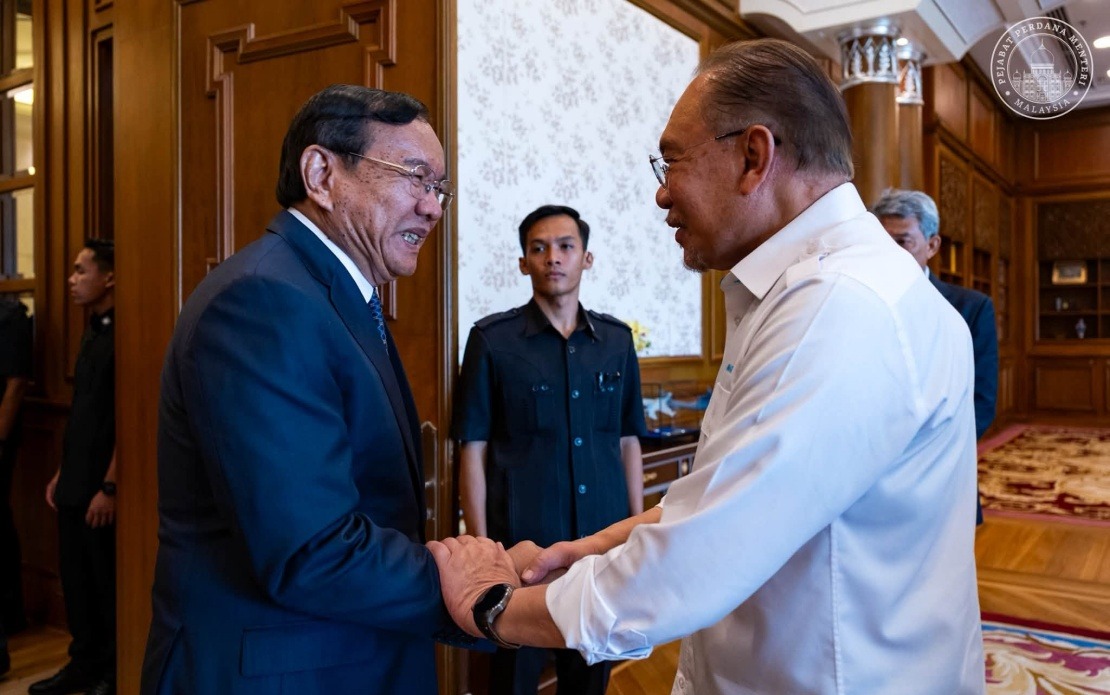
Malaysia and Cambodia are moving to deepen their bilateral partnership across an ambitious range of sectors, with Prime Minister Datuk Seri Anwar Ibrahim confirming the two nations have reaffirmed their commitment to strategic collaboration spanning the digital economy, artificial intelligence, the halal industry, food security and the development of human capital. The announcement comes as Cambodia's Deputy Prime Minister and Minister of Foreign Affairs and International Cooperation Prak Sokhonn makes a two-day official visit to Malaysia, signalling renewed momentum in the relationship between the two Southeast Asian neighbours.
During their discussions, both sides identified several emerging priority areas for enhanced partnership. The digital economy represents a particularly significant frontier for cooperation, given Malaysia's established fintech ecosystem and Cambodia's growing digital adoption across its urban centres. Artificial intelligence development emerged as another focal point, reflecting the region's broader recognition that AI competency will be essential for economic competitiveness in the coming decade. These technology-focused initiatives sit alongside more traditional sectors, particularly the halal industry where Malaysia has long maintained regional leadership, and food security—an area of mounting importance across Southeast Asia as climate pressures and demographic shifts reshape agricultural landscapes.
The strengthening of ties also extends to efforts to combat cross-border crime, a persistent challenge that affects both nations and the wider ASEAN region. Criminal networks operating across borders in human trafficking, drug smuggling, and illegal resource extraction impose substantial social and economic costs on member states. By formalising cooperation mechanisms in this area, Malaysia and Cambodia acknowledge that security challenges increasingly transcend national boundaries and require coordinated regional responses. This dimension of the partnership reflects a maturation in how ASEAN nations approach shared threats.
The Cambodian delegation's visit coincides with preparations for the Third Malaysia-Cambodia Joint Commission for Bilateral Cooperation, scheduled to convene on August 4. This formal mechanism provides the institutional framework through which the two governments translate broad commitments into concrete projects, allocate resources, and establish timelines for implementation. Joint commissions of this nature are crucial vehicles for moving beyond diplomatic rhetoric into actionable cooperation.
Looking further ahead, both nations are conscious that 2027 will mark the 70th anniversary of their diplomatic relations. This milestone provides both symbolic and practical impetus for the current cooperation push. Rather than allowing the anniversary to pass as a mere historical notation, Malaysia and Cambodia are using the decade between now and 2027 to build a stronger foundation for the next chapter of their bilateral relationship. This forward-looking perspective suggests that current initiatives are intended as more than short-term diplomatic gestures.
As ASEAN member states, Malaysia and Cambodia share institutional responsibilities that extend beyond their bilateral relationship. Both countries are signatories to the ASEAN Charter and committed to the ASEAN Community Vision 2045, which articulates a collective aspiration for regional peace, stability, and prosperity. PM Anwar's remarks emphasising these shared responsibilities suggest that bilateral cooperation is being framed not merely as a transaction between two nations, but as a contribution to broader regional objectives. This positioning aligns bilateral initiatives with the larger ASEAN architecture, potentially unlocking spillover benefits through ASEAN institutions and the broader community.
The emphasis on human capital development in the cooperation framework reflects recognition that technological advancement and economic transformation ultimately depend on the skills, education, and expertise of populations. Both nations face demographic and educational challenges that could constrain their development prospects. Collaborative programmes in vocational training, higher education partnerships, and professional exchange could help both sides address these constraints while building deeper people-to-people connections that underpin sustainable diplomatic relations.
PM Anwar's expression of hope that Malaysia-Cambodia relations will continue strengthening and create opportunities for mutually beneficial cooperation carries particular significance given Malaysia's broader engagement strategy in Southeast Asia. Under his administration, Malaysia has emphasised regional stability and economic cooperation as cornerstones of its foreign policy. The renewed focus on Cambodia reflects this orientation and suggests that bilateral ties, which sometimes receive less public attention than Malaysia's relationships with larger regional powers, are being elevated in policy priority.
The sectors identified for cooperation—digital economy, AI, halal, food security, human capital—represent areas where Malaysia possesses established expertise or institutional advantages that could genuinely benefit Cambodia, while Cambodia's own strategic location and development trajectory offer opportunities for Malaysian businesses and investors. This apparent complementarity suggests that the cooperation framework is built on more than diplomatic courtesy; substantive economic logic underpins the partnership.
From a Malaysian perspective, strengthening ties with Cambodia serves multiple objectives. It reinforces Malaysia's position within ASEAN as a stable, cooperative partner committed to regional integration. It creates commercial opportunities for Malaysian enterprises in Cambodia's growing economy. It contributes to regional stability and predictability, which supports Malaysia's broader economic and security interests. These practical dimensions make the bilateral engagement not merely a matter of diplomatic protocol but of tangible national interest, suggesting that current commitments are likely to translate into sustained effort rather than remaining aspirational statements.

