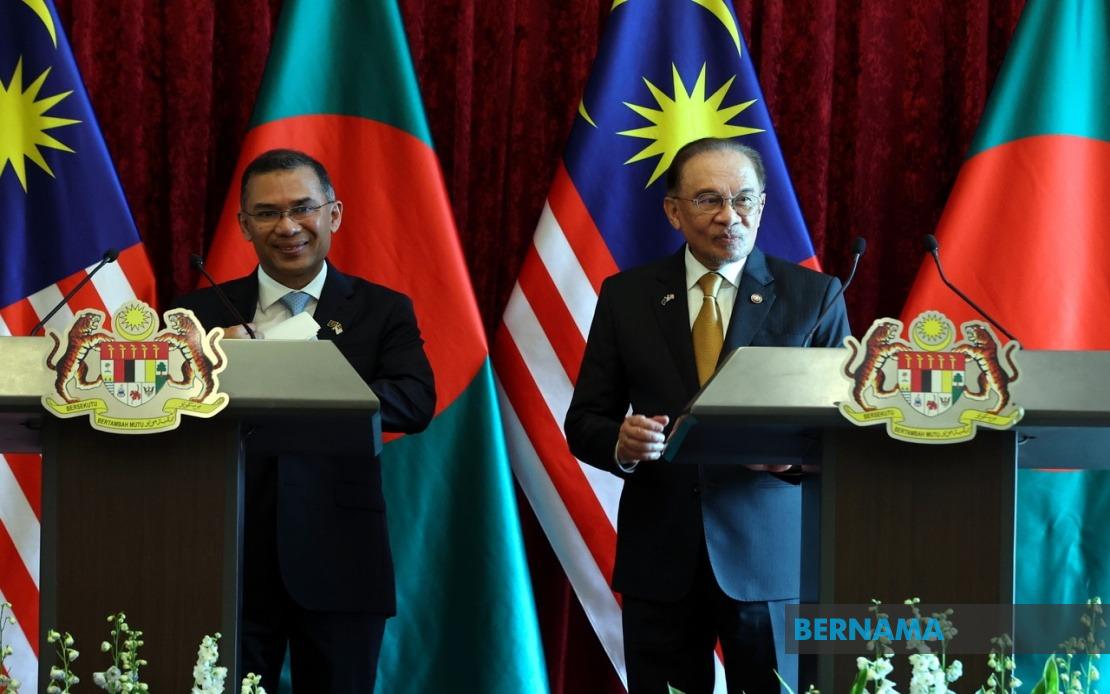
Malaysia and Bangladesh have reaffirmed their alignment on critical global affairs during Bangladesh Prime Minister Tarique Rahman's visit to Putrajaya, with Malaysian Prime Minister Datuk Seri Anwar Ibrahim emphasising both nations' commitment to supporting the Palestinian cause and pursuing stability across volatile regions. Speaking at a joint press conference on Monday following Rahman's arrival the previous day, Anwar outlined the breadth of bilateral accord, touching on the humanitarian crisis in Gaza, the broader geopolitical tensions affecting the Gulf, and diplomatic relations with Iran.
Rahman's trip represents his maiden official visit abroad since assuming the office of Bangladesh Prime Minister in February this year, signalling the strategic importance both Kuala Lumpur and Dhaka place on strengthening their relationship at this particular juncture. The timing is noteworthy given the volatile international climate, with the Middle East conflict continuing to dominate global affairs and drawing increasingly polarised responses from nations across Asia and beyond.
Anwar framed the visit as an extension of familial bonds between Malaysia and Bangladesh, two Muslim-majority nations with deepening people-to-people and institutional connections. His characterisation of the relationship as one rooted in "brotherhood" reflects the cultural and religious ties that have historically anchored their diplomatic engagement, even as geopolitical interests have diverged in certain areas.
The convergence on Palestine and Gaza reflects the shared moral compass of both leaderships on the Israeli-Palestinian conflict, an issue that continues to galvanise public opinion across the Muslim world and shape foreign policy priorities. Malaysia, under Anwar's administration, has maintained a consistent vocal stance on Palestinian rights, while Bangladesh similarly upholds this position as a core element of its foreign policy identity. The joint affirmation underscores how this issue remains a touchstone for solidarity among Southeast Asian and South Asian Muslim-majority states.
Beyond the Israeli-Palestinian question, the two leaders' synchronisation on Gulf region stability and Iran policy suggests a coordinated approach to managing one of the world's most tension-laden neighbourhoods. Malaysia's strategic location as a major maritime trading hub means Gulf security directly impacts its economic interests, while Bangladesh's position astride crucial shipping routes similarly binds its fortunes to regional equilibrium. This practical interdependence reinforces their diplomatic alignment.
Anwar's emphasis on continued multilateral engagement to "ensure peace" reflects a broader diplomatic philosophy that prioritises dialogue over isolation. Both Malaysia and Bangladesh are positioned as moderate voices within international forums, and their joint commitment signals an intent to work through established diplomatic channels and partnerships rather than adopt confrontational stances. This approach carries implications for how Southeast Asia might navigate increasingly polarised great-power competitions.
The Prime Minister's gratitude towards Rahman, coupled with his reflection on "enlarged family" and "brotherly relations," speaks to an intentional cultivation of South Asian-Southeast Asian ties at a moment when these regional bridges warrant strengthening. As Myanmar's instability continues to reverberate through the region and economic pressures mount on developing nations, the Malaysia-Bangladesh relationship gains renewed significance as a stabilising force.
Bangladesh's own recent political transitions and internal developments have sometimes occupied international attention, yet this visit demonstrates Anwar's confidence in engaging the new Rahman administration as a partner for advancing shared regional interests. The fact that Rahman chose Malaysia for his first official overseas visit underscores reciprocal commitment to deepening these bonds.
The bilateral cooperation extends beyond rhetorical alignment on global questions. Both nations have ongoing collaborations in trade, defence, education, and cultural exchanges, areas that provide substance to the diplomatic statements made during such high-level visits. Rahman's presence in Malaysia offers an opportunity to review these practical dimensions of engagement and chart new pathways for mutual benefit.
Looking ahead, the coordination between Malaysia and Bangladesh on international issues may influence how Southeast Asia and South Asia position themselves within broader Indo-Pacific discussions. As major powers compete for influence in the region, smaller and mid-sized nations like these two increasingly leverage their partnerships to amplify their collective voice and protect their interests against external pressures.
The visit also carries symbolic weight for domestic audiences in both countries. In Malaysia, it demonstrates Anwar's government's commitment to strengthening ties across the broader Islamic world and positioning the nation as a voice for developing nations on justice-related matters. In Bangladesh, Rahman's inaugural overseas journey to Malaysia signals continuity in foreign policy orientation while potentially indicating a preference for deepening South Asian-Southeast Asian cooperation over exclusive alignment with other powers.