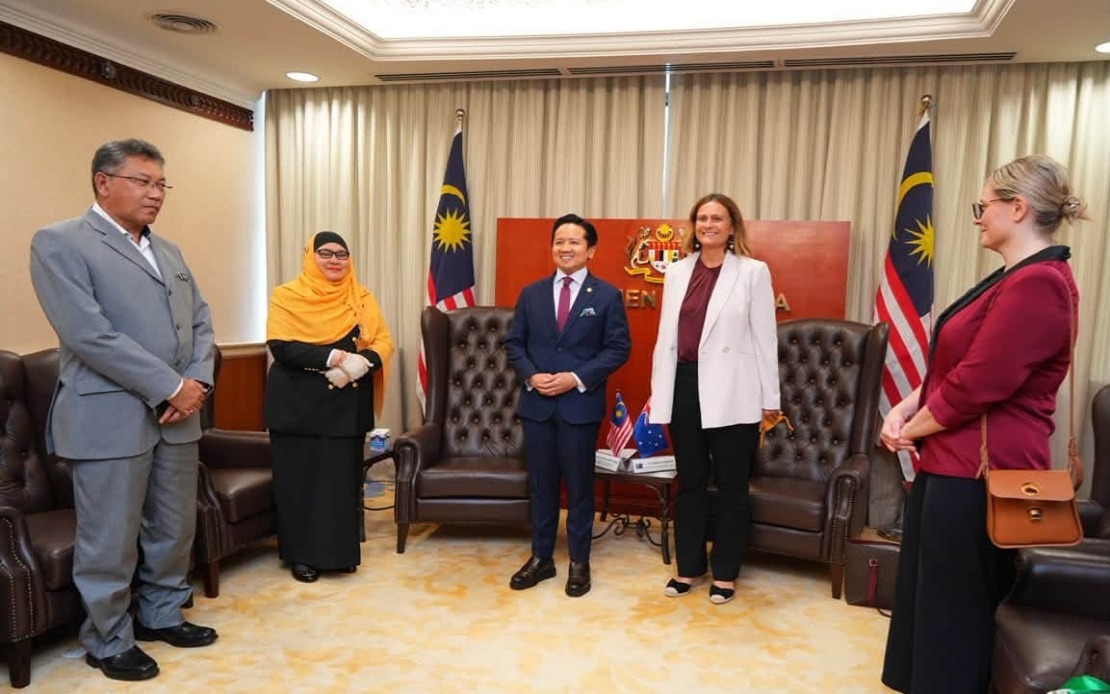
Malaysia and Australia are moving to deepen their strategic partnership in the critical minerals sector, with discussions centred on developing a comprehensive domestic supply chain for rare earth elements and establishing advanced manufacturing capabilities within the country. The two nations held talks at Parliament in Putrajaya to chart a path toward closer collaboration that would leverage Australia's technical prowess alongside Malaysia's commitment to sustainable resource management and industrial development.
The meeting between Natural Resources and Environmental Sustainability Minister Datuk Seri Arthur Joseph Kurup and Australian High Commissioner to Malaysia Danielle Heinecke underscored the growing importance of rare earth elements and critical minerals to regional economic competitiveness. These materials form the backbone of modern technology, from renewable energy systems to consumer electronics and defence applications, making their secure supply and domestic processing capacity increasingly vital for nations seeking technological sovereignty and reduced supply chain vulnerability.
A central pillar of the proposed cooperation involves neodymium magnet manufacturing, a downstream application that represents significantly higher value addition than raw mineral extraction or even refined rare earth oxides. By developing domestic production capabilities, Malaysia can capture more economic benefit from its natural resources while building technological expertise that attracts investment and creates skilled employment opportunities. This aligns squarely with Malaysia's National Mineral Policy 3, which explicitly prioritises moving beyond commodity extraction towards integrated value chain development within the country's borders.
Both countries also addressed the technically challenging issue of processing residues, particularly neutralisation underflow residue, which is generated during rare earth separation and presents environmental management obstacles. Australia's accumulated experience in handling such industrial byproducts could provide Malaysia with critical know-how to develop responsible processing methods that meet stringent environmental standards. The exchange of best practices in this domain represents a practical dimension of cooperation that could accelerate Malaysia's capacity to manage industrial sustainability challenges inherent to rare earth production.
The bilateral discussions reflect a broader strategic realignment in the Indo-Pacific region, where nations are reconsidering their approach to critical minerals supply chains in light of geopolitical tensions and supply concentration risks. With China currently dominating global rare earth refining and magnet manufacturing, alternative sources and processing hubs have become strategically attractive to Western-aligned nations and their partners. Malaysia's geographic location, existing processing infrastructure, and rich mineral endowments position it as a logical alternative hub, particularly for Australian mineral producers seeking to develop value-added processing outside China's orbit.
The cooperation framework also encompasses hazardous waste management and marine ecosystem conservation, reflecting a comprehensive approach to resource development that goes beyond simple extraction economics. These dimensions carry particular significance for Malaysia, which faces pressure to balance resource utilisation with environmental preservation, especially given the sensitivity of coastal ecosystems and marine biodiversity. Partnering with Australia on these governance dimensions can help establish best-practice standards that satisfy both commercial imperatives and environmental stewardship.
Climate financing and Malaysia's positioning ahead of the United Nations Climate Change Conference, with COP31 featuring prominently in discussions, reveals how critical minerals cooperation connects to broader climate action objectives. Rare earth elements and the technologies they enable—particularly permanent magnet motors for electric vehicles and generators for offshore wind farms—are essential to decarbonisation pathways. By securing reliable supply chains for these materials, both countries strengthen their capacity to meet climate commitments while building economic resilience through participation in the clean energy transition.
The cooperation initiative operates under the Malaysia-Australia Comprehensive Strategic Partnership framework, established in 2021, which has progressively expanded from traditional areas like defence and security into emerging domains such as critical minerals and clean energy. This evolution reflects how bilateral partnerships are becoming more multifaceted and economically embedded, with nations seeking to align strategic interests across multiple sectors simultaneously rather than maintaining rigid compartmentalisation of cooperation.
For Malaysian stakeholders, this development carries implications across multiple dimensions. Resource companies gain potential access to Australian technical expertise and possible downstream investment partnerships. Engineering and manufacturing firms can position themselves to participate in magnet production and downstream processing activities. Meanwhile, policymakers gain a reference model for managing industrial development in sensitive environmental contexts, and a pathway to elevating Malaysia's status from raw material supplier to technology partner in critical value chains. The initiative signals that resource nationalism in Malaysia increasingly involves not protectionism, but rather strategic engagement to capture greater value domestically whilst maintaining quality standards and environmental compliance that international partners demand.

