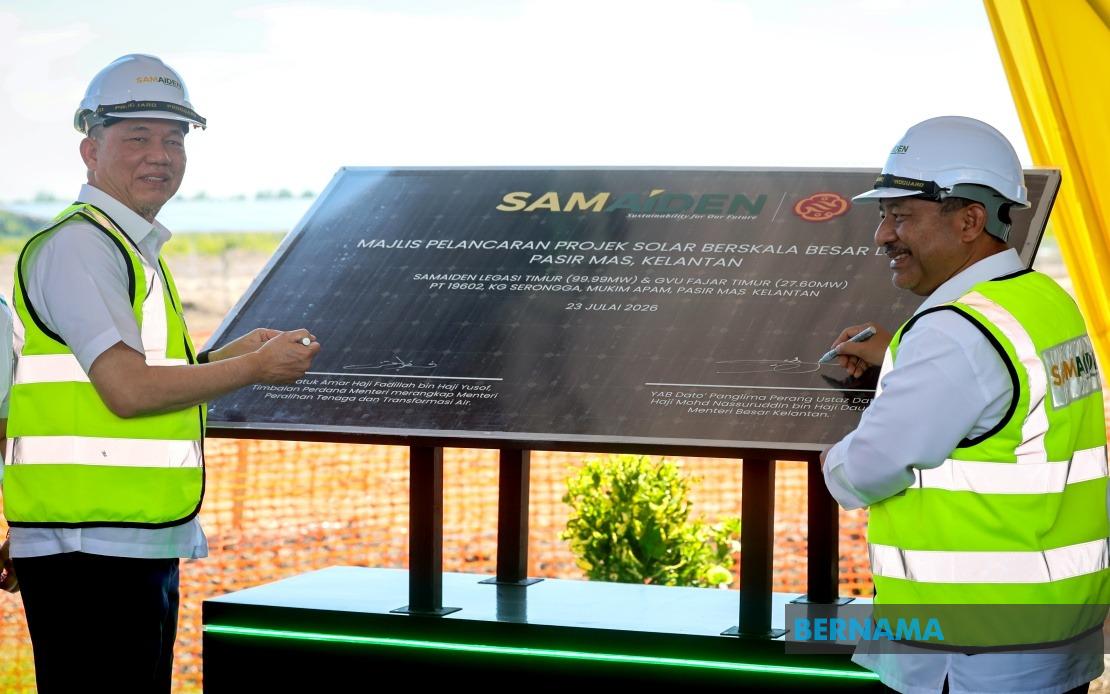
Malaysia's renewable energy sector has reached a critical milestone, with installed capacity climbing to nearly 32 per cent as of June, demonstrating substantial progress toward the government's 35 per cent objective by 2030. Deputy Prime Minister Datuk Seri Fadillah Yusof made the announcement during the commissioning of the Large-Scale Solar Project (LSS5) in Pasir Mas, Kelantan, underscoring the nation's deepening commitment to an accelerated energy transformation that extends far beyond simple environmental stewardship.
The trajectory outlined by Fadillah reflects a carefully calibrated progression embedded within the National Energy Transition Roadmap (NETR), a comprehensive policy framework designed to systematically reshape Malaysia's electricity generation mix. The government had previously reached 31 per cent renewable energy capacity by December 2025, surpassing its initial target for that period. The pathway forward now extends through 2030 with the 35 per cent milestone, before ultimately aiming for a substantially decarbonised grid at 70 per cent renewable capacity by mid-century. This staged approach provides businesses, utilities, and investors with sufficient visibility to align their capital deployment and infrastructure planning.
Fadillah, who holds the dual portfolio of Minister of Energy Transition and Water Transformation (PETRA), framed the energy transition as a strategic imperative rather than an optional sustainability initiative. He articulated three interrelated imperatives driving the transition: securing Malaysia's medium and long-term energy independence amid volatile global energy markets, strengthening the nation's economic competitiveness through cost-effective renewable generation, and fulfilling Malaysia's international climate commitments under global agreements. This triangulated rationale addresses domestic scepticism about the feasibility and affordability of rapid energy transition by emphasising tangible economic benefits alongside environmental and security considerations.
The government's approach emphasises maintaining an equilibrium between three competing policy objectives: ensuring uninterrupted energy supply to support industrial and residential demand, maintaining electricity costs at levels that preserve manufacturing competitiveness and household affordability, and advancing toward a genuinely sustainable energy system. This balancing act carries particular weight in Malaysia, where manufacturing remains a cornerstone of export-driven growth and where energy-intensive industries have historically enjoyed competitive advantage through relatively inexpensive electricity. The policy framework seeks to attract capital-intensive renewable energy projects by offering regulatory certainty and stable long-term contracts, while simultaneously demonstrating that the energy transition can unlock broader economic opportunities rather than impose net costs on the economy.
The LSS5 project in Pasir Mas exemplifies this investment attraction strategy. Located in Kelantan, one of Malaysia's least industrialised states, the solar installation signals investor confidence in the government's renewable energy policies and demonstrates the capacity for strategic energy infrastructure to catalyse broader development. Fadillah highlighted the project's potential to generate direct employment during construction and operations phases, stimulate ancillary industries supplying equipment and services, and bolster household incomes and local commerce in surrounding communities. For a state like Kelantan, which has historically lagged wealthier peninsular counterparts in per capita income and manufacturing capacity, renewable energy projects represent a potential diversification pathway that leverages existing resources—particularly abundant sunshine and available land—to create sustainable economic growth.
Kelantan Menteri Besar Datuk Mohd Nassuruddin Daud positioned the LSS5 project as establishing new standards for renewable energy development within the state. He characterised the initiative as a demonstration that Kelantan possesses the governance infrastructure, land assets, and policy environment necessary to attract substantial private capital into clean energy production. His remarks reflected an implicit competition between Malaysian states to capture renewable energy investment, a dynamic that mirrors competing claims for manufacturing and technology hub status. By framing LSS5 as a success story grounded in transparency, investor-friendly administration, and community engagement, Kelantan's leadership sought to signal readiness for larger-scale solar, wind, or hybrid renewable projects that could substantially diversify the state's economic base beyond traditional agriculture.
The state government's emphasis on community relations and environmental stewardship responds to a broader challenge facing large-scale renewable projects across Southeast Asia: securing and maintaining social licence to operate. Large solar farms require substantial land, necessitating negotiations with existing residents and users. Environmental considerations, including impacts on agricultural productivity, water resources, and biodiversity, require careful management to prevent renewable energy development from incurring hidden environmental costs. Kelantan's leadership acknowledged these concerns explicitly, pledging priority attention to safety standards, environmental protection, and strong community relations, suggesting that previous renewable projects in Malaysia had encountered friction around these dimensions.
The deployment strategy also encompasses distributed rooftop solar through the Solar ATAP Programme, which Fadillah encouraged homeowners, commercial premises, mosques, and other institutions across Kelantan to utilise. This dual-track approach—combining utility-scale solar farms with distributed residential and commercial installations—addresses different segments of the electricity market. Large-scale projects provide baseload renewable generation at low marginal cost once installed, while rooftop systems reduce system losses through local generation and consumption, defer distribution infrastructure investments, and provide residents with energy cost hedges against future tariff increases. The programme implicitly recognises that achieving 35 per cent renewable capacity by 2030 requires deployment across multiple technologies and scales rather than reliance on a few megaprojects.
For Malaysia and the broader Southeast Asian region, the renewable energy transition carries strategic implications extending beyond electricity supply and climate policy. China's dominance in manufacturing solar panels and components means that renewable energy investment creates dependencies on Chinese supply chains and manufacturing capacity, structuring trade relationships and technology transfer pathways. The push toward renewable energy coincides with regional competition for foreign direct investment in manufacturing and technology sectors, where clean energy credentials increasingly influence location decisions by multinational corporations. Malaysia's progress in meeting renewable energy targets consequently signals to potential investors that the country offers both political stability and alignment with global decarbonisation trends, potentially influencing decisions about where to locate energy-intensive production.
The government's renewable energy trajectory also intersects with electricity affordability and grid stability challenges facing Southeast Asia. Renewable energy deployment necessarily requires substantial investment in transmission infrastructure, battery storage systems, and smart grid technologies to manage intermittency. These costs ultimately translate into tariff impacts for consumers, creating political economy tensions between energy transition ambitions and public opposition to rising electricity prices. Malaysia's approach of emphasising cost affordability alongside renewable deployment targets suggests official recognition that rapid energy transition unsupported by plausible cost control measures will face domestic political resistance, particularly among lower-income households and industrial consumers already absorbing energy cost increases from fuel price inflation.
Looking forward, Malaysia's renewable energy agenda will require sustained policy consistency across multiple parliamentary terms and government administrations. The staged targets through 2050 imply that achieving 70 per cent renewable capacity will demand transformative investments in energy storage, transmission infrastructure, and grid modernisation that extend well beyond current planning horizons. International experience demonstrates that renewable energy integration at scales exceeding 50 per cent of generation requires sophisticated electricity markets, demand-response systems, and cross-border trading mechanisms that remain partially underdeveloped in Malaysia and Southeast Asia. The ambitious 2030 and 2050 targets consequently signal not merely solar and wind deployment targets, but implicit commitments to comprehensive electricity market restructuring and technological infrastructure transformation.

