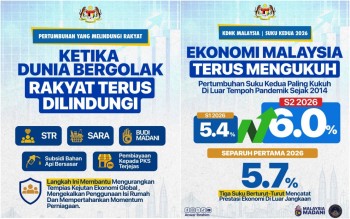
Malaysia has delivered a robust economic performance in the second quarter of 2026, with gross domestic product expanding at a rate of six per cent—a result that surprised observers and marked the nation's strongest quarterly showing in over a decade when excluding pandemic-distorted figures. Prime Minister Datuk Seri Anwar Ibrahim attributed the result to deliberate policy choices by the MADANI Government, which he said prioritised shielding ordinary Malaysians from the severe impact of global economic turbulence.
The achievement gains particular significance given the external environment. While Malaysia's economy accelerated, the broader global picture has darkened considerably, with international growth decelerating due to persistent supply chain bottlenecks and heightened geopolitical tensions centred on West Asia. That Malaysia managed to expand faster than many regional peers under such conditions reflects both structural economic resilience and the effectiveness of targeted interventions implemented by the administration.
According to Anwar's statement released on Facebook, the government has employed multiple channels to insulate households and businesses from inflationary pressures that have rippled outward from regional conflicts and supply disruptions. Beyond headline relief programmes such as BUDI MADANI, which provides direct economic support, the administration deployed the Sumbangan Tunai Rahmah and Sumbangan Asas Rahmah schemes—targeted cash assistance initiatives designed to reach vulnerable populations most affected by price volatility. These measures represent the visible dimension of the government's economic management strategy.
However, Anwar emphasised that behind-the-scenes technical work has been equally important. The Prime Minister highlighted ongoing efforts by multiple government agencies to manage inflation through supply-side interventions and price monitoring mechanisms. Rather than relying solely on demand-side stimulus or direct assistance, the MADANI Government has sought to address cost pressures at source by ensuring continuous market supply and preventing price hoarding. This dual approach—combining household support with preventive economic administration—appears to have created conditions favourable for sustained expansion.
The six per cent growth rate exceeds what most private sector economists had forecast for the quarter, suggesting the economy benefited from stronger-than-anticipated momentum across multiple sectors. This outperformance is noteworthy because second quarters typically face structural headwinds related to global industrial patterns and regional business cycles. The fact that Malaysia accelerated despite these seasonal factors indicates underlying economic vitality beyond cyclical bounce-backs.
From a regional perspective, Malaysia's Q2 performance positions the country among Southeast Asia's faster-growing economies. While some neighbouring nations have experienced slower growth due to their specific vulnerabilities to global supply disruptions or geopolitical exposure, Malaysia's diversified economy and policy toolkit have allowed it to navigate current challenges more effectively. The result provides a counterpoint to narratives of broad-based Asian deceleration and demonstrates that competent macroeconomic management can partly offset external shocks.
Nevertheless, Anwar struck a cautious note, acknowledging that substantial work remains ahead. The Prime Minister indicated that the government recognises sustainability challenges. Maintaining momentum requires not merely pushing headline growth figures upward, but ensuring that economic expansion translates into tangible improvements in living standards for ordinary citizens. This concern reflects growing awareness that rapid GDP growth divorced from household income gains or job quality improvements can mask underlying vulnerabilities in distribution and opportunity creation.
The Prime Minister specifically identified three priorities for the next phase of economic management: sustaining growth momentum, ensuring wealth creation reaches broader populations, and improving job quality rather than merely generating employment numbers. This framing suggests the MADANI Government is conscious that growth alone cannot be the ultimate objective—growth must be accompanied by meaningful wage improvements, career development opportunities, and expanded safety nets for those unable to fully participate in the formal economy. This perspective aligns with international best practice in post-pandemic economic policy, where policymakers increasingly acknowledge that inclusive growth matters as much as aggregate expansion.
Special emphasis was placed on protecting vulnerable groups, a category that has expanded in Malaysia as inflation has eroded purchasing power among middle-income and lower-income households. While targeted cash assistance has provided immediate relief, the government's medium-term strategy appears focused on structural improvements that reduce vulnerability to future shocks. This might encompass skills training, business development support for informal sector workers, and strengthening of social protection systems.
The government's commitment to continued economic reform reflects acknowledgment that the external environment will likely remain uncertain. Global supply chains remain stressed, regional geopolitical risks persist, and inflation dynamics could easily shift. Under such conditions, relying on one-off stimulus becomes counterproductive; instead, sustainable approaches that enhance underlying economic resilience and flexibility prove more durable. The MADANI Government's framing of ongoing reform efforts as integral to long-term prosperity suggests awareness that short-term growth management must be subordinated to deeper institutional and structural improvement.
For Malaysian policymakers, the Q2 2026 result validates the approach of combining immediate relief with technical economic management and longer-term structural reform. The ability to exceed growth expectations while simultaneously addressing inflation and household vulnerability demonstrates that these objectives, often portrayed as conflicting, can be pursued in concert when policy is coherently implemented across multiple agencies and timeframes. This integrated approach may offer lessons for other emerging economies confronting similar combinations of external headwinds and domestic development needs.

