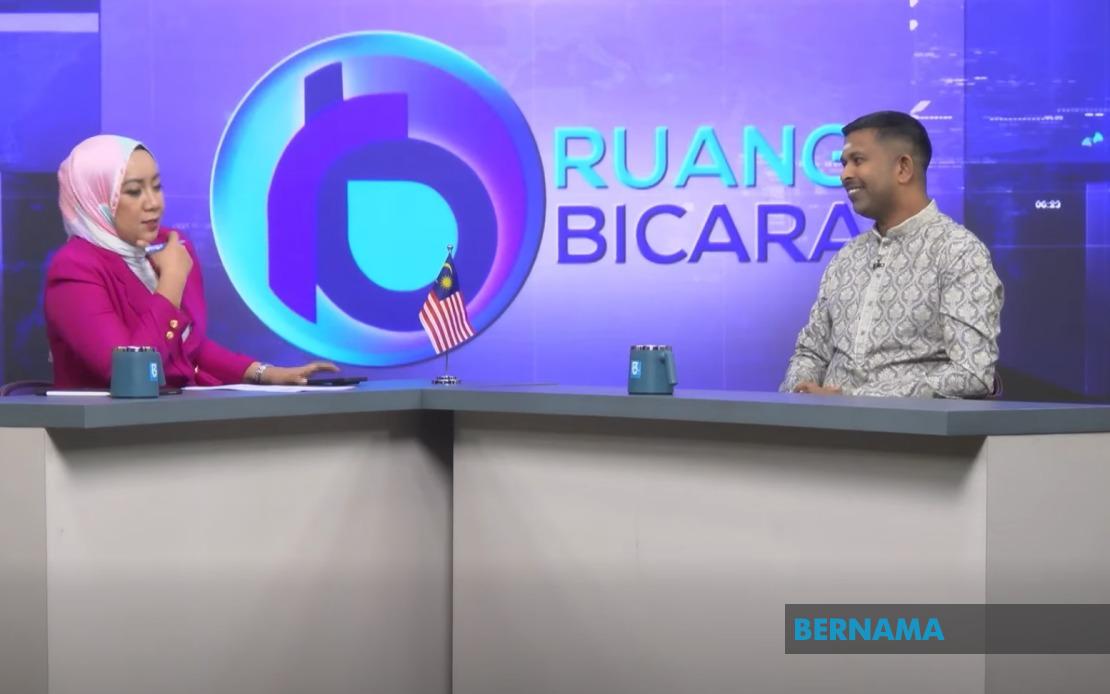
Malaysia's constitutional commitment to the Malay language as the national tongue demands far more than legislative protection—it requires active, coordinated engagement from every segment of society, from government ministries to private enterprises and educational institutions, according to a leading legal and linguistic authority. Prof Dr Ramalinggam Rajamanickam, Faculty of Law professor at Multimedia University and member of the Dewan Bahasa dan Pustaka Board of Governors, articulated this vision during a recent television discussion on national language policy, underscoring that responsibility for maintaining the language's dignity extends to all citizens regardless of sector or background.
The constitutional foundation for Malay's position is formidable. Article 152 of the Federal Constitution explicitly designates Malay as the national language, a provision reinforced by the National Language Act 1963/67, which mandates its use in official government operations and formal documentation. Yet according to Prof Ramalinggam, the legal framework alone provides insufficient protection for the language's future vitality. While Malaysia's usage rates for Malay remain generally robust compared to many multilingual nations, the quality and precision of that usage faces mounting pressure from contemporary linguistic trends that threaten to erode grammatical standards and semantic clarity.
The core challenge confronting Malaysia's language policymakers is not whether citizens employ Malay, but how well they employ it. The phenomenon known colloquially as "bahasa rojak"—the mixing of Malay with English, Chinese, and other languages, often exacerbated by abbreviated social media communication—represents a subtle but pervasive threat to linguistic coherence. While such code-switching carries no inherent moral dimension in casual conversation, the deterioration of standard Malay grammar and sentence structure in formal contexts poses genuine risks for official communication, legal precision, and institutional credibility. Government ministries, courts, and educational bodies depend upon language consistency and correctness to function effectively, yet insufficient monitoring and enforcement mechanisms currently exist to maintain standards across the public sector.
Prof Ramalinggam identified universities and higher education as critical pressure points requiring urgent institutional reform. Malaysian universities must consciously position Malay as a genuine language of scholarship and scientific inquiry, not merely as a ceremonial national symbol relegated to secondary importance behind English. This does not suggest diminishing English proficiency—which remains essential for global academic participation—but rather establishing a bilingual framework where Malay serves meaningfully in research dissemination, classroom instruction, and knowledge production. The absence of such commitment leaves young Malaysians with the impression that serious intellectual work necessarily occurs in English, thereby implicitly positioning Malay as intellectually subordinate.
The emergence of artificial intelligence and digital technologies introduces unprecedented complexity to Malaysia's language policy landscape. Rather than passively awaiting technological adaptation to Malay, Prof Ramalinggam argues that Malaysia must proactively invest in the linguistic infrastructure necessary to embed Malay within advanced computational systems, algorithms, and AI applications. This requires sustained collaboration among government agencies, research institutions, technology companies, and linguistics specialists to develop vocabulary, encoding systems, and processing capabilities that enable Malay to function effectively across scientific, economic, and technological domains. The investment required is substantial, but the alternative—a future where cutting-edge technology operates primarily or exclusively in English—represents a slow but inexorable marginalization of the national language.
Historically, Malay enjoyed recognition across Southeast Asia as a lingua franca facilitating regional commerce and diplomatic exchange. This legacy, though often overlooked in contemporary discussions, suggests genuine potential for renewed prominence. Countries including China, Japan, and India maintain scholarly interest in Malay language study, indicating continuing international recognition of its significance. Malaysia could harness this latent global interest by strengthening domestic language development, thereby creating exportable expertise and educational capacity that positions Malay as a serious field of international academic inquiry rather than a purely domestic concern.
Implementing this comprehensive approach demands specific institutional accountability mechanisms. Government ministries must establish clear monitoring systems ensuring that official communications maintain grammatical and stylistic standards befitting national institutions. Simultaneously, universities require mandate adjustments and resource allocations that genuinely prioritize Malay alongside English rather than treating it as a secondary obligation. The private sector, often overlooked in language policy discussions, bears responsibility for maintaining professional communication standards within commercial contexts, where increasingly casual linguistic practices threaten workplace coherence and customer confidence.
Prof Ramalinggam's emphasis on maintaining multilingual capacity represents a sophisticated rejection of false choices between linguistic loyalty and practical necessity. Empowering the national language need not entail diminishing other languages; indeed, cognitive research increasingly demonstrates that multilingualism enhances rather than diminishes intellectual capacity. The proposition advanced is essentially that Malay should occupy its constitutionally mandated position as the foundational language of national identity and official discourse, while English and other languages retain their legitimate roles in specialized contexts. This balanced approach acknowledges geopolitical reality while honoring constitutional commitments.
For Malaysia's policymakers and institutional leaders, Prof Ramalinggam's analysis suggests that incremental reforms prove insufficient for the challenge ahead. The language requires not sporadic campaigns or symbolic gestures, but rather sustained structural investment comparable to that devoted to mathematics, science, or technology education. Without such commitment, the gradual erosion of Malay's functional capacity and cultural prestige will continue, ultimately compromising one of Malaysia's few truly unifying national symbols at a time when social cohesion grows increasingly precious.
The pathway forward remains available but narrowing. Success demands that government, academia, business, media, and individual citizens collectively reconceive language development not as a niche cultural project but as a fundamental nation-building imperative worthy of resources, expertise, and sustained attention. Only through such comprehensive mobilization can Malaysia ensure that its national language remains not merely a constitutional fact but a living, dynamic instrument capable of serving the nation's intellectual, economic, and cultural requirements across the twenty-first century.

