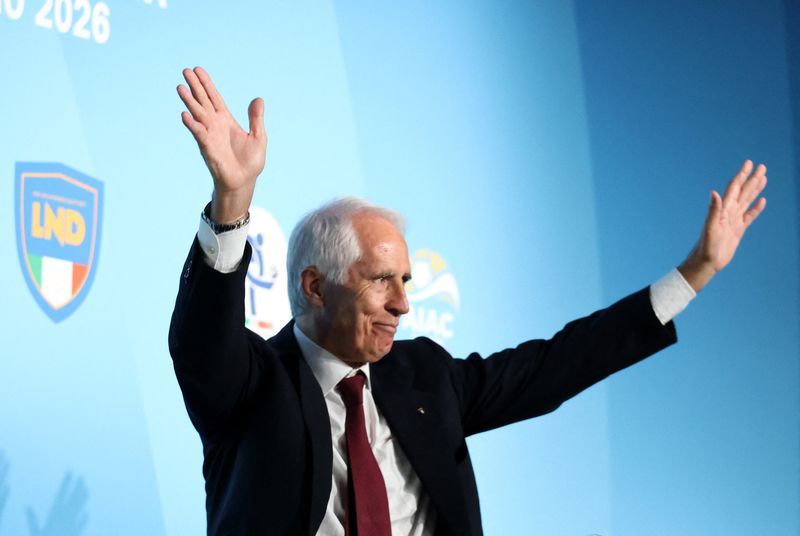
Giovanni Malago has assumed leadership of the Italian Football Federation at perhaps its most critical juncture in decades, elected president on Monday with a clear mandate to restore the four-time world champions to international prominence. The 67-year-old businessman takes charge following Italy's shock World Cup qualification exit in April, the third consecutive tournament the Azzurri will miss—a dramatic reversal for a nation that won the 2020 European Championship and has long considered itself a football powerhouse. Malago defeated rival Giancarlo Abete with 68.58% of the vote at the federation assembly in Rome, assuming the position vacated by Gabriele Gravina, whose resignation came amid widespread fury from supporters and political figures over the qualification collapse.
Malago arrives at the federation with considerable organisational credentials, having recently overseen the Milano Cortina Winter Olympics in February, where he earned recognition for delivering a smoothly-run Games. A former futsal player and previous head of the Italian National Olympic Committee, he brings administrative experience from outside football's traditional power structures. However, his appointment to the FIGC represents perhaps his most consequential challenge yet, requiring him to navigate the turbulent waters of Italian football's institutional reform whilst managing sky-high public expectations and deep internal fractures within the federation.
The depth of Italian football's crisis cannot be overstated. Beyond the national team's qualification failures, the country's clubs have also suffered devastating European exits, leaving Italian football in its weakest position for four decades. This dual collapse—at both national and continental club level—reflects systemic problems that extend far deeper than tactical shortcomings or individual manager failings. The nation faces questions about its competitive structure, youth development pathways, and the fundamental approach to nurturing talent in an era when other European nations have substantially modernised their football infrastructure.
During his campaign, Malago articulated a vision of the federation as an institution capable of inspiring rather than merely administering. He emphasised that Italian football's rich historical achievements should serve as motivation rather than burden, urging the federation to embrace forward-thinking ambition whilst remaining grounded in the country's football heritage. This balancing act—honouring tradition whilst pursuing necessary reform—represents perhaps the central challenge of his tenure. Italy's football culture runs deep; revitalising the system requires changes that will inevitably provoke resistance from those invested in established hierarchies and methods.
Immediate priorities facing Malago include the appointment of a new men's national team coach, a decision that will fundamentally shape Italy's immediate direction. The previous head coach, Gennaro Gattuso, resigned following the Bosnia & Herzegovina playoff defeat in April that eliminated Italy from World Cup contention. The choice of successor will signal whether the federation intends to pursue continuity with Italian football philosophy or embrace new methodologies. Additionally, Malago must oversee a comprehensive overhaul of youth development systems, an area where Italy has demonstrably fallen behind comparable nations in recent years. Roberto Baggio and other prominent figures have repeatedly warned that Italy's talent development infrastructure no longer meets modern standards, a diagnosis that demands substantial investment and institutional restructuring.
The 2032 European Championship, which Italy will co-host alongside Turkey, provides an important medium-term objective and potential turning point. Hosting a major tournament on home soil offers both opportunity and risk—a successful campaign could restore confidence and prove the federation's reform efforts are working, whilst failure would deepen the crisis. Malago's team has limited time to implement changes and see them bear fruit at competitive level. The tournament deadline creates pressure to move quickly on structural reforms whilst allowing sufficient time for young players developed under new systems to integrate into the national team setup.
Gravina, the previous federation president who led the FIGC since 2018, reflected on his departure with some candour. In remarks made as the election assembly began, the 72-year-old acknowledged that he should have stepped down earlier, a recognition that the federation had perhaps reached its breaking point under his stewardship. His tenure witnessed the triumph of Euro 2020, creating a high point from which subsequent decline appeared all the steeper. The trajectory from continental champions to repeated World Cup failures over just three years underscores the volatility of international football and the difficulty of maintaining competitiveness across multiple competition cycles.
Warning signs of structural problems had accumulated well before the April qualification disaster. The decline in Italian clubs' European performance, coupled with documented deficiencies in youth player development, suggested deeper institutional weaknesses rather than temporary fluctuations. Some observers had warned for years that Italian football's traditional methods were becoming obsolete in a rapidly evolving global game. Malago's election signals that the federation has accepted these diagnoses and is committed to substantial change, though translating recognition of problems into effective solutions will test his leadership considerably.
For Southeast Asian football observers, the Italian situation offers instructive lessons about the risks of complacency and the necessity of continuous institutional adaptation. Regional federations navigating their own development challenges can observe how Italian football attempts to modernise its youth systems, organisational structures, and coaching philosophies. The federation's efforts to balance tradition with innovation, whilst managing expectations in a football-mad nation, echo challenges faced by ambitious football associations throughout Asia seeking to establish themselves as serious continental and global competitors.
Malago's emphatic statement that "alone I can do nothing, together we can do everything" underscores his recognition that federation reform cannot succeed through top-down decree alone. Building consensus around difficult changes, involving clubs, regions, coaches, and administrators in shared objectives, will be essential. The federation's institutional culture, shaped by decades of certain approaches and power distributions, will resist transformation. Malago's challenge involves constructing coalitions for change whilst maintaining enough stability to allow the national team to compete effectively in upcoming tournaments.
The election of Malago represents both an ending and a beginning for Italian football. It acknowledges that the previous approach has failed and that new leadership is essential, yet success remains far from guaranteed. The magnitude of structural problems, combined with the unforgiving nature of elite football competition, means even a capable administrator faces daunting obstacles. Italian football's recovery will ultimately depend not just on Malago's leadership abilities, but on whether the federation's broader culture can embrace the comprehensive modernisation that three consecutive World Cup failures have made impossible to ignore.