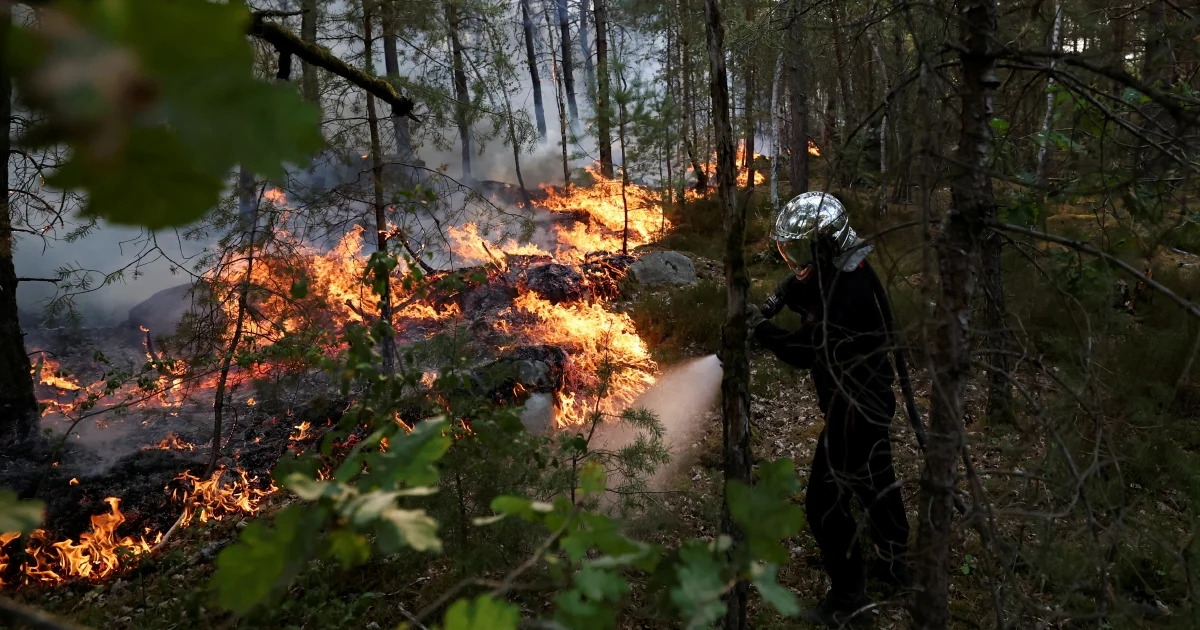
France faced a critical firefighting emergency on Monday as multiple wildfires tore through a historic forest region south of the capital, destroying an area exceeding 1,300 hectares in what has become a significant environmental incident for the region. The blazes, detected in the Arbonne-la-Foret area, prompted an immediate and intensive response from French firefighting services, who deployed substantial resources to contain the rapidly spreading fires before they could cause further damage to the densely forested terrain.
The scale of the destruction underscores growing concerns about forest vulnerability in Europe, particularly in regions near major population centres. While southern France typically experiences higher wildfire risks during summer months, incidents of this magnitude so close to Paris highlight how environmental threats are spreading northward and becoming more unpredictable. The Arbonne-la-Foret forest has significant ecological and historical value, making this incident particularly troubling for conservation advocates and local communities who depend on the ecosystem for recreational and economic purposes.
Police involvement in the investigation became crucial when authorities identified suspicious circumstances surrounding the fire's origin. Following preliminary investigations, law enforcement arrested two individuals suspected of deliberately setting the fires through arson. This criminal dimension adds complexity to what might otherwise be treated as a natural disaster, as authorities must now balance immediate firefighting priorities with criminal investigation protocols and evidence preservation at the scene.
The arrests suggest that human negligence or malice, rather than natural causes like lightning strikes or accidental campfires, was responsible for the catastrophe. Arson investigations in wildfire cases demand meticulous coordination between firefighters, forensic teams, and investigators to establish clear evidence of intent and identify those responsible. The timing of the arrests—coming just hours after the fires were detected—indicates that authorities had quickly gathered enough preliminary evidence to move forward with detention.
For Malaysia and other Southeast Asian nations watching European environmental crises, this incident carries important lessons about forest management and disaster preparedness. While Malaysia's tropical rainforests face different threats—primarily from agricultural expansion and illegal logging rather than combustion-driven wildfires—the underlying importance of rapid response systems and interagency coordination remains universally applicable. The French response demonstrates how developed nations mobilise resources in environmental emergencies, a model that regional authorities might study.
The economic implications of such large-scale forest destruction extend beyond immediate ecological loss. Tourism, timber resources, and carbon sequestration services provided by forests represent significant economic value. Recovery and reforestation efforts will require sustained investment over years or decades, diverting resources from other development priorities and burdening local budgets long after initial emergency response concludes.
Criminal arson in forests represents a particularly reprehensible form of environmental crime because perpetrators cause widespread, indiscriminate damage affecting countless ecosystems and communities with minimal direct personal risk. Unlike other property crimes, arson in forested areas can accelerate uncontrollably, making it exponentially more destructive than the perpetrator's initial action. French authorities' swift action to apprehend suspected arsonists sends an important message about accountability and consequences for such destructive behaviour.
The investigation will likely reveal specific motives—whether personal grievance, financial gain through insurance fraud, political protest, or mere recklessness. Understanding arson motivations helps authorities develop prevention strategies and identify high-risk individuals or groups. Enhanced monitoring in vulnerable areas, stricter penalties for forest crimes, and public education campaigns about fire dangers typically follow such incidents in European nations.
Firefighting operations in this magnitude require coordination across multiple jurisdictions and agencies, involving ground crews, aerial support, and logistical networks to sustain operations over extended periods. French authorities have extensive experience managing such crises, yet the resources demanded by 1,300 hectares of active burning remain substantial. Water drops from helicopters, firebreaks established by ground teams, and strategic positioning of personnel represent capital-intensive responses that strain budgets regardless of preparedness level.
The broader context includes climate change's influence on wildfire behaviour. Warmer temperatures, longer dry seasons, and shifting precipitation patterns increase forest fire risk across Europe. While single incidents cannot be definitively attributed to climate trends, accumulating data suggests regions historically considered low-risk are now experiencing devastating blazes at increased frequency. This pattern demands that European nations, including France, reassess forest management practices, building maintenance around vulnerable areas, and early-warning system investments.
As investigations proceed and firefighting operations continue, authorities will examine whether security measures, public awareness programs, and enforcement actions around the Arbonne-la-Foret area were adequate before the incident. Post-disaster evaluations typically identify system gaps and recommend improvements to prevent recurrence. The arrested individuals will face legal proceedings that may result in significant sentences, reflecting the severity of deliberately igniting massive uncontrolled fires.

