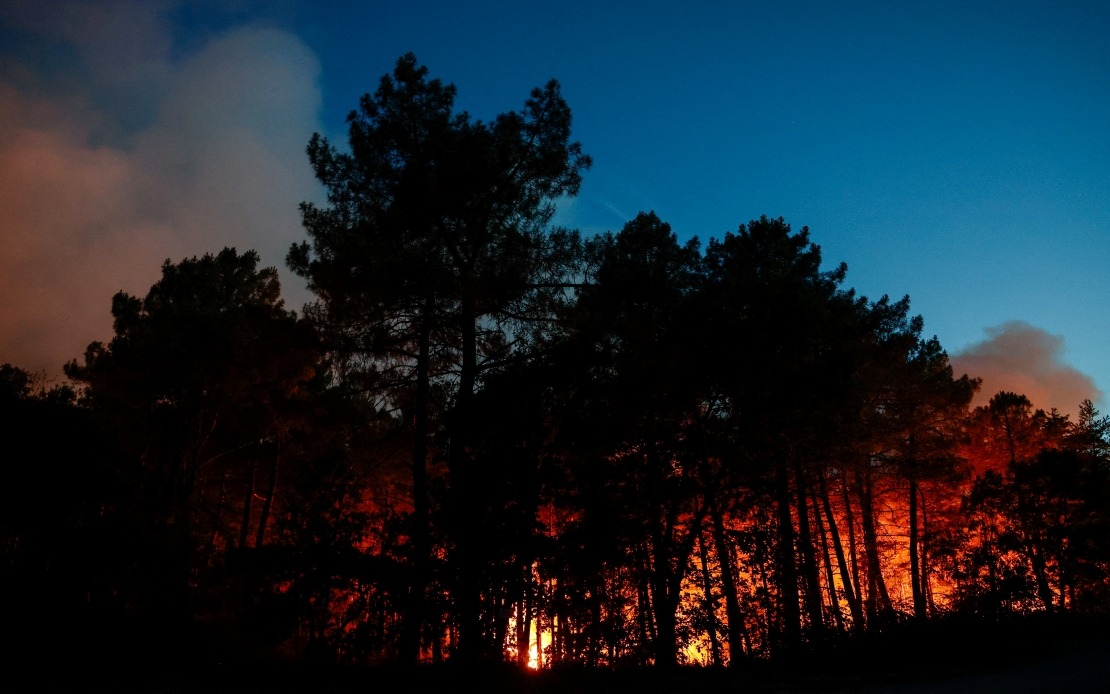
France's historic Fontainebleau forest faced an unprecedented crisis on Monday as around 400 firefighters mobilised to combat a rapidly spreading wildfire that has consumed approximately 800 hectares of woodland and prompted the evacuation of more than 1,000 residents and tourists. The blaze, which ignited late Sunday evening in proximity to a motorway, represents one of the most significant wildfire incidents to strike northern France in recent years, catching authorities and emergency services off guard as temperatures soar across Western Europe.
The scale of the conflagration has prompted intensive investigation into its origins. French Interior Minister Laurent Nuñez visited the scene and publicly stated that investigators are treating the fire as potentially deliberate, noting that the emergence of multiple distinct fire outbreaks concentrated within a one-kilometre radius strongly suggests possible arson rather than natural causes. The gendarmerie has consequently launched a formal investigation into the circumstances surrounding the ignition. Such clustering of fire starts within a confined geographic area is rarely observed in natural wildfire patterns and typically warrants serious suspicion of human intervention.
Aircraft equipped for water-bombing operations have been deployed to augment ground-based firefighting teams, extracting water from the Seine river to douse the advancing flames. The Seine-et-Marne department coordinating the response has mobilised these aerial assets in an effort to contain the perimeter and prevent further expansion of the burned zone. The combination of aerial and ground-based suppression efforts underscores the scale of resources considered necessary to manage this particular crisis.
The Fontainebleau forest itself represents an invaluable natural and cultural asset across Europe. The woodland encompasses the historically significant Château de Fontainebleau, a former royal residence that has held prominence in French history and architecture for centuries. Beyond its cultural dimensions, the forest constitutes one of the largest continuous forested expanses in Western Europe, making its preservation a matter of environmental concern extending well beyond France's borders. The loss of 800 hectares represents substantial ecological damage to an irreplaceable ecosystem.
Accounts from local officials paint a harrowing picture of the fire's rapid progression across the landscape. The mayor of Le Vaudoué, describing the scene to BFM Television, characterised the advancing flames as resembling a wall of fire moving with alarming velocity directly toward residential areas at the forest's periphery. This description captures the intensity and speed with which the blaze propagated, leaving limited time for residents to prepare for evacuation and creating dangerous conditions for both civilians and emergency personnel.
The timing of this catastrophe coincides with France's third major heatwave episode during the current year, creating ideal conditions for explosive fire behaviour. Extended periods of elevated temperatures dry vegetation to critically flammable levels, reducing the moisture content that normally provides natural fire resistance. These climatic conditions transform forests into tinderboxes where any ignition source, whether natural or intentional, can rapidly escalate into uncontrollable infernos. The convergence of deliberately set fires with extreme weather conditions represents a particularly dangerous scenario for fire management.
French government spokeswoman Maud Bregeon characterised the situation as exceptional, emphasising that all accessible firefighting resources had been mobilised to prevent further spread. She further highlighted that wildfire incidents approaching this magnitude have constituted relative rareties across northern France historically, suggesting that current conditions or changing patterns may be rendering previously unlikely scenarios increasingly probable. The deployment of every conceivable asset indicates governmental recognition of the crisis's severity.
The breadth of France's heat emergency extends considerably beyond the Fontainebleau incident. The national meteorological service Météo-France elevated thirty-seven administrative departments to its maximum red heat alert status as the week commenced, indicating that dangerous temperatures and dry conditions affected vast portions of French territory simultaneously. This widespread heat alert demonstrates that fire risk permeates multiple regions concurrently, straining emergency response capabilities across the nation.
For Malaysian and Southeast Asian observers, the Fontainebleau crisis offers instructive parallels to regional wildfire challenges, particularly those experienced across Indonesia, where transboundary haze episodes regularly affect Malaysia and Singapore. While Southeast Asian fires typically occur during dry seasonal windows and often involve agricultural land clearing, the Fontainebleau incident demonstrates that developed European nations with advanced infrastructure face equivalent vulnerabilities when climatic extremes converge with either intentional or negligent fire-setting behaviour. The incident underscores how even wealthy nations struggle managing catastrophic wildfire scenarios when heatwaves amplify fire behaviour beyond historical experience.
The investigation into suspected arson carries significant implications for forest protection policy. Should deliberate fire-setting be confirmed, it would represent a particularly troubling escalation of environmental crime, transforming what might otherwise be addressed through improved forest management and fire prevention into a security concern. The psychological profile of individuals willing to ignite massive forest fires during extreme heat events, potentially endangering thousands of residents, suggests motivation patterns that extend beyond simple criminality into potentially ideological or anarchic territory. Such incidents prompt reassessment of forest perimeter security and surveillance protocols.
The displacement of over 1,000 residents highlights secondary consequences extending well beyond immediate property damage. Evacuation, sheltering, potential property loss, and psychological trauma accompanying forced displacement create ripple effects throughout affected communities. Recovery from such incidents involves not merely replanting damaged forest zones but also supporting resident populations psychologically and economically through extended periods as communities stabilise and individuals assess their situations.
Looking forward, the Fontainebleau fire will likely catalyse policy discussions across France and Europe regarding wildfire preparedness, particularly within previously considered lower-risk regions. The incident demonstrates that climate change is expanding the geographic distribution of catastrophic fire risk, rendering historical precedent unreliable as planning frameworks. Fontainebleau's status as a protected heritage site may also drive investigations into whether additional safeguards around historically significant forests require implementation, balancing preservation objectives against firefighting operational requirements.

