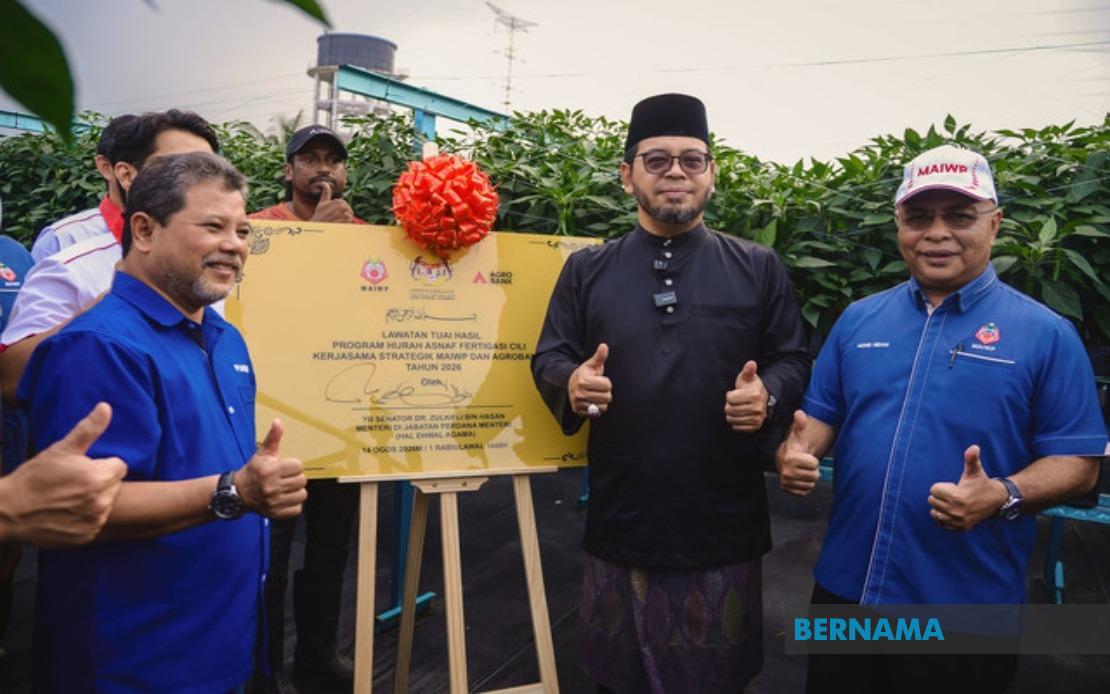
The Majlis Agama Islam Wilayah Persekutuan (MAIWP) is moving forward with an ambitious expansion of its chilli farming initiative aimed at empowering asnaf—eligible low-income Muslim beneficiaries—following impressive results that have already demonstrated the project's viability and income-generating potential. The enlarged operation, now encompassing five acres, represents a significant scaling up of an agricultural scheme that has proven both economically and socially transformative for its initial cohort of participants in the Federal Territories.
Dr Zulkifli Hasan, the Minister in the Prime Minister's Department (Religious Affairs), underscored the programme's achievements as validation of a strategic approach to poverty alleviation through skills development and modern farming techniques. The data supports his optimism: the inaugural harvest yielded more than 16.7 tonnes of chillies, generating returns exceeding RM207,000 for participating asnaf families. These figures exceed what many conventional agricultural support schemes in the region have historically achieved, particularly when measuring returns per household and timeframe to profitability.
At the heart of this initiative lies advanced fertigation technology—a drip irrigation method combined with precision nutrient delivery that maximizes yield while minimizing water and fertilizer waste. This approach is particularly well-suited to Malaysia's tropical climate and the economic constraints faced by asnaf participants, who often lack capital for traditional large-scale farming infrastructure. By democratizing access to such technology through government sponsorship, MAIWP has removed a significant barrier that typically prevents lower-income communities from competing in high-value agricultural markets.
The expansion to five acres signals MAIWP's confidence in both the technical sustainability and market demand for chilli production. Chillies remain a staple ingredient across Southeast Asian cuisines, with consistent domestic demand and significant export potential. The scale increase also enables participants to achieve economies of scale in both production and marketing, reducing per-unit costs and improving profit margins as output grows.
Beyond raw agricultural production, the programme deliberately incorporates value-addition strategies that align with broader economic diversification goals. Participants are being encouraged to develop processed chilli products—pastes, sauces, dried variants, and specialized blends—that command higher retail prices and tap into growing consumer interest in artisanal and locally-sourced condiments. This downstream integration represents sophisticated economic thinking, as it captures additional margin while creating employment opportunities in post-harvest processing and packaging.
Alinda Rosely, a 49-year-old single mother and programme participant, embodies the human impact behind these statistics. Her testimony reveals how technical skill acquisition translates into concrete livelihood improvement: she earned RM40,000 within six months during a favorable pricing period last year. For a single-parent household, such income can mean the difference between precarious living and genuine economic stability. Her narrative also highlights how the programme addresses not merely income poverty but the psychological and social dimensions of economic marginalization, providing pathways to self-reliance that restore dignity alongside financial security.
The timing of this expansion aligns with broader regional trends in agricultural modernization and social enterprise development. Several Southeast Asian nations, including Thailand and Indonesia, have pioneered similar high-value crop initiatives targeting low-income rural communities. Malaysia's approach through MAIWP demonstrates how Islamic social finance mechanisms can be leveraged to fund contemporary agricultural transformation, blending traditional zakat principles with cutting-edge farming methodology.
MAIWP's track record provides institutional credibility for this expansion. As of mid-August 2026, the organization had distributed RM699.57 million in zakat across 38 distinct welfare assistance schemes, alongside substantial funding for community development initiatives. This demonstrates both the financial capacity and operational competence required to manage a scaled-up agricultural programme effectively. The chilli project sits within a portfolio approach to poverty alleviation rather than existing as an isolated initiative, allowing it to benefit from organizational infrastructure, technical expertise, and market linkages developed across MAIWP's broader activities.
The programme's alignment with MAIWP's mission to cultivate self-reliant and competitive asnaf communities reflects a philosophical shift in how religious social institutions approach poverty reduction. Rather than perpetuating dependency through unconditional assistance, this model emphasizes capability-building, asset creation, and market integration. Participants graduate from beneficiary status to productive economic agents capable of supporting themselves and contributing to broader economic activity.
For Malaysian policymakers and development practitioners, this expansion offers valuable lessons regarding the intersection of social welfare and agricultural entrepreneurship. The demonstrated profitability makes the model potentially replicable across other Muslim-majority communities in Malaysia and the broader Southeast Asian region, whether through religious institutions, cooperative frameworks, or government agricultural departments. The five-acre expansion should therefore be understood not merely as a local scaling exercise but as a pilot for potentially much larger regional application.
Looking forward, the success metrics that will matter most are sustainability indicators: whether participating farmers retain their skills and market access after MAIWP's direct support concludes, whether income gains prove durable across multiple growing seasons and price cycles, and whether the model genuinely breaks cycles of poverty or merely provides temporary relief. The coming harvest cycles will provide crucial data on these longer-term sustainability questions, particularly as the programme faces the inevitable challenges of commodity price fluctuations and climate variability inherent to agricultural production.

