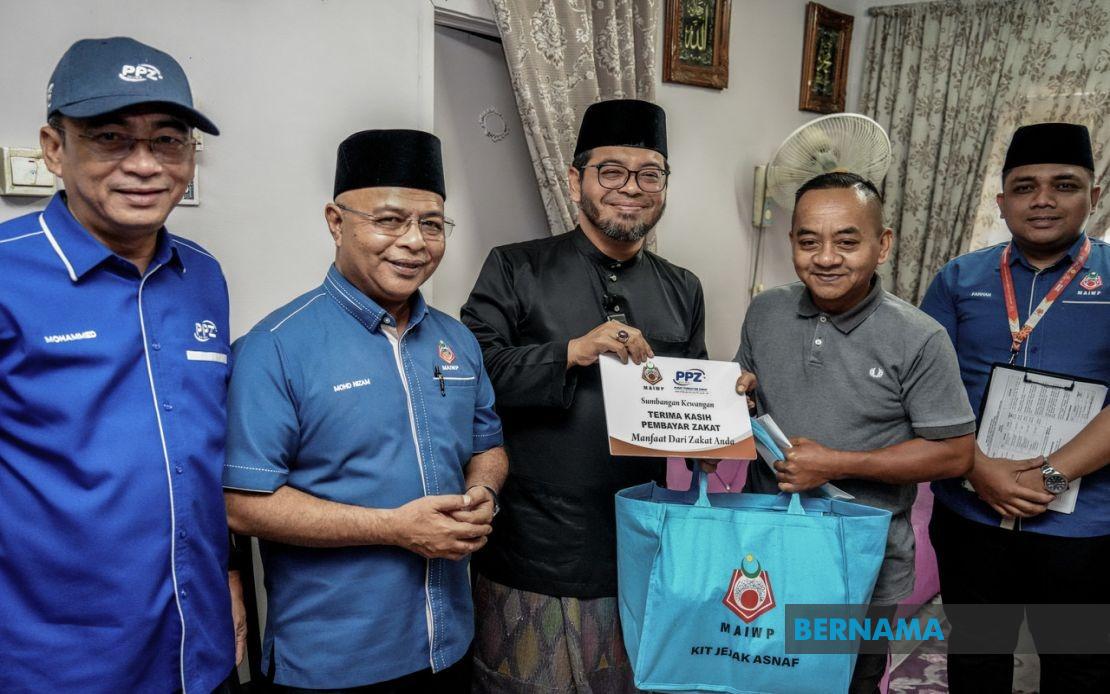
The Federal Territories Islamic Religious Council (MAIWP) has rolled out a targeted assistance programme for a widow now responsible for five children aged between six and 15, whose husband passed away earlier this month. The comprehensive support package addresses immediate financial pressures facing the family, encompassing monthly living expenses, rental assistance and educational costs as the household adjusts to life without its primary income earner.
Datak Dr Zulkifli Hasan, Minister in the Prime Minister's Department (Religious Affairs), emphasised that hands-on engagement with assistance recipients remains fundamental to MAIWP's operational philosophy. By conducting direct visits to families receiving aid, the council gains critical insight into their circumstances and ensures that support mechanisms genuinely address their needs rather than following a one-size-fits-all approach. This personalised methodology reflects a broader shift in social welfare provision toward needs-based rather than standardised assistance models.
Beyond the widow's family, MAIWP's outreach extends across multiple vulnerable households within the Federal Territories. The council visited a household comprising a married couple and eight school-aged children, where the father works as a Kuala Lumpur City Hall (DBKL) driver and the mother manages the home full-time. Despite dual-parent structure, the family's financial constraints necessitate targeted support, which MAIWP provides through monthly General Medical Assistance covering essential items such as diapers and diabetic supplies, wheelchair support and educational expenses.
A third family profile demonstrates the diverse circumstances MAIWP addresses. A divorced single mother who has been raising three school-age children independently since 2018 receives monthly cost-of-living assistance supplemented by provisions for basic necessities, school fees and learning materials. These three household profiles illustrate how MAIWP's assistance framework accommodates varied family structures and income levels across the Federal Territories' population.
Zulkifli underscored MAIWP's multi-layered support strategy, which transcends simple cash transfers to encompass specialised assistance tailored to specific household needs. For the widow's family, the council had previously furnished General Schooling Aid and is now expanding its intervention to address the compounded financial burden following the husband's death. This escalation in support reflects recognition that the loss of a primary earner creates cascading financial challenges affecting multiple household expenditure categories simultaneously.
The organisational commitment to community welfare represents a significant component of Malaysia's Islamic institutional framework. MAIWP operates across Kuala Lumpur, Labuan and the Federal Territory of Putrajaya, serving as the primary body overseeing Islamic religious affairs and welfare provision in these jurisdictions. For Malaysian readers, understanding how such councils function provides insight into the structured support available to vulnerable populations within these territories, particularly for Muslim families facing sudden economic dislocation.
As of mid-August 2026, MAIWP had distributed RM699.57 million in cumulative assistance, demonstrating the substantial financial commitment underpinning these welfare initiatives. This figure contextualises the scale of need within the Federal Territories and indicates sustained institutional investment in social support mechanisms. The magnitude of distribution underscores how Islamic religious bodies in Malaysia function as significant welfare actors alongside government agencies, fulfilling both spiritual and social roles within their communities.
For Southeast Asian observers, Malaysia's approach to welfare delivery through Islamic institutional channels offers a distinctive model compared to purely secular government-administered systems. The integration of religious values with practical financial assistance reflects how religious institutions across the region adapt to provide contemporary social safety nets whilst maintaining doctrinal foundations. This dual function has become increasingly relevant as economic pressures and family disruption create growing welfare demands across urban Malaysian populations.
The widow's situation encapsulates challenges facing many Malaysian households where sudden death of a working-age adult precipitates financial crisis without adequate insurance or savings. Educational continuity for children becomes particularly vulnerable in such circumstances, as families must choose between immediate consumption needs and schooling investments with longer-term returns. MAIWP's inclusion of schooling assistance within its aid package addresses this critical vulnerability, recognising that educational disruption compounds long-term economic disadvantage.
Minister Zulkifli's comments regarding MAIWP's implementation philosophy suggest an evolution in Malaysian social welfare thinking toward evidence-based, needs-responsive programming. Rather than administering assistance through centralised formulae, frontline engagement with beneficiaries enables iterative refinement of support packages. This approach generates valuable data regarding actual household circumstances whilst building organisational capacity to identify emerging vulnerabilities before they become severe crises affecting family stability and child welfare.
The programme's focus on schooling support across all three households visited reflects institutional recognition that educational continuity represents critical infrastructure for intergenerational mobility and poverty reduction. By ensuring children remain enrolled and adequately resourced despite household economic stress, MAIWP's interventions aim to prevent educational disruption that might otherwise trap families in poverty across multiple generations. This forward-looking dimension extends beyond immediate crisis response to encompass longer-term community development objectives.
For Malaysian citizens navigating MAIWP's assistance systems, understanding eligibility criteria and application procedures remains essential. The council's on-the-ground engagement suggests that proactive outreach occurs alongside application-based mechanisms, meaning vulnerable families need not wait for self-identification if MAIWP's outreach programmes identify them. This dual-channel approach potentially captures families who lack awareness of available support or face barriers to formal application processes.
Looking forward, MAIWP's expanded assistance for the widow's family establishes a precedent for responsive social welfare provision responsive to major household disruptions. As Malaysia continues urbanisation and economic transformation, such flexible assistance frameworks become increasingly vital for maintaining social stability and ensuring vulnerable populations access foundational support. The council's demonstrated willingness to escalate assistance based on changing circumstances provides hope for Malaysian families facing unexpected economic shocks.

