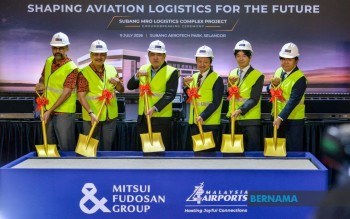
Malaysia Airports Holdings Bhd (MAHB) and Mitsui Fudosan Group have announced a landmark RM80 million investment to build a comprehensive air cargo and logistics hub at Subang Airport, signalling a significant evolution in how the country's aviation assets are being developed and monetised. The joint venture, which sees MAHB contribute a 30 per cent equity stake while Mitsui Fudosan provides the remaining 70 per cent, was formally inaugurated at a groundbreaking ceremony on Thursday at the Subang facility.
Transport Minister Anthony Loke Siew Fook endorsed the partnership as a forward-thinking approach to unlocking dormant value within Malaysia's airport infrastructure. Rather than relying solely on internal capabilities, the minister explained that MAHB would leverage its substantial land holdings across the country by collaborating with experienced international developers. This strategy reduces the operational burden on Malaysia's largest airport operator while attracting foreign investment and expertise that might otherwise be unavailable through domestic channels alone.
Mitsui Fudosan brings considerable pedigree to the arrangement, having successfully designed and operated multiple logistics facilities at Tokyo's Haneda Airport, one of Asia's busiest aviation hubs. The Japanese conglomerate's experience in managing high-capacity logistics infrastructure in a complex, space-constrained environment offers valuable lessons for Subang's expansion. According to Minister Loke, tapping into Mitsui Fudosan's institutional knowledge substantially mitigates risks that MAHB might otherwise face in developing and operating such a facility independently.
The new complex will be housed within Subang Aerotech Park, an industrial zone specifically designated for aviation and aerospace enterprises. The project entity, established as MFMA Industrial Sdn Bhd, represents the formal partnership between Mitsui Fudosan (Asia) Malaysia Sdn Bhd and Malaysia Airports (Subang) Sdn Bhd. This legal structure allows both parties to pool resources, share decision-making authority, and distribute financial returns according to their respective stakes in the venture.
The facility is strategically positioned to serve maintenance, repair, and overhaul (MRO) operations alongside general air cargo logistics. This dual-purpose design reflects the broader ecosystem developing around Subang, where aviation businesses increasingly require integrated support services. By combining MRO capabilities with cargo handling infrastructure, the complex positions itself to capture multiple revenue streams from airlines, aircraft leasing companies, and freight operators operating in the region.
For Malaysia, the project carries implications that extend beyond Subang's borders. Southeast Asia's air cargo sector has experienced sustained growth, particularly following post-pandemic normalisation of global supply chains. Malaysia's geographic position as a regional logistics hub makes investments in cargo infrastructure strategically important for maintaining competitiveness against neighbouring hubs like Singapore and Thailand. The Subang facility contributes to a broader ecosystem that enhances Malaysia's attractiveness to international logistics providers and aircraft maintenance companies.
Mitsui Fudosan's decision to commit substantial capital to Malaysian infrastructure suggests confidence in the country's medium-term economic trajectory and regulatory stability. The company's willingness to accept a majority stake also indicates that it views the Subang project as strategically significant, rather than a peripheral investment. This confidence, particularly from an established Japanese developer, may encourage other international property and logistics firms to evaluate similar opportunities within Malaysia's airport network.
The partnership model employed here reflects a broader global trend in which airport operators unbundle their traditional business lines. Rather than attempting to develop and operate every ancillary service internally, airports increasingly prefer equity partnerships with specialists who can deliver superior operational performance and financial returns. This approach allows MAHB to realise value from its land assets without diverting management attention from core airport operations.
The MRO logistics complex arrives at a propitious moment for Malaysia's aerospace sector. Subang Airport hosts a concentration of aircraft maintenance facilities and aerospace-related businesses, creating a natural cluster effect. By adding dedicated cargo and logistics infrastructure, the development enhances the ecosystem's functionality and attractiveness to companies considering regional headquarters or operational bases.
Minister Loke's remarks underscore government support for such public-private partnerships, positioning them as vehicles for infrastructure development that align private capital incentives with national economic objectives. This approach contrasts with purely government-funded infrastructure projects, which face budget constraints and often experience implementation delays. By structuring the Subang investment as a commercial partnership, both parties benefit from clear profit motives and accountability mechanisms.
The RM80 million investment commitment reflects confidence in Subang's continued relevance within Malaysia's aviation ecosystem. While Kuala Lumpur International Airport (KLIA) serves as the primary long-haul gateway, Subang's proximity to Malaysia's economic heartland and its specialised role in MRO, business aviation, and regional cargo operations ensure sustained demand for such facilities.
Looking ahead, this partnership may serve as a template for developing other airport-adjacent infrastructure across MAHB's portfolio. Success at Subang could prompt similar joint ventures at other Malaysian airports, potentially unlocking billions of ringgit in dormant asset value. For investors monitoring Malaysia's infrastructure development pipeline, the Subang project demonstrates that even mature airport operators can reinvent themselves through strategic partnerships and innovative asset utilisation models.

