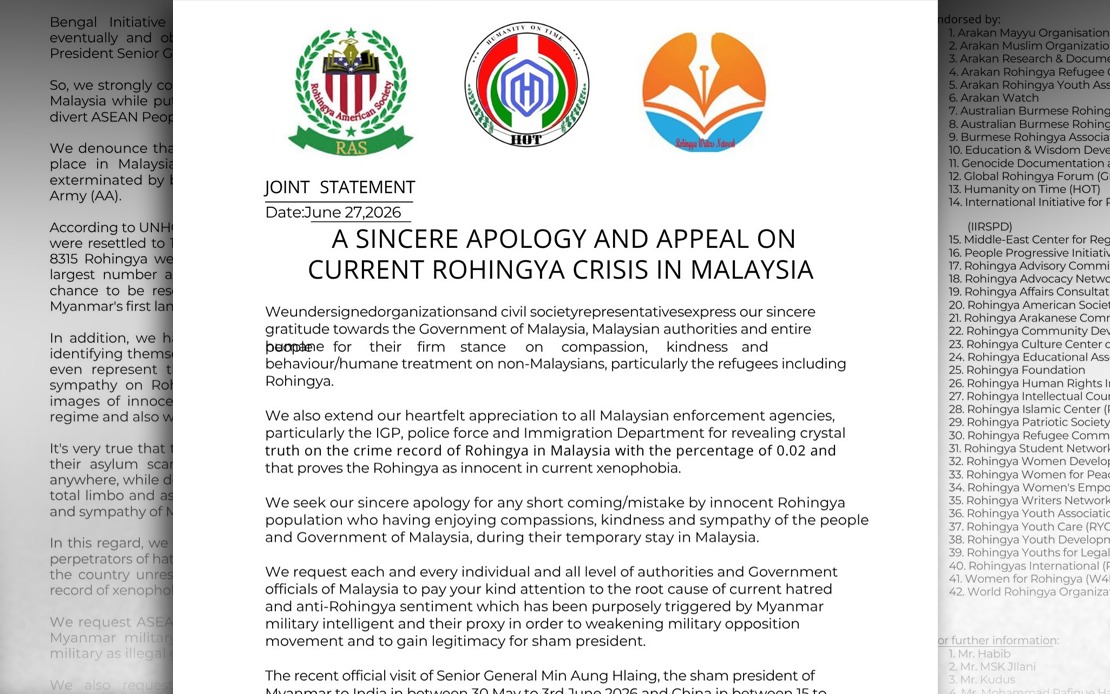
Malaysian Humanitarian Aid and Relief (MAHAR) has responded positively to a collective apology issued by 40 Rohingya non-governmental organisations, characterising the move as an encouraging demonstration of accountability within the refugee advocacy sector. The acceptance of this apology represents a significant moment in the dialogue between humanitarian actors and Malaysia's broader civil society, signalling a willingness among established aid organisations to engage constructively with grassroots refugee support groups. However, MAHAR's statement makes clear that accepting the apology is only a starting point for what the organisation views as a more comprehensive agenda around refugee management and community cohesion in Malaysia.
In articulating its response, MAHAR has laid out an expanded vision of what effective humanitarian work should encompass. The organisation contends that simply delivering food parcels and temporary shelter, while essential, falls short of the full responsibilities that NGOs should undertake when operating within host communities. This position reflects growing recognition across Southeast Asia that refugee assistance exists within a complex ecosystem of social, legal, and cultural considerations that cannot be separated from the provision of material aid. MAHAR's framework suggests that humanitarian organisations have an obligation to function as educators and bridges between refugee populations and their Malaysian hosts, a role that extends beyond traditional charity into the realm of social integration and civic responsibility.
Central to MAHAR's vision is the notion that Rohingya NGOs must actively cultivate respect among the refugee population for Malaysian legal systems, established cultural practices, and local values. This messaging carries particular weight in Malaysia, where public sentiment toward refugee communities has become increasingly sensitive in recent years. By calling on NGOs to take the lead in promoting compliance with local norms, MAHAR positions these organisations as essential mediators who can help prevent friction between refugees and Malaysian communities. The emphasis on cultural and legal integration reflects an understanding that long-term stability and acceptance depend not merely on managing material deprivation but on fostering genuine social cohesion and mutual understanding across different populations sharing the same urban and rural spaces.
Beyond the immediate context of refugee support in Malaysia, MAHAR has urged Rohingya NGOs to escalate their international advocacy efforts aimed at reversing the persecution of Rohingya people in Myanmar. This counsel reflects a sophisticated understanding of humanitarian crises: that alleviating symptoms without addressing root causes perpetuates dependency and extends suffering indefinitely. By encouraging NGOs to engage in global advocacy for systemic change in Myanmar, MAHAR suggests that truly transformative humanitarian work must operate simultaneously at local, national, and international levels. The suggestion that lasting solutions require ending persecution in Myanmar rather than merely managing refugee flows speaks to the interconnected nature of displacement crises in Southeast Asia, where countries like Malaysia bear the burden of host communities while the underlying political instability remains unresolved.
MAHAR President Jismi Johari has emphasised that humanitarian operations must prioritise the safety and wellbeing of both refugee populations and the Malaysian communities that host them. This dual-focus framework represents an important shift in how some humanitarian actors now conceptualise their responsibilities. Rather than treating refugee assistance as a zero-sum proposition where refugee welfare necessarily conflicts with host community interests, Johari's approach suggests that protecting both groups simultaneously is not only possible but essential for sustainable outcomes. This perspective has gained traction globally in response to criticisms that refugee advocacy can sometimes overlook legitimate security and social concerns raised by host populations.
Johari acknowledged that concerns raised by Malaysian citizens regarding safety issues deserve serious consideration and should not be dismissed outright, particularly when raised by individuals directly affected by incidents involving members of refugee communities. This recognition signals MAHAR's understanding that public trust in humanitarian systems depends on addressing real grievances with transparency rather than defensive posturing. In the Malaysian context, where instances of crime or social disorder involving foreign nationals have periodically sparked broader public anxiety, this approach attempts to separate legitimate concerns from xenophobic generalisation. By validating that certain Malaysians have experienced genuine problems while maintaining that criminal behaviour should not be attributed to entire communities, MAHAR charts a middle path between advocacy and pragmatism.
Simultaneously, Johari has cautioned against painting entire refugee communities through the lens of individual misconduct. His assertion that wrongdoing exists across all societies represents a straightforward appeal to logical consistency and fairness. This argument proves particularly relevant in Malaysia, where media coverage of refugee-related incidents can sometimes eclipse reporting on crimes committed by citizens or other foreign populations. By insisting on proportionality in how different communities are evaluated, MAHAR implicitly critiques the phenomenon of selective attention and double standards that can distort public perception of crime and security threats. The organisation's framing suggests that honest assessment of criminal justice issues requires examining patterns rather than isolated incidents and applying equivalent standards across different demographic groups.
The resolution of community tensions, according to MAHAR's analysis, requires empathy, mutual respect, and active engagement from all stakeholders involved. This formula acknowledges that addressing safety concerns and building cohesive societies demands genuine dialogue rather than top-down management. In the Malaysian context, where civil society has demonstrated capacity for organising around shared concerns, MAHAR's call for constructive engagement reflects optimism that Rohingya NGOs, local civil society groups, and government agencies can collaborate on solutions that protect everyone's interests. The emphasis on empathy suggests that understanding the perspectives of different groups—whether Malaysian citizens worried about security or Rohingya facing persecution—provides essential groundwork for sustainable progress.
MAHAR has reaffirmed its institutional commitment to humanitarian practice grounded in three pillars: justice, safety, and human dignity. These principles apply equally to refugee populations and Malaysian residents, according to the organisation's statement. This framing represents a significant evolution in how humanitarian organisations in Southeast Asia conceptualise their ethical obligations. Rather than viewing justice and safety as potentially competing values, MAHAR insists that legitimate humanitarian work must deliver on all fronts simultaneously. The inclusion of human dignity for both refugees and host communities signals that sustainable humanitarian systems require balanced attention to the vulnerabilities and rights of all people affected by displacement and the hosting of refugee populations.

