The MADANI Government has doubled down on its pledge to translate macroeconomic achievements into concrete improvements for Malaysians across all income levels, according to Communications Minister Datuk Seri Fahmi Fadzil. Speaking in Kota Kinabalu, Fahmi stressed that while national statistics demonstrate robust economic expansion—encompassing investment inflows, government revenue, foreign reserves, gross domestic product growth and international trade—these headline figures matter only insofar as they enhance the lived experience of ordinary citizens.
The minister's remarks underscore a philosophical distinction between abstract economic performance and what might be termed the "felt economy"—the actual purchasing power, affordability of essentials, and financial security that households experience month to month. This framing has become central to how the current administration justifies its policy directions and differentiates itself from previous approaches. Rather than celebrating growth figures alone, the government seeks to demonstrate that improved macro conditions are filtering through to individual bank accounts and household budgets.
Fahmi illustrated this principle by referencing the government's diesel subsidy retargeting initiative, branded BUDI MADANI, which seeks to direct fuel assistance more efficiently to those most in need. The scheme represents a deliberate policy choice to move away from universal subsidies toward means-tested support, acknowledging that blanket subsidies often deliver disproportionate benefits to higher-income groups. The minister emphasised that implementation of such programmes requires careful consideration of local realities, particularly the geographic challenges faced by residents in East Malaysia.
Sabah and Sarawak present distinctive logistical complexities absent in peninsular Malaysia. Large distances between district centres mean that rural populations incur substantial transportation costs simply to access basic government services, goods and markets. These travel expenditures represent a significant drag on household budgets in sparsely populated regions. By tailoring subsidy programmes to account for such geographic variations, the government aims to ensure that policy design reflects actual community needs rather than applying uniform measures that may prove inadequate or misdirected in certain contexts.
Prime Minister Datuk Seri Anwar Ibrahim and his Cabinet, according to Fahmi, have made addressing such distributional concerns a priority within their economic deliberations. This signals a shift toward what policymakers term inclusive growth—expansion that simultaneously reduces inequality and ensures benefits reach marginalised or underserved populations. The emphasis on geographic specificity in policy design suggests the administration recognises that a one-size-fits-all approach to economic management poorly serves a nation as geographically and demographically diverse as Malaysia.
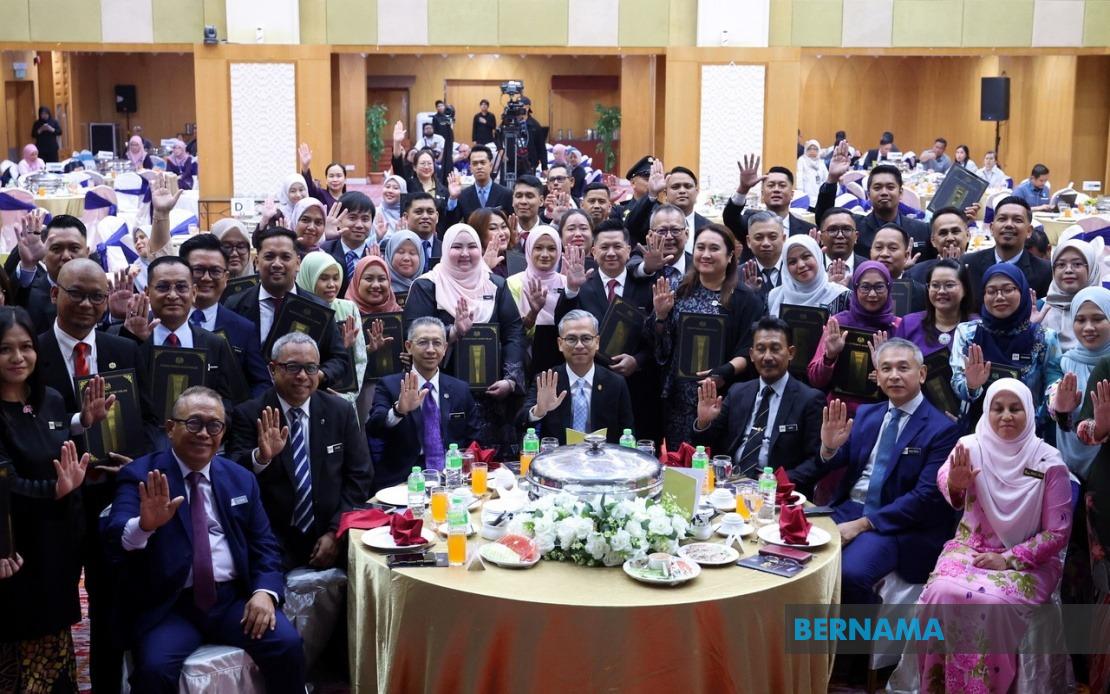
Fahmi delivered these comments while officiating the Communications Ministry's Sabah and Labuan Zone Excellent Service Awards ceremony, an event recognising outstanding performance within the ministry's regional operations. The gathering included senior officials such as Communications Ministry secretary-general Datuk Abdul Halim Hamzah and representatives from affiliated agencies including the Malaysian Broadcasting Department, Community Communications Department, and the National Film Development Corporation (FINAS). The venue and occasion provided an appropriate platform for articulating government messaging around inclusive economic policy.
Beyond subsidy targeting, Fahmi stressed that ministries and government agencies bear responsibility for communicating policy rationales transparently to the public. Misunderstanding or misinterpretation of government programmes can erode public confidence and undermine policy effectiveness. When citizens lack clear explanations for programme design—particularly when changes affect their material circumstances—they may interpret reforms as hostile or inequitable. Accordingly, the minister urged government communicators to invest effort in comprehensive, accessible explanations of how policies function and whom they are designed to benefit.
This emphasis on communication reflects recognition that economic policy operates within a political and social environment where public perception shapes political sustainability. A programme mathematically optimised to improve overall welfare may generate political backlash if beneficiaries and affected groups misunderstand its mechanisms or believe themselves unfairly treated. Clear, culturally appropriate communication about policy objectives, implementation timelines and expected impacts thus becomes integral to successful governance, not merely an afterthought.
The MADANI framework itself—a policy platform introduced following the 2022 general election—centres on shifting from growth-focused development to what architects term human-centric economics. This philosophical reorientation suggests that successive administrations recognise growing public demand for economic policies demonstrably improving living standards for working and middle-class Malaysians. Rising inflation, stagnant wage growth and increasing cost pressures on essential services have made citizens increasingly sceptical of announcements highlighting GDP expansion or foreign investment records when their own purchasing power declines.
For Malaysian policymakers and observers, Fahmi's remarks illuminate ongoing tensions within governance between aggregate economic metrics and distributional outcomes. Southeast Asian nations pursuing rapid development have frequently encountered situations where national accounting statistics improve substantially whilst many citizens experience stagnating or declining material circumstances. Malaysia's own middle-income country status makes this tension particularly acute—the nation has achieved significant development outcomes yet faces challenges in ensuring broad-based prosperity and addressing regional disparities that leave East Malaysian populations relatively disadvantaged.
The government's commitment to people-centred economics also carries implications for regulatory and subsidy frameworks across sectors including energy, transport, and essential goods. Policymakers increasingly examine whether universal price controls or subsidies effectively serve equity objectives or whether targeted, geographically sensitive approaches better achieve distributional goals. These discussions will likely intensify as Malaysia navigates energy transition, fiscal consolidation and rising commodity prices—factors that constrain government capacity to maintain comprehensive universal subsidies whilst pressuring household budgets upward.
Looking forward, the efficacy of MADANI's people-economy approach will be measured through household survey data capturing real living standards, consumer confidence indices, and wage growth relative to inflation. These metrics, more than headline GDP figures, will ultimately determine whether the government's professed commitment to tangible prosperity translates into electoral support and public legitimacy. In this sense, Fahmi's emphasis on connecting national economic performance to individual wallets represents not merely rhetorical positioning but recognition that governance sustainability increasingly depends on demonstrable improvements in how ordinary citizens experience their economic circumstances.

