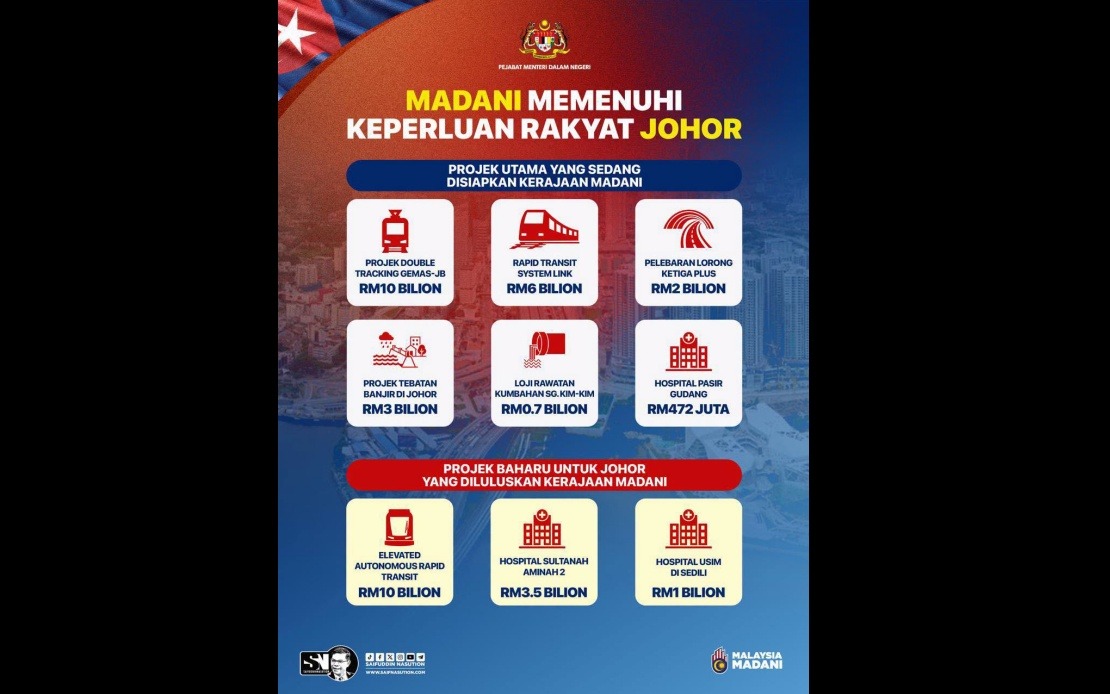
The MADANI Government is reinforcing its pledge to drive equitable and sustainable development throughout Malaysia, with Pakatan Harapan secretary-general Datuk Seri Saifuddin Nasution Ismail emphasizing that no state will be left behind in the nation's development agenda. Speaking in Johor Bahru on June 29, Saifuddin outlined how Prime Minister Datuk Seri Anwar Ibrahim's administration has structured its priorities around core infrastructure investment, public transport expansion, healthcare advancement, and flood prevention measures—all designed to tangibly improve living standards for ordinary Malaysians.
The emphasis on tangible outcomes over headline figures reflects a deliberate shift in how the current administration frames development success. Rather than merely citing investment volumes or project numbers, government officials are increasingly focused on demonstrating how these initiatives translate into everyday benefits for citizens. This rhetorical approach signals recognition that Malaysians have grown skeptical of grand announcements without visible improvements to transportation networks, hospital waiting times, or flood prevention in vulnerable communities. For Johor specifically, this messaging carries particular weight given the state's historical role as Malaysia's economic engine and its vulnerability to seasonal flooding that affects thousands of residents annually.
Johor currently serves as a testing ground for several flagship projects that exemplify the MADANI framework. The Gemas-Johor Bahru Electrified Double Tracking Project represents a substantial investment in rail infrastructure modernization, promising faster and more reliable connections between one of Malaysia's major industrial hubs and the broader rail network. Complementing this initiative, the Rapid Transit System Link aims to address urban mobility challenges in the Johor Bahru metropolitan area, where traffic congestion has become increasingly problematic. These transportation investments signal the government's recognition that economic competitiveness depends heavily on efficient movement of both people and goods.
Highway infrastructure receives parallel attention through the third lane widening of the PLUS Highway, a crucial artery connecting Kuala Lumpur with southern regions. This expansion project addresses bottlenecks that have long plagued commuters and commercial operators, particularly during peak travel periods. The investment demonstrates understanding that modern logistics and workforce mobility require world-class transport corridors, especially as Malaysia competes with regional neighbors for foreign direct investment and talent retention.
Flood mitigation emerges as another critical policy pillar, reflecting deepening climate vulnerability across Southeast Asia. The Johor flood mitigation project directly targets one of the state's most pressing challenges, where recurring inundation disrupts economic activity and displaces thousands annually. The Sungai Kim Kim Sewage Treatment Plant investment addresses environmental degradation that exacerbates flooding risks while simultaneously improving water quality and public health outcomes. These projects underscore how sustainable development now requires integrated approaches to climate adaptation and environmental protection.
Healthcare expansion forms the third major development stream. The Pasir Gudang Hospital addresses existing capacity constraints in a densely populated industrial zone, while newly approved projects including Sultanah Aminah Hospital 2 and USIM Hospital in Sedili indicate planned geographic expansion of healthcare infrastructure across the state. For Malaysia's aging population and the growing burden of non-communicable diseases, hospital bed capacity and specialist service availability have become critical development indicators. These investments position Johor to better serve not only its resident population but potentially medical tourists from regional markets.
The government's approval of the Elevated Autonomous Rapid Transit system represents commitment to forward-looking urban transport solutions. This technology-dependent approach aligns with broader digital and smart city aspirations, positioning Malaysia as an early adopter of autonomous transport systems in Southeast Asia. Success with E-ART implementation could create templates for other Malaysian cities and regional capitals exploring similar solutions.
For Malaysian policymakers and regional observers, the MADANI development framework reflects several strategic considerations. First, it acknowledges that infrastructure investment alone cannot sustain political legitimacy—visible improvements in service delivery, job creation, and quality-of-life metrics matter equally. Second, it recognizes that balanced regional development remains politically essential in a federal system where state-level grievances can accumulate into electoral challenges. Third, it demonstrates that climate vulnerability and environmental degradation now occupy central positions in development planning, no longer treated as secondary concerns.
The emphasis on inclusive development carries particular resonance in Johor, where rapid industrialization and urbanization have created winners and losers. Strategic investment in public transportation, healthcare access, and flood protection promises to distribute development benefits more broadly than purely market-driven growth patterns would achieve. However, implementation capacity and project execution timelines will ultimately determine whether these pledges translate into realized benefits.
For Southeast Asian governments grappling with similar development challenges, the MADANI approach offers a counterbalance to purely growth-focused models that can amplify inequality. Malaysia's explicit commitment to sustainability, healthcare access, and climate adaptation provides a potential model for regional peers, though success requires sustained political will, adequate funding, and effective bureaucratic execution—challenges that extend far beyond rhetorical commitment. The coming years will reveal whether the government can deliver on this ambitious development agenda while managing competing fiscal priorities and regional expectations.

