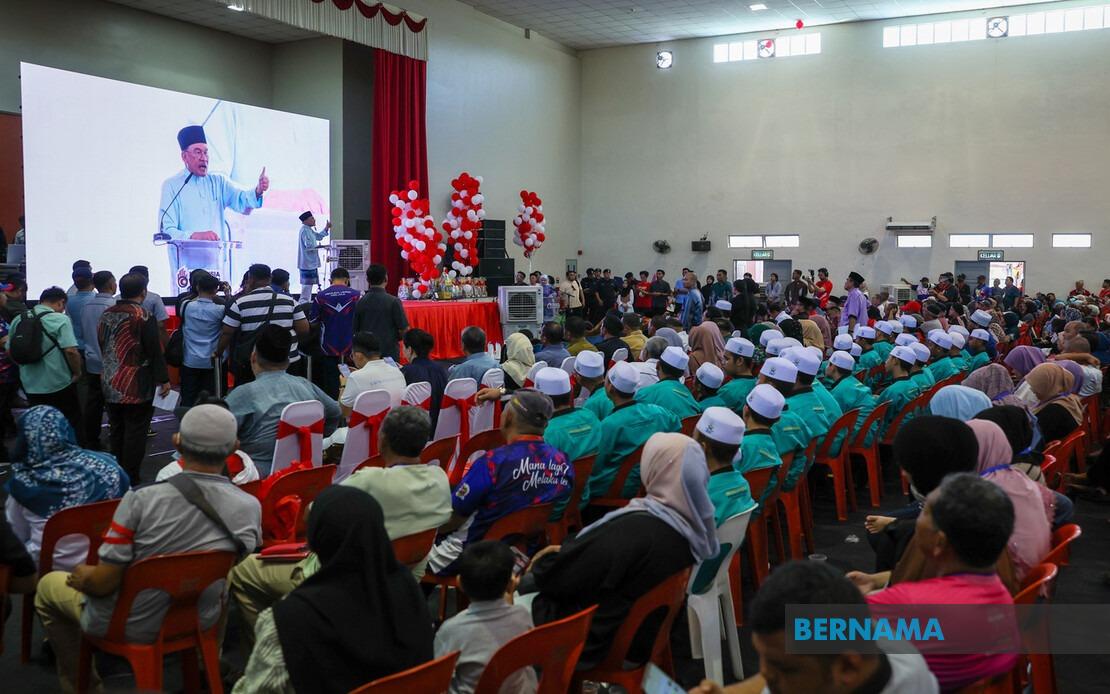
Prime Minister Datuk Seri Anwar Ibrahim has moved to address longstanding concerns about educational equity across Malaysia's diverse school systems, asserting that the MADANI Government will pursue a balanced approach that supports all communities without abandoning any segment. Speaking at the Gelombang MADANI Carnival in Alor Gajah on Wednesday, Anwar sought to reassure stakeholders that increased allocations for Islamic educational institutions do not represent a departure from the government's commitment to vernacular education.
The Prime Minister's statement carries particular significance given Malaysia's complex education landscape, where Chinese and Tamil vernacular schools have historically competed with government-funded institutions for resources and attention. Anwar's framing emphasises that the restoration and enhancement of funding for pondok schools and tahfiz institutions addresses a historical neglect rather than representing new preferential treatment. He indicated that long-awaited announcements regarding allocations for Chinese and Tamil schools would materialise within approximately two weeks through a formal event in Kuala Lumpur, signalling concrete follow-through on these commitments.
Since assuming the premiership in 2022 and the formation of the Unity Government, Anwar explained that his administration has systematically restored and expanded support for Islamic educational institutions after a period of discontinued assistance. The restoration began in 2023 and expanded further in 2024, reflecting what the Prime Minister characterised as correcting previous imbalances. This incremental approach suggests a deliberate strategy to rebuild infrastructure and capacity in religious schools while maintaining parallel commitments to other education streams.
Anwar framed educational equity within a broader governance philosophy centred on social cohesion and Malaysia's success as a plural society. He emphasised that the country's stability and harmony depend on all communities receiving fair attention and resources, positioning equitable education policy as foundational to intercommunal peace. His comments acknowledged that without deliberate government action to prevent any group from feeling marginalised, the conditions for social tension increase—a concern particularly relevant in Southeast Asia where education systems can become flashpoints for communal grievances.
During the event, the Prime Minister announced RM1.29 million in infrastructure allocations distributed across 13 Islamic educational institutions throughout Melaka State. The funding reflects varied grant amounts reflecting different institutional needs and capacities. Recipients included Madrasah Tahfiz Al-Quran Wal Qiraat Kota Melaka, which received RM250,000, alongside multiple Sekolah Agama Rakyat establishments in localities such as Durian Tunggal and Taman Maju, each receiving RM100,000 to RM140,000. These targeted investments aim to upgrade physical infrastructure, suggesting that previous underinvestment had resulted in deteriorating facilities across the religious education sector.
A critical dimension of Anwar's vision involves modernising Islamic educational institutions to prevent them from becoming educationally disadvantaged relative to other school systems. He specifically mentioned integrating artificial intelligence and computer training into pondok school curricula—a significant marker of contemporary educational aspirations. The integration of technology-focused learning demonstrates awareness that religious education must remain academically competitive and relevant to contemporary employment markets, otherwise risking generational disadvantage for students educated exclusively within the traditional Islamic school system.
Anwar invoked the Islamic concept of 'ummatan wasatan'—often translated as the middle path or balanced community—as philosophical grounding for the government's education approach. Drawing on Surah Al-Baqarah verse 143, he articulated a vision of Malaysia as a nation exemplifying balanced conduct across faith, knowledge, character, and environmental stewardship. In this conception, equitable education policy represents not merely administrative fairness but a manifestation of Islamic principles about conducting oneself and society with integrity and moderation.
The Prime Minister extended this reasoning to encompass Malaysia's wider international reputation and soft power positioning. He suggested that a country successfully maintaining peaceful coexistence across religious and ethnic lines, with equitable institutional support across different educational traditions, becomes a beacon and model for societies struggling with communal tensions. This aspirational framing positions Malaysia's plural education system as a competitive advantage rather than a burden, suggesting that the nation's diversity, properly managed through deliberate equitable policy, generates distinctive international standing.
Anwar's remarks implicitly acknowledged that previous administrations had allowed perceptions of preferential treatment towards particular education streams to develop, potentially undermining community confidence in governmental fairness. By explicitly committing to transparent, timely announcements regarding vernacular school allocations, the current government appears intent on demonstrating commitment through concrete action rather than rhetoric alone. The two-week timeline for Kuala Lumpur announcements suggests these commitments represent firmed policy rather than aspirational statements.
For Malaysian policymakers and education stakeholders, Anwar's positioning suggests that the MADANI administration views education funding decisions through a social cohesion lens rather than purely budgetary or sectarian considerations. The emphasis on preventing any community from feeling neglected reflects understanding that education systems carry profound symbolic weight beyond their immediate pedagogical functions, with funding decisions communicating governmental priorities and respect to constituent communities.
The announcement also indicates practical government action to address longstanding resource disparities within the Islamic education sector itself. Rather than treating pondok schools and tahfiz institutions as homogeneous, the varied allocation amounts suggest tailored assessment of individual institutional needs, potentially reflecting efforts to prioritise institutions most severely affected by previous resource constraints or those serving particularly vulnerable student populations.

