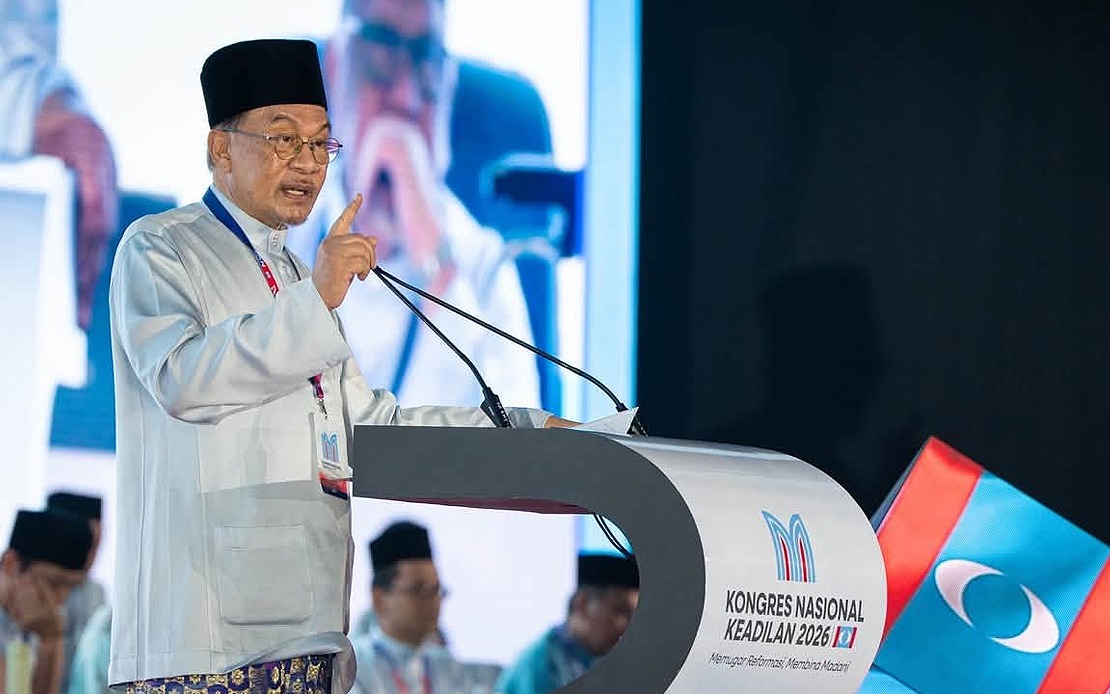
The MADANI Government's reform agenda risks losing traction if its benefits do not reach ordinary Malaysians, according to Prime Minister's Senior Political Advisor Tengku Datuk Seri Zafrul Tengku Abdul Aziz. Speaking during the 2026 PKR National Congress in Melaka, he highlighted a critical gap between policy implementation and public awareness, cautioning that impressive economic statistics alone are insufficient to sustain public support. The congress, themed "Reviving Reform, Building MADANI", convened at the Melaka International Trade Centre (MITC) with deliberations closely aligned to PKR President Datuk Seri Anwar Ibrahim's keynote address on the party's policy direction.
Tengku Zafrul's intervention reveals underlying concerns within the ruling coalition about translating ambition into outcomes. Malaysia's economy expanded by six percent, surpassing analyst expectations, yet the Senior Political Advisor stressed that such macroeconomic achievements mean little if citizens cannot discern concrete improvements in their daily lives. This disconnect between headline growth and household-level prosperity has become a persistent challenge for governments across Southeast Asia, where rapid statistical improvements often mask unequal distribution of economic gains. For Malaysia specifically, where income disparities remain stubbornly wide and certain regions lag significantly in development indicators, the concern carries particular weight.
The advisor identified communication as a critical vulnerability in the administration's strategy. The MADANI Government has implemented numerous initiatives spanning institutional reform, economic policy, and social programmes, yet public awareness remains disappointingly low. Tengku Zafrul frankly acknowledged that responsibility for this awareness gap lies not with citizens but with government channels themselves. He pointed out that extensive lists of achievements circulated by party leadership hold little value if Malaysians remain unaware of what these programmes entail or how to access their benefits. This candid assessment suggests the administration recognises that political credibility increasingly depends on effective public engagement rather than policy announcements alone.
Among the signature initiatives highlighted by Anwar Ibrahim at the congress was the abolition of the Universities and University Colleges Act (AUKU), a longstanding demand from student activists and civil society organisations. This reform represents a symbolic victory for democratic freedoms, removing restrictions on campus political expression that had persisted since 1971. Alongside this, the government has prioritised rehabilitation of the Federal Land Development Authority (FELDA), an institution central to Malaysia's rural development model but latterly beset by governance challenges and financial difficulties. These policy pillars illustrate the MADANI coalition's intention to address systemic institutional weaknesses whilst expanding democratic space, objectives that resonate particularly strongly with younger voters and reform-minded constituencies.
The upcoming Budget will introduce additional economic initiatives designed to broaden the distribution of growth benefits. Without detailing specific measures, Tengku Zafrul emphasised that fiscal policy will reinforce the government's commitment to ensuring prosperity reaches beyond concentrated urban and corporate sectors. For Southeast Asian observers, Malaysia's efforts to balance macroeconomic stability with inclusive growth carry regional implications, particularly as middle-income economies across the region grapple with similar challenges of maintaining competitiveness whilst addressing rising inequality and social expectations.
Tengku Zafrul's remarks underscore PKR's recognition that the reform struggle remains incomplete. The party's role within the broader MADANI coalition carries responsibility for demonstrating that genuine political change translates into material improvements for constituents. This burden is particularly acute for PKR given its identity as a reform-oriented party with a base of supporters motivated by democratic ideals and social justice concerns. If such supporters perceive that reforms are largely symbolic or that benefits accrue disproportionately to certain groups, electoral and organisational consequences could follow.
The advisor argued that sustained public trust hinges on improving both the mechanics of programme delivery and internal party discipline. PKR's strength, he contended, depends on cultivating readiness to listen to grassroots feedback and strengthening organisational machinery to ensure reform commitments actually materialise. This diagnosis suggests the party recognises gaps between aspiration and execution, areas where bureaucratic inertia, resource constraints, or coordination failures have hindered impact. Addressing such shortcomings requires not only policy innovation but also patient institutional development, a less glamorous but arguably more essential dimension of governance reform.
The congress debates generally reflected alignment with Anwar Ibrahim's broader policy framework, indicating substantial internal cohesion within PKR on strategic direction. Maintaining such unity whilst pressing reform agendas forward represents a significant challenge, particularly given the diversity of interests within Malaysia's ruling coalition. The Melaka congress provided an opportunity to reinforce party messaging and recalibrate approach based on feedback from delegates representing constituency-level concerns. Such periodic political gatherings serve important functions in democratic systems, enabling grassroots engagement with leadership and vice versa.
Looking forward, the MADANI Government faces the persistent challenge of validating its reform credentials through observable improvements in institutional performance, economic opportunity distribution, and democratic participation. For Malaysian voters, particularly those who supported the coalition in hope of genuine change, tangible results matter more than sophisticated policy papers or leadership pronouncements. Tengku Zafrul's emphasis on closing the gap between reform ambition and popular experience represents implicit acknowledgment that the administration cannot rely on goodwill indefinitely. Rebuilding institutional trust, eroded through decades of governance concerns, requires sustained demonstration that government serves all citizens equitably. As Malaysia navigates complex regional geopolitical and economic dynamics, such domestic confidence proves essential for maintaining the political stability necessary to pursue longer-term national objectives.

