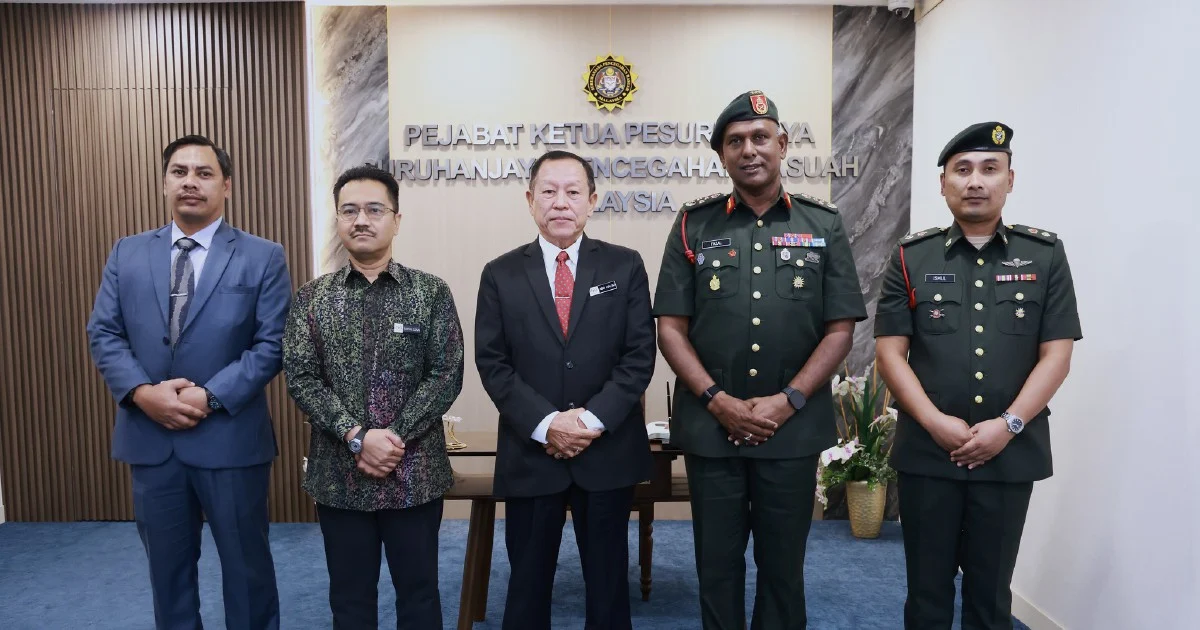
The Malaysian Anti-Corruption Commission and the armed forces have announced plans to substantially elevate their collaborative efforts in combating corruption, marking a significant broadening of institutional cooperation between two critical national bodies. This enhanced partnership, based in Putrajaya, will centre on the systematic exchange of intelligence and information, alongside improvements to governance frameworks that protect both institutions from internal vulnerabilities that corrupt actors might exploit.
The decision to formalise deeper intelligence-sharing protocols reflects a growing recognition across Malaysia's security and oversight apparatus that corruption undermines military effectiveness and national resilience. By pooling analytical resources and operational information, the MACC and armed forces can identify patterns of misconduct that might otherwise escape detection within siloed institutional structures. This horizontal cooperation model has proven effective in other jurisdictions where anti-corruption agencies and defence establishments have jointly confronted systematic malfeasance.
Malaysia's defence sector has historically presented particular challenges for integrity enforcement, given the scale of procurement operations, the geographic dispersion of military installations, and the sensitivity surrounding classified information. The armed forces manage substantial budgets allocated to equipment acquisition and infrastructure development, creating environments where corrupt networks can flourish if oversight mechanisms remain fragmented. By establishing direct channels with the MACC, military leadership demonstrates commitment to rooting out internal misconduct that compromises operational readiness and squanders public resources.
The intelligence-sharing framework will likely encompass several operational domains. Personnel investigations, where both institutions maintain separate intelligence networks, can now benefit from cross-institutional data comparison. Asset declaration compliance, financial transaction monitoring, and procurement transparency initiatives will gain depth when armed forces internal audit findings can be correlated with broader MACC investigations into corruption networks operating across multiple sectors. This integrated approach prevents corrupt officials from exploiting jurisdictional boundaries or institutional information gaps.
For Malaysian observers tracking anti-corruption progress, this agreement signals institutional maturation at the MACC, which has faced criticism for inconsistent prosecution and perceived selectivity in pursuing high-level cases. Securing formal cooperation with the armed forces demonstrates the commission's expanding influence and capacity to coordinate across previously separate governmental domains. The armed forces, conversely, show willingness to open traditionally insular organisations to external scrutiny, acknowledging that institutional transparency enhances rather than threatens operational capability.
Regionally, Malaysia's effort resonates with broader Southeast Asian trends toward strengthening accountability mechanisms. Singapore's rigorous civil service standards and Indonesia's increasingly assertive Corruption Eradication Commission have highlighted how institutional cooperation strengthens anti-corruption outcomes. Thailand's military, despite governance challenges, has maintained formal integrity units. Vietnam's Communist Party has pursued systematic anti-corruption campaigns involving security apparatus coordination. Malaysia's initiative positions the country within these regional conversations, suggesting receptiveness to governance evolution.
The emphasis on governance enhancement within the partnership framework addresses structural vulnerabilities rather than merely pursuing individual cases. Both institutions will likely examine procurement procedures, appointment mechanisms, financial controls, and information security protocols that create opportunities for corruption. By jointly redesigning these systems, the MACC and armed forces can implement preventive measures that complement investigative work. This forward-looking dimension offers more sustainable corruption reduction than reactive prosecution alone.
For Malaysian taxpayers and citizens, the implications extend beyond symbolic institutional cooperation. Defence budgets represent substantial public expenditure, and wastage through corrupt procurement inflates military costs while reducing capability. Personnel morale within the armed forces suffers when corrupt officers advance while honest soldiers remain undercompensated. Public trust in both institutions improves when citizens observe genuine commitment to accountability. The intelligence-sharing agreement thus connects to fundamental questions about effective governance and fiscal responsibility.
Implementation challenges will test the durability of this partnership. Institutional cultures differ substantially between the MACC, a civilian oversight body, and the armed forces, shaped by hierarchical command structures and operational security requirements. Balancing information transparency with classified military sensitivity will require sophisticated protocols. Personnel trained within closed military systems may resist sharing sensitive intelligence with external agencies, even nominally cooperative ones. Regular leadership engagement and clear operational guidelines will prove essential to translating formal agreements into substantive cooperative practice.
The partnership's success will depend partly on adequate resourcing. Both institutions must invest in compatible information systems, specialized training for liaison officers, and dedicated analytical capacity to process shared intelligence effectively. Without financial commitment proportionate to ambition, the cooperation framework risks becoming ceremonial rather than transformative. Malaysian policymakers should ensure budgetary allocations match the stated importance of this collaboration.
Longer-term, this development opens possibilities for expanding the intelligence-sharing model to other sectors where corruption poses systemic risks. Procurement-related malfeasance extends across infrastructure development, healthcare supply chains, and education sector contracts. Extending similar cooperative frameworks to relevant agencies managing these domains could multiply anti-corruption effectiveness across government. Malaysia's MACC and armed forces initiative may thus represent the foundation for more comprehensive institutional coordination against corrupt networks operating throughout the public service.
The announcement reflects genuine evolution in Malaysia's approach to governance challenges. Rather than viewing anti-corruption and national defence as separate institutional domains, both are now explicitly understood as interconnected components of national interest protection. This integrated perspective, properly implemented, can yield substantial improvements in both institutional integrity and public sector accountability, setting precedent for more ambitious governance reforms across Malaysian government.

