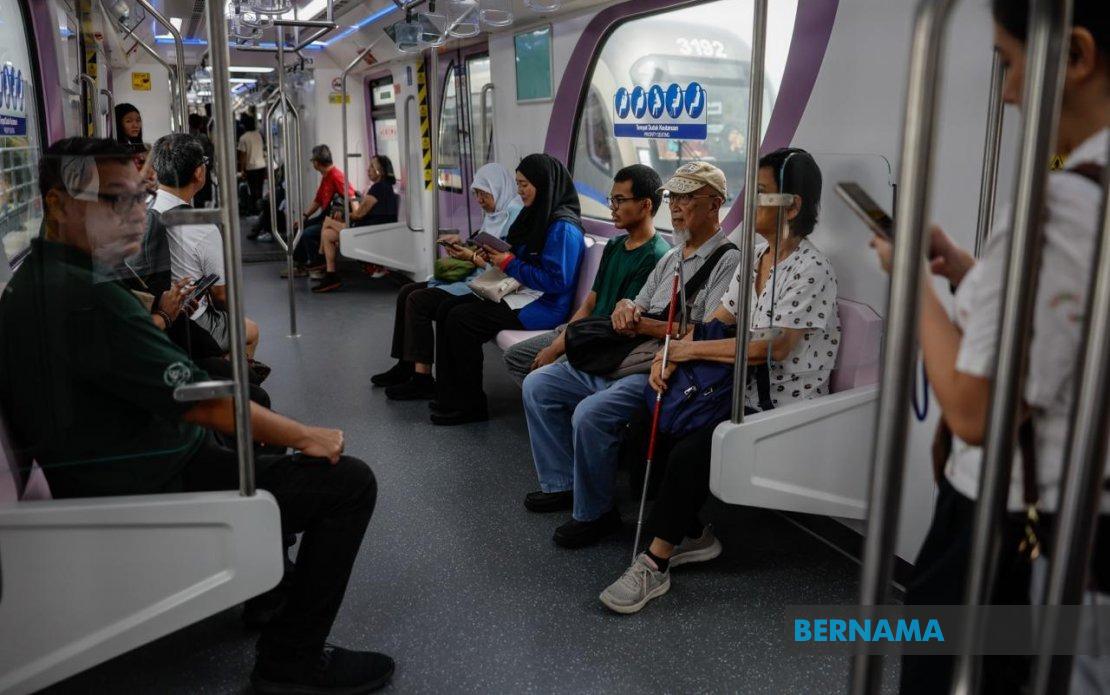
The inaugural operations of Malaysia's Light Rail Transit 3 (LRT3) Shah Alam Line have generated considerable enthusiasm among early adopters, who broadly characterised the service as comfortable, well-designed, and genuinely transformative for commute patterns across the Klang Valley. The project, representing a RM16.63 billion government investment in public transport infrastructure, marks a significant expansion of the country's rapid transit network and reflects Kuala Lumpur's ongoing efforts to modernise urban mobility beyond the capital's core.
Prime Minister Datuk Seri Anwar Ibrahim's announcement of complimentary travel through 31 July—encompassing both the main line and feeder bus services operated by Prasarana Malaysia Berhad—has created a natural testing ground for the network's viability. This promotional period effectively functions as an extended trial that will determine whether commuters integrate the line into their permanent travel routines or view it as an occasional option. The free-fare window appears strategically timed to capture patronage data during the height of working and academic calendars, enabling the authorities to make evidence-based refinements before permanent pricing structures take effect.
Among the first-day passengers was Razlan Ibrahim, a 40-year-old commuter who is visually impaired and who traversed the route from Kajang to Glenmarie 2 station. His assessment underscores a crucial distinction: the infrastructure demonstrates genuine commitment to inclusive design, yet execution remains incomplete in certain respects. The tactile pathways installed at stations such as Bandar Utama—directional guidance systems using textured surfaces that allow visually impaired users to navigate independently—represent best-practice implementation that Razlan explicitly praised. These physical pathways provide unambiguous wayfinding to facilities including disability-accessible toilets, prayer rooms segregated by gender, and lifts, creating a coherent navigational experience for users who cannot rely on visual cues.
Nevertheless, Razlan identified a significant information access gap: the absence of comprehensive Braille signage at critical locations throughout the stations. While tactile pathways answer the question of how to move through space, Braille addresses the question of what spaces exist and what their purposes are. The omission means that visually impaired passengers can successfully locate facilities once they reach them, but may struggle to identify whether those facilities are available, what services they provide, or how to request assistance. This distinction between physical accessibility and informational accessibility reflects a broader pattern in developing-world transit systems, where capital investment in mobility infrastructure sometimes outpaces investment in the communicative dimensions of accessibility.
Private sector worker Samantha Fong, 26, articulated a different set of passenger priorities centring on operational efficiency and personal security. Her observation that the LRT3 enables direct travel between Bandar Utama and Glenmarie 2 without transfers highlights how new route geometry can fundamentally simplify commute logistics. For workers whose journeys previously required multiple vehicle changes, even modest time savings accumulate into meaningful quality-of-life improvements—less waiting, less navigation complexity, reduced exposure to transit-related delays. Fong's suggestion regarding women-only coaches reflects international best practice documented in transit systems across Asia, where dedicated cars reduce harassment and create spaces in which female commuters report greater comfort and security.
A parallel observation from 26-year-old Rainchie Lee reinforces the network's immediate appeal to time-conscious professionals. Lee's emphasis on the extended trial period as an evaluation tool—allowing students and workers to determine whether the line suits their requirements before committing to regular use—demonstrates sophisticated consumer thinking about transport adoption. This voluntary assessment phase mitigates the risk that users would pay for unsuitable service and then abandon it, instead permitting genuine behaviour-based decisions about integration into daily routines. The low waiting times reported by multiple first-day users suggest that scheduling has been calibrated reasonably accurately, a non-trivial achievement given the uncertainty surrounding actual demand patterns in newly opened transit corridors.
The LRT3 Shah Alam Line represents the latest iteration of Malaysia's ongoing expansion of light rail coverage as an alternative to car-dependent urban mobility. The Klang Valley's chronic traffic congestion—one of the region's most visible quality-of-life challenges—has driven repeated government investment in rapid transit, though historically the network's coverage has concentrated on routes serving central business districts and affluent residential zones. The Shah Alam extension responds partly to demands from workers in the industrial regions west of Kuala Lumpur to access reliable transit. For residents of expanding suburban areas such as those served by Glenmarie 2 station, the introduction of rail service represents connectivity that may not have existed even five years prior.
The feedback captured on opening day reflects broader tensions in contemporary transport policy across Southeast Asia. Transit authorities generally excel at engineering physical space and scheduling trains, where technical expertise and capital investment yield measurable results. Accessibility for persons with disabilities, however, demands sustained attention to information design, staff training, and ongoing community engagement—functions that consume institutional attention and resources without generating the same visible infrastructure achievements as new stations or expanded lines. Malaysia's evident success in installing tactile pathways demonstrates that accessibility can be embedded into transit design, yet Razlan Ibrahim's experience also shows that such commitments remain partial without complementary investment in information provision.
The suggestion of women-only coaches merits attention as policy consideration for subsequent phases of the network's development. International evidence from systems in India, Japan, and elsewhere indicates that dedicated women's spaces function most effectively when they represent genuine safety enhancements rather than tokenistic gestures. Implementation requires honest assessment of harassment patterns on existing services, adequate staffing to manage occupancy and security, and communication strategies that encourage adoption without stigmatizing users. Whether such measures would be appropriate for the LRT3 system depends on empirical documentation of passenger experience—data that the forthcoming months of free operation should help generate.
The RM16.63 billion investment in the LRT3 Shah Alam Line embeds Malaysia's transport policy within a distinctly regional context. As Southeast Asian cities compete to position themselves as knowledge economy hubs and international financial centres, transit quality increasingly functions as both practical infrastructure and symbolic indicator of urban modernity. Singapore's renowned transport system, Bangkok's expanding BTS network, and Jakarta's nascent MRT system all shape implicit benchmarks against which Malaysian authorities and commuters evaluate local provision. The Shah Alam Line's debut success positions Malaysia competitively within this regional hierarchy, provided that authorities translate early enthusiasm into sustained service quality and systematic removal of the accessibility barriers that first-day passengers have identified.
Moving forward, the policy challenge extends beyond the initial launch phase. Maintaining patronage through the transition from free to paid service requires ensuring that the value proposition remains compelling relative to alternative transport modes and that pricing structures reflect genuine affordability for the target demographic of commuters. The one-month trial period provides critical data about passenger composition, peak demand patterns, and operational challenges, yet authorities must convert this information into concrete service refinements. Addressing Razlan Ibrahim's Braille signage recommendations costs a fraction of the capital investment already deployed; implementing women-only coaches requires modest train modifications but significant policy deliberation; maintaining low wait times demands sophisticated demand management as novelty-driven ridership settles into baseline patterns. Success on the LRT3 Shah Alam Line will ultimately be measured not by opening-day enthusiasm but by whether the system evolves responsively to passenger needs.

