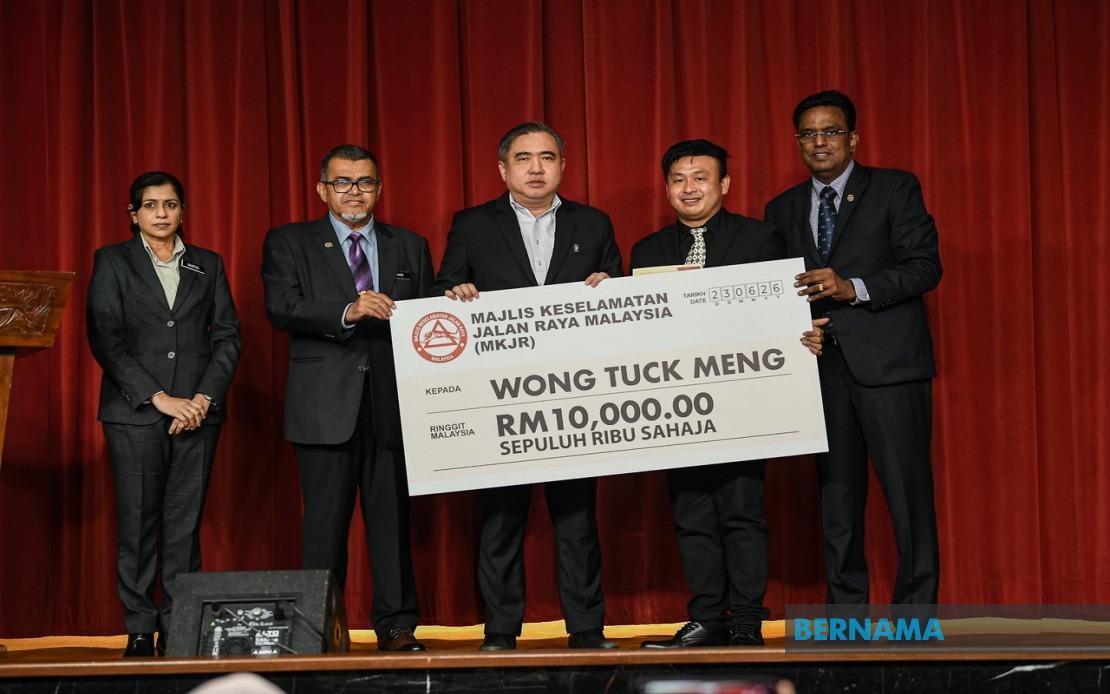
Wong Tak Ming, a lorry driver whose decisive actions averted a potentially devastating accident on a busy Malaysian highway, was today recognised by the government with a Special Certificate of Appreciation and a monetary award of RM10,000. The honour came during a special ceremony held at the Parliament building in Kuala Lumpur, where Transport Minister Anthony Loke presented the accolade to the 42-year-old driver, whose selfless intervention on June 15 prevented what could easily have resulted in significant loss of life.
The incident unfolded when an express coach bound for Kuala Lumpur from Kedah encountered mechanical complications whilst navigating a treacherous downhill gradient in the vicinity of the Menora Tunnel in Perak. As the bus lost traction and careened out of control, Wong, who was operating his lorry behind the stricken vehicle, recognised the gravity of the situation and acted with remarkable composure. Rather than attempting to flee from the impending collision, he deliberately manoeuvred his heavy vehicle to make contact with the rear of the bus, using the mass and braking capacity of his lorry to gradually decelerate the runaway coach. Once he had sufficiently reduced its speed, Wong steered both vehicles towards the guardrail, bringing them both to a controlled halt and preventing the bus from plummeting down the embankment or striking other motorists on the highway.
Loke's remarks at the ceremony underscored the magnitude of Wong's courage, emphasising that his intervention prevented a tragedy that could have claimed multiple lives. The minister noted that the swift thinking demonstrated by the lorry driver exemplified the kind of civic responsibility and personal bravery that society should celebrate and emulate. "His swift action prevented what could have been a tragic accident and saved many lives," Loke stated, whilst acknowledging that Wong had placed himself in considerable danger in order to protect the passengers aboard the bus. The award, funded by the Malaysian Road Safety Council (MKJR), represents official recognition of an act that extended far beyond the boundaries of ordinary duty.
When asked about his motivations during the ceremony, Wong displayed the humility characteristic of those who perform extraordinary feats without seeking recognition. He explained that in the critical moments when the bus began to lose control, his instincts simply focused on preventing fatalities and creating a buffer of time for vehicles ahead to clear the danger zone. "At that moment, I was only thinking about preventing any loss of life. There was still some distance between the bus and my lorry, so I had time to sound the horn to alert vehicles ahead," Wong recounted, demonstrating that his actions were not confined to the physical intervention but extended to warning other motorists of the unfolding emergency. This layered approach to crisis management, combining quick decision-making with spatial awareness and communication, exemplified the kind of comprehensive thinking that could mean the difference between catastrophe and survival on Malaysia's highways.
Parliament itself has formally acknowledged Wong's bravery through its official channels. Deputy Speaker Datuk Dr Ramli Mohd Nor conveyed the legislative body's gratitude to Wong following Transport Minister Loke's tabling of the Road Transport (Amendment) Bill 2025 for its second reading. This parliamentary recognition carries particular significance, as it elevates Wong's actions from a localised incident into a matter of national importance, signalling that the government views road safety and individual heroism as priorities worthy of the highest levels of official acknowledgment.
The incident gained considerable traction on social media platforms, where video footage of the dramatic rescue circulated widely and garnered substantial public admiration. The viral nature of the footage meant that Wong's actions transcended their immediate impact, serving as an educational moment for the broader driving community about the importance of situational awareness, quick decision-making, and the willingness to intervene even when personal risk is involved. In an era when many motorists become inured to the dangers of highway travel through routine exposure, Wong's example provides a potent reminder that individual actions, undertaken in moments of crisis, can have profound consequences.
The recognition of Wong's bravery also reflects broader concerns within Malaysia regarding road safety and the prevention of highway accidents. The Menora Tunnel area, situated in Perak, is a location where numerous accidents have occurred over the years, often exacerbated by challenging terrain and vehicle malfunction. By honouring Wong's intervention, the government implicitly acknowledges that whilst infrastructure improvements and regulatory measures are essential, the human factor—individual alertness, compassion, and willingness to act—remains crucial to accident prevention. Wong's actions demonstrate that even when mechanical failures occur and professional safety systems fail, an alert and courageous individual can step into the breach and prevent tragedy.
The RM10,000 award, whilst modest compared to the value of the 21 lives potentially saved, symbolises governmental appreciation for actions undertaken not for financial gain but from genuine concern for public welfare. For Wong, the recognition provides vindication that his split-second decision to intervene, made without certainty of outcome or guarantee of safety, was the correct course of action. More broadly, the award serves as a statement to the Malaysian public that such behaviour is valued, respected, and worthy of emulation—a message that becomes increasingly important as road networks become more congested and accident risks correspondingly increase across the nation.