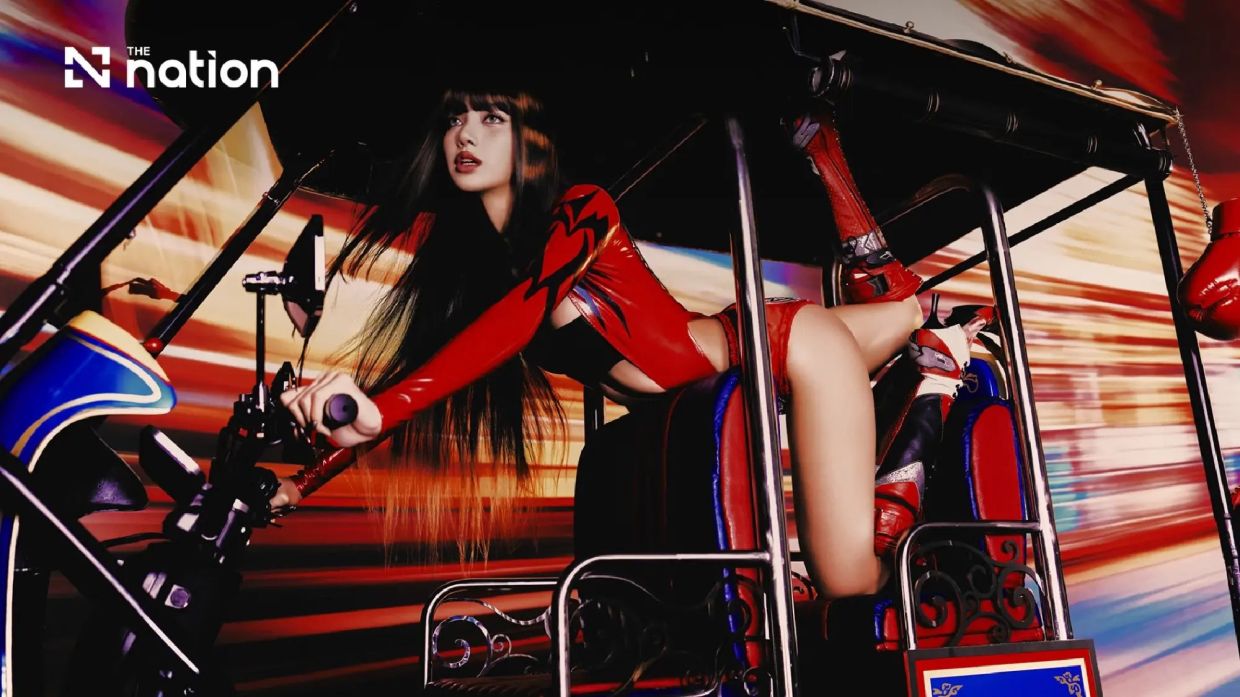
BLACKPINK's Lalisa Manobal is bringing Thailand's most iconic imagery to the global stage with her latest single "SaWaDiKa", a campaign that intertwines the country's martial arts heritage, distinctive streetscape and everyday vernacular into a sleek, high-fashion aesthetic. Released on September 3, 2026 (September 4 Thailand time), the single marks Lisa's return to explicitly celebrating her Thai roots through music and visual storytelling, positioning the nation's cultural markers as central to her international identity.
The campaign's visual identity draws its strength from unexpected juxtapositions. Campaign images reveal Lisa reimagining traditional Muay Thai attire through a contemporary luxury lens—boxing shorts emblazoned with her name, leather bodysuits paired with footwear inspired by ring combat, and dramatic lighting that suggests motion and power. Rather than reverting to literal reproductions of fight-sport garments, the concept instead raids the vocabulary of Muay Thai styling and merges it with futuristic sportswear aesthetics. This approach allows Lisa to honor the martial art without reducing it to costume, instead positioning it as a raw material for fashion innovation.
Equally striking is the incorporation of Bangkok's ubiquitous blue-and-red tuk-tuks, vehicles that have become synonymous with Thai street culture and tourism imagery. In the campaign, Lisa sits atop one of these iconic vehicles, the surrounding graphics created through streaked lighting to convey velocity and drama. The tuk-tuk ceases to be merely a transportation symbol and instead becomes a prop within a larger narrative about movement, modernity and the merging of tradition with forward momentum. This visual choice speaks to how contemporary artists can reimagine familiar national signifiers without kitsch, instead using them as platforms for bold creative statements.
The single's title itself represents a calculated decision to center Thai language within global pop music discourse. "SaWaDiKa" is a stylized rendering of "sawasdee ka", the polite Thai greeting that structures daily social interaction across the country. By naming her single after this everyday phrase, Lisa ensures that the Thai language accompanies her music across international charts and streaming platforms. The choice carries particular significance in an era when English-language dominance in pop music remains largely unquestioned, making the decision to foreground Thai vocabulary a subtle but meaningful act of linguistic assertion.
Lisa's choice did not escape the attention of Thailand's official tourism apparatus. Thapanee Kiatphaibool, governor of the Tourism Authority of Thailand, publicly welcomed the single's title on social media, noting how the greeting reinforces perceptions of Thai warmth and hospitality. This endorsement reflects the broader recognition within government circles that cultural soft power—particularly when wielded by globally recognized figures—represents a valuable asset for national branding. Lisa's position as the "Amazing Thailand Ambassador" since 2025 underscores this relationship, formalizing her role as a conduit between Thai identity and international audiences.
The rollout strategy itself demonstrated sophisticated marketing coordination. Before the single's official announcement, outdoor displays reading "HELLO สวัสดีค่ะ" appeared simultaneously in Bangkok, New York, Los Angeles and Mexico City, generating intrigue among Lisa's fanbase while establishing the greeting as the campaign's central motif. This multi-city activation transformed a simple daily expression into a global pop culture moment, collapsing the distinction between Thai cultural artifact and contemporary music marketing. For Malaysian audiences familiar with similar greetings in their own linguistic traditions, the campaign illustrates how regional pop stars increasingly leverage local language and heritage as differentiating factors in a crowded international music landscape.
The "SaWaDiKa" single represents the latest chapter in Lisa's ongoing artistic conversation with her Thai identity. Her 2021 debut "LALISA" incorporated traditional dress, dance-inflected choreography and musical elements explicitly drawn from Thai culture, with the artist having actively requested these inclusions during production. The accompanying music video placed her in elaborate gold Thai-inspired costumes within settings that evoked her native Buri Ram province. Three years later, "Rockstar" shifted that dialogue into contemporary Bangkok, filming along Yaowarat Road in Chinatown and other metropolitan locations, establishing the Thai capital as a futuristic pop setting rather than a heritage destination.
"SaWaDiKa" now extends this trajectory by adding Muay Thai, tuk-tuks and the Thai language itself to her established visual vocabulary. The progression suggests an artist systematically exploring different dimensions of Thai cultural expression—from traditional ceremonial dress to urban contemporary landscape to combat sports and transport infrastructure. Rather than treating Thainess as something preserved in heritage contexts, Lisa's approach positions it as a living, evolving aesthetic that can inhabit fashion-forward, global pop music spaces without apology or explanation.
The single arrives as the lead track from her forthcoming six-track EP "PRESS PLAY", scheduled for October 23, 2026. Official descriptions frame the project as both a return to fundamentals and a celebration of her trajectory from Thailand to international prominence. The remaining five track titles remain unannounced, leaving room for speculation about whether subsequent releases will continue this cultural excavation or shift toward different creative territories. The decision to foreground "SaWaDiKa" as the project's introduction, however, suggests that Thai identity will remain a defining feature of this era.
For Malaysian listeners, Lisa's approach offers instructive parallels about how Southeast Asian artists can navigate global pop music markets while maintaining authentic connections to regional identity. The campaign demonstrates that Thai cultural symbols—from martial arts to street vehicles to linguistic markers—possess sufficient visual and emotional resonance to anchor international music releases without requiring dilution or translation. This confidence in local cultural material, coupled with sophisticated production values and genuine artistic investment, stands in contrast to approaches that treat national identity as decorative or apologetic.
The timing of "SaWaDiKa"'s release at 7am Thailand time on September 4 additionally reflects the growing importance of simultaneous global releases to pop music strategy. Rather than following legacy patterns of delayed international rollout, Lisa's campaign ensures that Thai audiences experience the single's debut moment alongside listeners worldwide. This simultaneity has the effect of positioning Thailand not as a secondary market receiving recycled content, but as an equal participant in global pop culture production cycles.
As streaming data accumulates and fan responses emerge, "SaWaDiKa" will likely demonstrate whether audiences worldwide embrace the single's explicit Thai cultural positioning. Early indicators suggest that fans respond positively to artists who authentically represent their heritage rather than obscuring it in pursuit of perceived commercial universality. Lisa's career trajectory—from BLACKPINK's global success to increasingly prominent solo work—grants her sufficient cultural capital to take creative risks that might prove prohibitive for emerging artists. Whether this single catalyzes a broader trend toward more confident regional representation in international pop music remains an open question, but "SaWaDiKa" certainly positions the conversation at the center of contemporary music discourse.

