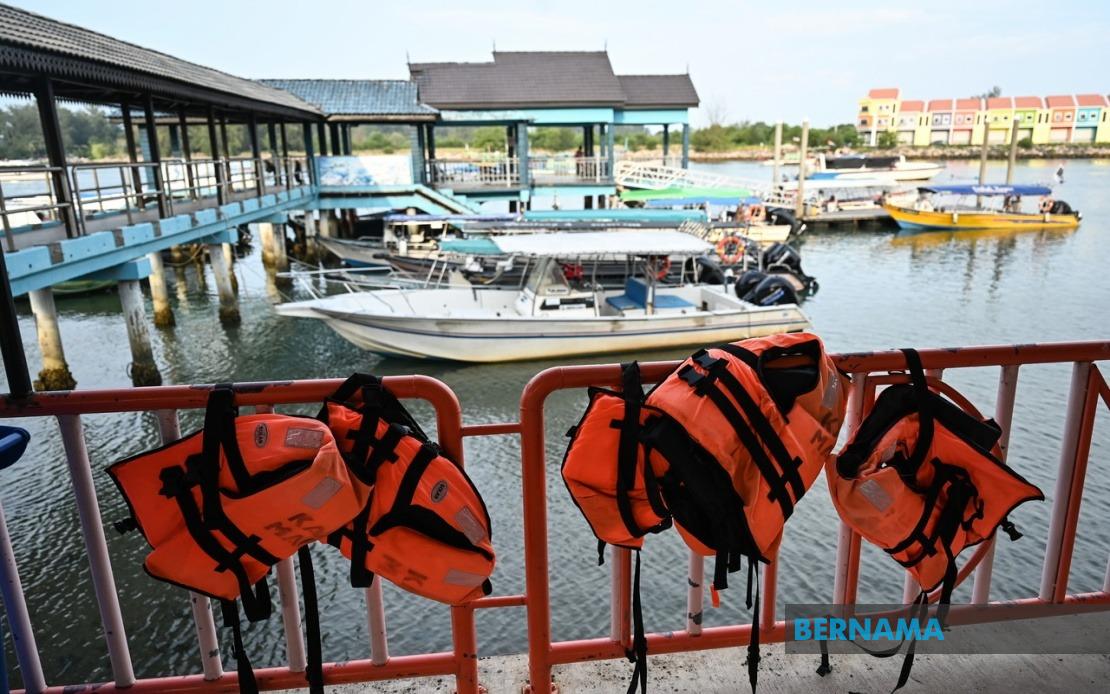
The Terengganu state government is pushing for absolute adherence to life jacket protocols across all maritime activities, particularly squid jigging expeditions, following a vessel capsize near Dataran Kuala Nerus that resulted in one fatality. Datuk Razali Idris, chairman of the State Tourism, Culture, Environment and Climate Change Committee, has emphasized that personal flotation devices cannot be treated as optional equipment to be donned only when perceived danger looms. Instead, participants must maintain their life jackets throughout their entire time aboard, without exception, even during rest and sleeping periods when vigilance naturally diminishes.
The tragic incident occurred approximately nine nautical miles off Dataran Kuala Nerus at around 9 pm, claiming the life of boat crew member Ahmad Nasaruddin Mohmad Jalil, 37. Three participants sustained injuries during the capsizing—squid jigging enthusiasts Faris Ibrahim, 33, Ahmad Danial Iman, 24, and Fatin Fariesya Rohaizan, 26—while eight individuals were successfully rescued. Two of the injured received outpatient treatment at Hospital Sultanah Nur Zahirah in Kuala Terengganu, with the third remaining under continued medical observation. The incident underscores vulnerabilities in maritime safety practices that extend beyond squid jigging to encompass all water-based recreational and commercial activities throughout the state.
Razali has articulated a comprehensive safety philosophy that positions boat operators as stewards of passenger welfare. Every vessel transporting people must be comprehensively equipped with life jackets, fire extinguishers, and additional safety apparatus appropriate to the vessel type and operating conditions. This responsibility extends uniformly to crew members, paying passengers, and recreational participants alike. The message is unambiguous: life jackets remain donned from embarkation until all persons have safely returned to the jetty. This standard applies not merely to specialized activities like squid jigging but across the entire spectrum of maritime operations, establishing a culture where safety compliance is non-negotiable.
Boat skippers bear particular responsibility for implementing mandatory pre-departure safety briefings that address critical information passengers require before venturing offshore. These briefings should systematically cover operational procedures, prevailing meteorological and sea conditions, anticipated journey duration, and crucially, proper life jacket deployment and secure fastening. Razali highlighted that tourist operators ferrying passengers to islands have long established this practice as routine protocol, suggesting that squid jigging operations should adopt identical standards. Skippers, possessing intimate knowledge of local maritime conditions and vessel capabilities, are uniquely positioned to assess real-time safety parameters and make informed decisions about whether conditions warrant postponement.
The responsibility for safety compliance flows bidirectionally between operators and participants. Razali has urged squid jigging enthusiasts to respect skipper guidance without pressuring operators to proceed when maritime conditions present unacceptable risks. He emphasized that most Terengganu boat operators demonstrate genuine professionalism and maintain willingness to provide refunds when circumstances prevent safe operation. This collaborative approach requires participants to recognize that cancellations or delays represent prudent risk management rather than commercial inconvenience. Additionally, all maritime stakeholders must observe warnings and operational restrictions issued by the Malaysia Marine Department, particularly prohibitions on launching when adverse weather renders operations unsafe.
Regarding the specific capsize incident, preliminary investigation indicates the boat was mechanically sound and operated by an experienced skipper, yet substantial water ingress into the engine compartment preceded the eventual sinking. While sea conditions were rough at the time, no active storm was occurring, suggesting the casualty resulted from environmental factors rather than mechanical failure or operator incompetence. Significantly, all passengers aboard were wearing life jackets at the moment of capsize, and this universal compliance directly enabled the rescue of eight individuals and survival of the injured. The single fatality, a crew member, underscores that even proper equipment cannot guarantee safety without complementary precautions, yet life jacket compliance clearly mitigated what could have constituted a far greater tragedy.
The Terengganu government has determined that existing standard operating procedures governing squid jigging activities remain adequate and require no revision. Razali characterized current guidelines as sufficient provided operators and participants demonstrate consistent compliance. This position reflects confidence that the regulatory framework appropriately addresses maritime safety considerations specific to the squid jigging industry. However, adequacy of written procedures proves meaningless without rigorous implementation. The focus therefore shifts from regulatory redesign to enforcement of compliance with established safety measures, particularly the critical practice of mandatory safety briefings before departure.
Governance authority for maritime safety in Terengganu reflects a distributed model whereby the state government functions in an advisory capacity while the Malaysia Marine Department retains jurisdiction over vessel licensing, operational approvals, and compliance monitoring. This institutional arrangement means state directives supplement rather than supersede federal maritime authority. Consequently, Razali's appeals function as government recommendations supported by policy influence but ultimately depend upon Malaysia Marine Department enforcement mechanisms and individual operator commitment. This governance structure creates potential gaps where advisory guidance lacks binding enforcement, emphasizing the necessity for voluntary operator compliance and passenger awareness.
The incident carries broader implications for maritime safety culture throughout Malaysia's coastal regions and recreational diving industries. Squid jigging represents a significant economic activity generating employment and attracting both domestic and international participants seeking authentic fishing experiences. Yet incidents such as this capsize reveal that operational practices may lag behind safety standards applicable to organized tourist operations. Harmonizing safety protocols across maritime activities would strengthen the overall regulatory environment. Additionally, the tragedy demonstrates how life jackets function as critical last-resort protective equipment; participants cannot rely solely upon vessel integrity or skipper expertise but must maintain personal protective measures throughout every moment aboard.
For Malaysian maritime stakeholders and recreational enthusiasts, the core message resonates clearly: life jackets represent non-negotiable safety fundamentals rather than situational accessories. The Terengganu incident, while resulting in a single verified fatality, illustrated how comprehensive life jacket compliance prevented exponentially worse outcomes. As maritime recreational activities expand across Southeast Asian nations, establishing and maintaining rigorous safety cultures becomes increasingly essential. Operators, passengers, and regulatory authorities must collectively internalize that water safety protocols exist to preserve human life and that compliance requires unwavering commitment rather than casual adherence. The Terengganu government's renewed emphasis on these principles reflects sobering recognition that operational complacency exacts tragic human costs.

