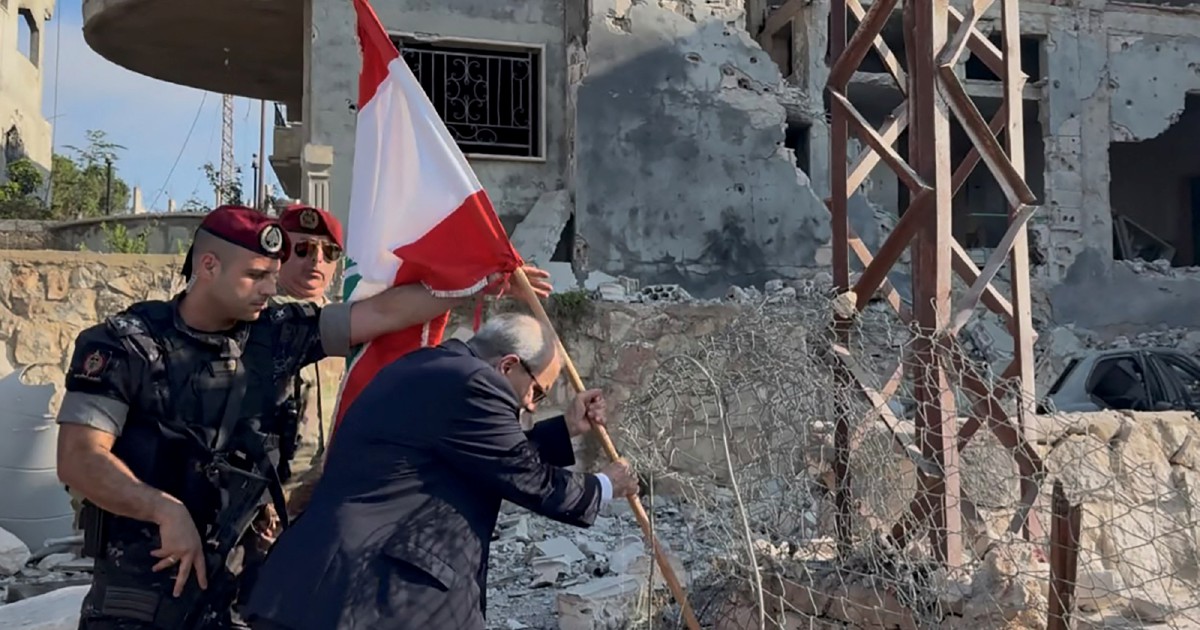
Lebanese Prime Minister Nawaf Salam declared on Wednesday that his government remains committed to achieving a complete Israeli withdrawal from all occupied territories, underscoring Beirut's unwavering position on national sovereignty and territorial integrity during a visit to Zawtar al-Gharbiyah, a southern village where Lebanese armed forces have recently re-established a military presence.
The timing of Salam's statement comes at a critical juncture for Lebanon, a nation grappling with decades of conflict and fragmentation along its border regions. His remarks, made during the visit to the newly deployed Lebanese army positions, represent a clear reaffirmation of his administration's core diplomatic objective and signal the government's determination to exercise full state control over areas previously contested or occupied by foreign military forces.
The deployment of Lebanese troops to villages such as Zawtar al-Gharbiyah symbolizes an important step in the broader Lebanese strategy to reassert state authority in border regions and reduce reliance on non-state armed groups for security matters. Prime Minister Salam's public statements during such visits serve multiple purposes: they reinforce domestic legitimacy by demonstrating commitment to national interests, while simultaneously conveying resolve to regional and international stakeholders, including the United States and France, which have traditionally maintained significant diplomatic interests in Lebanese affairs.
Lebanon's pursuit of Israeli withdrawal must be understood within the context of decades-long disputes over the Shebaa Farms, Kafr Shuba, and other contested areas that have remained flashpoints between Beirut and Tel Aviv. These territories represent not merely strategic real estate but emblematic issues of national dignity and sovereignty for Lebanon, particularly among its diverse political constituencies. The presence of foreign military forces in these areas continues to undermine Lebanon's ability to exercise complete territorial control and fuels tensions that periodically threaten regional stability.
For Malaysian and Southeast Asian observers, Lebanon's situation offers instructive parallels regarding maritime disputes, territorial claims, and the challenge of smaller nations asserting sovereignty against more militarily powerful neighbours. Like maritime disputes in the South China Sea, territorial disagreements along Lebanon's borders involve complex historical claims, international law interpretations, and the delicate balance between diplomatic negotiation and national assertion of rights. The Lebanese government's emphasis on working through diplomatic channels rather than military confrontation mirrors the approach several ASEAN nations have adopted in similar regional disputes.
Salam's government has attempted to navigate between multiple competing pressures: satisfying domestic constituencies demanding robust patriotic stances, maintaining international relationships crucial for economic survival and reconstruction, and managing the influence of Hezbollah and other armed groups that operate independently from state structures. This balancing act becomes increasingly precarious as Lebanon continues its economic crisis, with the Lebanese pound having collapsed and widespread poverty affecting millions of citizens who increasingly view political elites as disconnected from their hardships.
The Lebanese army's deployment to previously unstable areas represents an effort to rebuild state institutions and establish monopoly over security provision, a fundamental prerequisite for any sustainable political settlement. However, the success of such deployments depends heavily on continued international support, including funding and training for Lebanese armed forces. Without sustained assistance from allies and the international community, the Lebanese state risks being unable to maintain its newly reasserted territorial presence, potentially creating vacuums that non-state actors or rival powers might exploit.
From a regional perspective, Lebanon's diplomatic trajectory intersects with broader Middle Eastern dynamics involving Iran, Syria, Saudi Arabia, and the United States. Israeli military presence on Lebanese soil connects to wider security architectures in the eastern Mediterranean and the Levant, where multiple actors pursue competing strategic objectives. Salam's statements therefore acquire significance beyond bilateral Lebanese-Israeli relations, resonating through complex regional networks of influence and counter-influence that define contemporary Middle Eastern geopolitics.
International involvement remains essential for any resolution of the Israeli-Lebanese territorial disputes. The United Nations Interim Force in Lebanon (UNIFIL) and various international mediation efforts have attempted to prevent escalation and create diplomatic space for negotiations. Prime Minister Salam's emphasis on working towards complete withdrawal suggests confidence, at least rhetorically, in international mechanisms and the diplomatic process, even as Lebanon faces constraints from internal fragmentation and external pressures that limit negotiating leverage.
For Malaysia and the broader Southeast Asian community, the Lebanon situation underscores how territorial disputes and national sovereignty concerns remain potent political and security issues in different regions, requiring sustained patience, international coordination, and commitment to rules-based approaches. The Lebanese government's emphasis on peaceful resolution, despite substantial provocations and historical grievances, offers lessons about persistence in pursuing national interests through diplomatic channels while simultaneously rebuilding state capacity and institutional strength.

