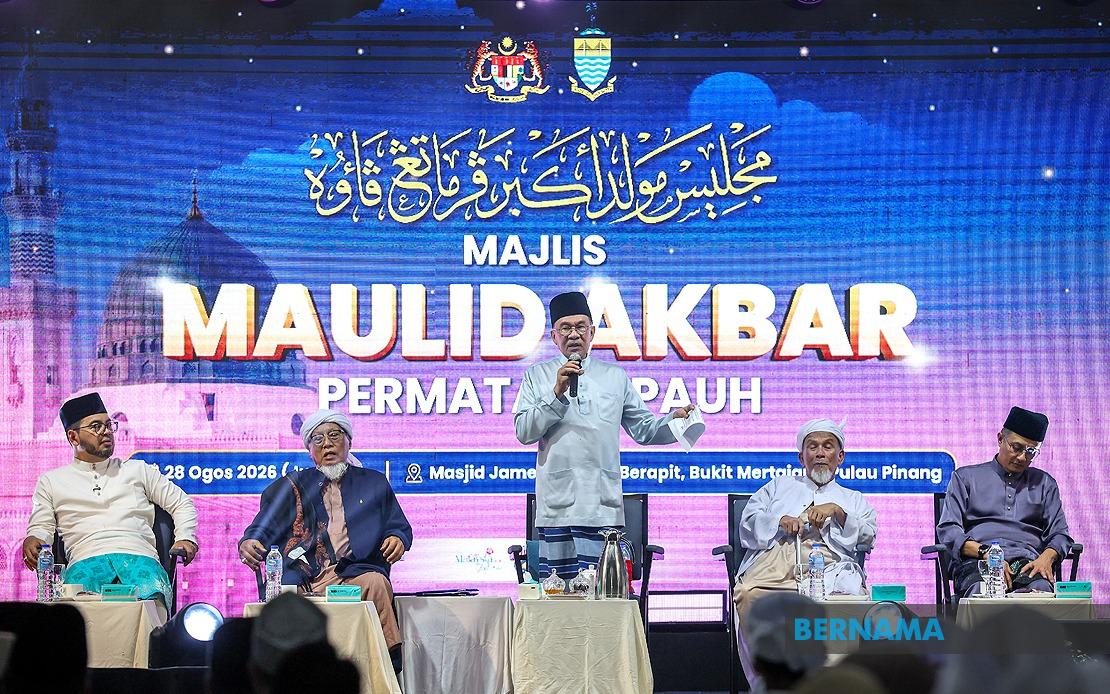
Prime Minister Datuk Seri Anwar Ibrahim has called on the Muslim community to become moral exemplars for Malaysian society, emphasizing that genuine respect flows from demonstrating virtue through everyday actions rather than from religious identity alone. Speaking at a Maulid Akbar ceremony held in conjunction with National Day celebrations at Masjid Tengah in Bukit Mertajam, Anwar stressed that Muslims must earn social regard through visible commitment to integrity, diligence and ethical conduct.
The Prime Minister outlined a vision where public perception of Muslims improves through tangible evidence of their commitment to positive values. He highlighted that when individuals work conscientiously, honour their commitments, demonstrate honesty in transactions and refrain from misusing positions of responsibility, they naturally command respect from those around them. This emphasis on demonstrable behaviour rather than rhetorical claims suggests Anwar believes the Muslim community's standing in Malaysia depends fundamentally on whether individuals live according to their stated principles.
Anwar positioned Islamic values as inherently inclusive, describing Islam as carrying a universal message of compassion and benevolence extending to all people regardless of ethnic or religious background. This framing carries significance for Malaysia's multicultural context, where public articulation of Islam's inclusive dimensions matters for social cohesion. By emphasizing that Muslims must prioritize community welfare broadly conceived, Anwar attempted to reorient discussion away from narrow sectarian concerns toward shared national interests.
Central to the Prime Minister's remarks was the concept of balance in human development. He advocated for simultaneous cultivation of knowledge, faith, moral character and spiritual growth alongside physical wellbeing and material advancement. This holistic framework suggests Anwar views incomplete development—whether purely spiritual or purely material—as inadequate for both individual flourishing and national progress. The articulation of this balanced approach reflected broader thinking about how Muslim-majority societies can modernize without sacrificing ethical foundations.
Anwar drew explicit connections between individual moral conduct and the success of Malaysia MADANI, the government's development framework. He argued that policies, economic expansion and technological mastery cannot alone sustain national progress without underlying foundations of faith, morality and character. This positioning treats ethical conduct not as peripheral to governance but as a prerequisite for meaningful development. The framework suggests that without such moral moorings, material achievements become hollow and potentially corrosive to social stability.
The Prime Minister employed evocative imagery to convey this balance, suggesting that while Malaysia must aspire to reach skyward through development ambitions, it must simultaneously remain grounded in fundamental values. This metaphorical language indicates Anwar's concern that rapid modernization risks severing societies from stabilizing moral traditions. The emphasis on being "rooted in the earth" while reaching upward reflects a tension many developing societies face between embracing progress and preserving cultural identity.
Anwar specifically advocated for strengthened engagement between political leaders and Islamic scholars, positioning religious intellectuals as essential sources of constructive guidance and perspective. This suggests recognition that governance challenges require input from diverse expertise, including religious scholarship. The emphasis on "constructive advice" rather than mere affirmation indicates Anwar values substantive intellectual engagement rather than ceremonial deference to religious figures.
The Prime Minister's insistence on the primacy of moral and spiritual foundations for development contrasts with approaches emphasizing technical solutions or market mechanisms alone. For Malaysia specifically, this positioning reflects long-standing commitments to Islam's role in national identity while attempting to redirect that role toward ethical governance rather than political or cultural assertion. The argument that respect for Muslims depends on individual behaviour rather than institutional power represents a subtle but significant reorientation of how religious identity functions in public life.
Minister in the Prime Minister's Department (Religious Affairs) Dr Zulkifli Hasan's attendance underscored the government's commitment to this message. The presence of the religious affairs minister alongside the Prime Minister at a religious ceremony signalled institutional alignment on these themes, suggesting they represent deliberate policy positioning rather than ad hoc remarks.
For Southeast Asian and Malaysian observers, Anwar's emphasis on individual virtue as the foundation for community standing and national development offers a distinctive perspective in regional governance discourse. Rather than framing Muslim identity primarily through political assertion or institutional prerogative, he positioned it fundamentally as requiring ethical performance. This approach potentially resonates with broader aspirations across Muslim-majority societies to reconcile religious identity with contemporary governance demands and multicultural realities.
The practical implications of this framing extend beyond rhetoric into governance priorities. If Muslim leaders genuinely must earn respect through demonstrated integrity and diligence, this creates accountability pressure for officials and institutional leaders to maintain ethical standards. Anwar's insistence that corruption, dishonesty and abuse of power fundamentally contradict Islamic values while simultaneously undermining the community's social standing created direct linkages between individual conduct and collective wellbeing.
The Malaysia MADANI framework itself gains depth through this moral interpretation. Rather than constituting merely another development strategy emphasizing economic metrics, it becomes a program rooted in spiritual and ethical renewal. This positions Malaysia's development trajectory as dependent not just on policy execution but on a cultural shift toward prioritizing integrity and character across society.

