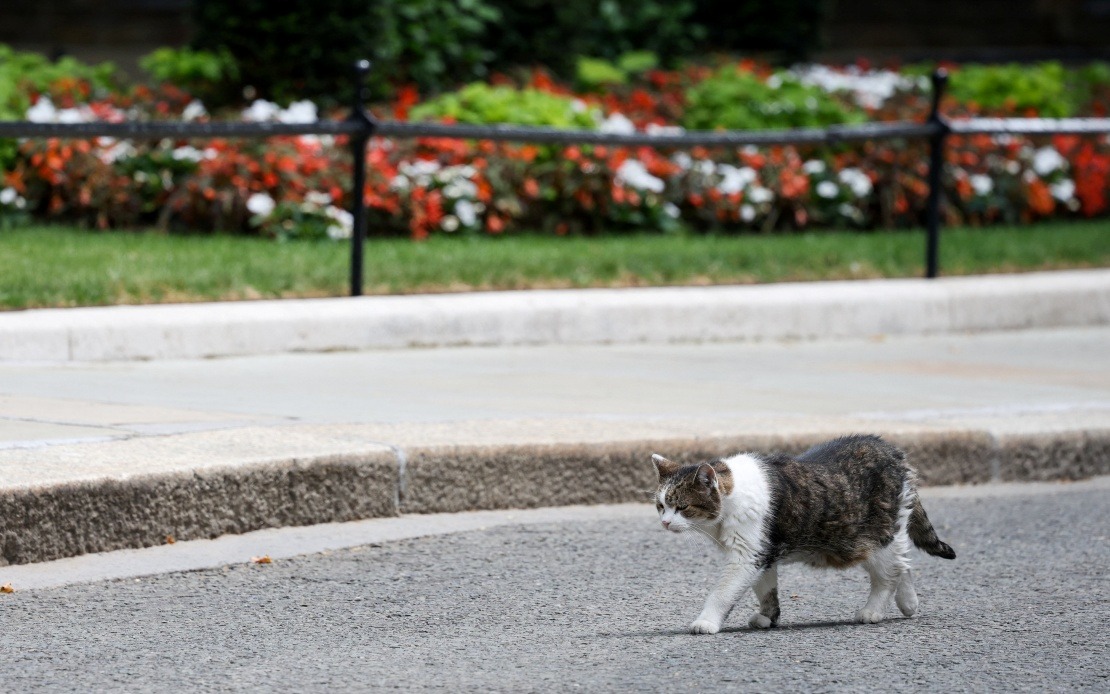
Larry, the long-serving tabby cat of 10 Downing Street, has achieved an unusual distinction in British politics: he has witnessed the arrival and departure of six consecutive prime ministers, a tenure that far outlasts most human occupants of the residence. The feline fixture was recently spotted roaming the grounds outside the iconic building on July 21 as Andy Burnham, the newly installed Prime Minister, convened his first Cabinet meeting following his assumption of office, according to reports from Anadolu Ajansi.
The presence of Larry outside 10 Downing Street while ministerial colleagues gathered indoors for their inaugural gathering under the new administration underscores the cat's established role as an unofficial—yet remarkably enduring—symbol of continuity within Britain's highest office. Unlike the politicians who come and go with electoral cycles and party fortunes, Larry represents an unbroken thread through years of political upheaval and transition at the heart of Westminster governance.
Larry's tenure at Number 10 stretches across a remarkable span of British political history. The cat has resided at the Prime Minister's official residence through administrations of vastly different political complexions and governing philosophies, from various Conservative and Labour governments to coalition arrangements. This longevity makes Larry something of a silent witness to pivotal moments in recent British politics, from major legislative battles to international crises, all witnessed from his privileged vantage point within the corridors of power.
The British public has long developed an affection for Larry, who has become a recognisable figure in media coverage of 10 Downing Street and political events. Citizens and observers often comment on the cat's apparent indifference to the political machinations occurring within the building, projecting onto him a sense of stability that the constantly shifting world of electoral politics often lacks. His continued presence provides a reassuring constant in an environment characterised by ambition, competition, and regular upheaval.
For Malaysian readers observing British politics from afar, Larry's story offers an interesting reflection on institutional continuity and symbolism. Just as Malaysia has its own symbols of state and institutional traditions that provide continuity through periods of political change, Larry embodies the idea that certain fixtures can transcend individual political actors and persist through multiple changes of leadership. The cat's indifference to which prime minister occupies the residence serves as a humorous reminder that institutions and their symbolic dimensions often outlast the individuals who temporarily hold power within them.
The arrival of a new Prime Minister traditionally involves considerable fanfare, ceremonial procedures, and the establishment of new priorities and directions for government. Yet Larry's continued presence, unimpressed by such transitions, highlights the distinction between the temporary nature of political office and the more permanent structures that support governance. The cat's casual wandering outside while ministerial business proceeds inside suggests an almost philosophical detachment from the urgency and importance that political actors attach to their own tenure.
From a Southeast Asian perspective, where political transitions can carry significant consequences and occasionally precipitate institutional instability, the smooth transfer of power symbolised by Larry's continued residence at 10 Downing Street reflects the deep institutional stability of the British political system. Regardless of which party forms government or which individual becomes Prime Minister, the machinery of state continues functioning with remarkable consistency, and even the official cat remains undisturbed by such transitions.
Larry's role has evolved into something beyond that of a mere pet. The cat has become part of the fabric of British political life, attracting media attention, public interest, and even diplomatic recognition. Foreign observers and visiting dignitaries have remarked upon Larry's presence, and the cat has featured in countless photographs and news stories. This transformation from household pet to quasi-institutional fixture demonstrates how institutions develop symbolic elements that transcend their original purpose.
The question of how Larry will navigate the tenure of Prime Minister Andy Burnham remains to be seen, though the cat's track record suggests remarkable adaptability. Having already survived numerous transitions between different political personalities and governing styles, Larry appears well-equipped to continue his residence at 10 Downing Street regardless of the political complexion of future governments. The cat's survival instincts and apparent indifference to political ideology suggest he will likely continue his tenure for years to come.
For those tracking British politics and institutional dynamics, Larry's continued presence serves as a gentle reminder that beyond the headlines, the speeches, and the policy announcements, there exists a deeper layer of institutional life that persists unchanged. The cat's appearance outside the building on Andy Burnham's first day as Prime Minister symbolises both the transition that has occurred and the remarkable continuity that characterises the British state. In six prime ministerial tenures, Larry has become not merely a resident of 10 Downing Street, but an embodiment of institutional permanence in a world of political flux.

