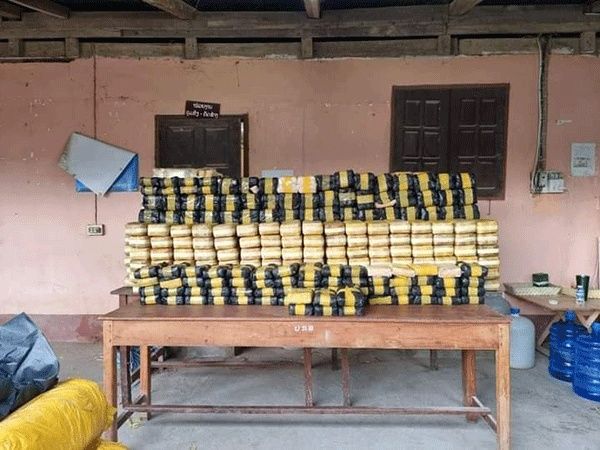
The scale of drug trafficking in Laos's Xaysomboun province has emerged as a critical security challenge, with narcotics cases overshadowing all other criminal activity in official statistics released this week. During the first six months of 2024, drug-related offences represented 24 of 54 criminal incidents recorded by provincial police, translating to nearly 44 per cent of all criminal cases and underscoring the severity of the problem facing authorities in central Laos. The figures, presented by Police Brigadier General Ouday Insouvanh during discussions with the Minister of Public Security, Police Lieutenant General Vanthong Kongmany, on August 7, have galvanised calls for significantly more aggressive enforcement strategies.
The composition of these drug cases reveals substantial investigative workload. Of the 24 narcotics-related incidents, only two had progressed to formal prosecution through the Public Prosecutor's Office by the reporting period's end, while the remaining 22 cases remained under active investigation. This pattern suggests either the complexity of drug trafficking networks or resource constraints within the provincial police force, a common challenge across Southeast Asia where drug smuggling organisations operate with increasing sophistication. The slow progression rate highlights the labour-intensive nature of drug enforcement, where investigations frequently require extensive surveillance, financial tracking, and international coordination.
When viewed against the broader criminal landscape in Xaysomboun, the dominance of drug cases becomes even more apparent. Across all 54 recorded offences, police managed to resolve only 15 cases conclusively, with six settled through alternative mechanisms and four formally concluded and forwarded for prosecution. The remaining 29 cases, nearly 54 per cent of the total caseload, continue under investigation, indicating that provincial police resources are stretched across multiple crime categories simultaneously. This backlog of unresolved cases underscores the demanding operational environment facing security forces in the province.
Lao authorities have positioned drug suppression as part of a comprehensive national security agenda, one established five years ago and maintained as a top-priority initiative. National-level data presented by Prime Minister Sonexay Siphandone at an Extraordinary Session of the National Assembly last month demonstrates the scale of this campaign across Laos. During the same six-month period, authorities nationwide processed 1,786 drug-related cases, resulting in 4,025 arrests including 93 foreign nationals. These statistics, coupled with substantial seizures of narcotics and drug-related paraphernalia alongside vehicles used in trafficking operations, reflect coordinated enforcement across multiple provinces and agencies.
The focus on drug trafficking gains particular significance for regional observers given Laos's geography and the broader Southeast Asian drug trade. The country sits on critical smuggling routes connecting major production areas in Myanmar and Thailand with markets across the region and beyond. Xaysomboun's central location makes it strategically important in these trafficking networks, and the concentration of drug cases suggests the province functions as either a transit point or distribution hub. For Malaysian policymakers and security analysts, these enforcement challenges in neighbouring countries carry implications for regional stability and cross-border security cooperation.
Beyond narcotics, Police Lieutenant General Vanthong directed the Xaysomboun Provincial Public Security Command to strengthen enforcement across a wider spectrum of criminal activity. His explicit calls for tougher action against smuggling, human trafficking, theft, burglary, illegal mining, and gambling operations indicate that Lao authorities recognise these activities as interconnected rather than separate phenomena. Criminal organisations frequently diversify their operations across multiple illicit enterprises, and the minister's comprehensive approach reflects understanding of these networks' complex structures. For Southeast Asian security observers, this integrated enforcement model represents an emerging regional standard.
A particularly significant directive from the minister addressed cybercrime and online activities, marking a notable evolution in Lao security priorities. Police Lieutenant General Vanthong instructed the provincial force to strengthen oversight of social media usage and tackling digital crimes in accordance with ministry orders. This instruction positions Xaysomboun among the first provincial jurisdictions in Laos to formally prioritise cybersecurity alongside traditional crime categories. The shift reflects global trends whereby organised criminal enterprises increasingly exploit digital platforms for money laundering, drug trafficking coordination, and fraud operations, vulnerabilities that smaller Southeast Asian economies face with particular acuteness.
Road safety emerged as an equally pressing concern during the meeting, with statistics revealing a separate but substantial security crisis affecting civilians directly. During the six-month period, Xaysomboun recorded 60 traffic accidents resulting in four deaths, 80 injuries, and 109 damaged vehicles. The financial impact exceeded 2.56 billion kip, representing substantial losses for affected families and communities. While less dramatic than narcotics enforcement, road safety reflects the broader security environment where multiple threats simultaneously demand police attention and resources. The casualty figures underscore how public safety challenges extend beyond organised crime into everyday risks that affect ordinary citizens.
The provincial security apparatus also manages significant responsibilities regarding foreign national supervision and tourism oversight. During the six-month period, officers inspected 1,698 tourists, identifying 396 foreign nationals among them. This surveillance function reflects Lao government concerns about monitoring foreign presence within the country, a priority across Southeast Asia where migration and tourism create security vulnerabilities. Immigration management and foreigner oversight have become integral to security operations, requiring coordination between multiple agencies and creating additional demands on already-stretched provincial police forces.
Police Lieutenant General Vanthong's broader guidance to provincial leadership emphasised professionalisation and disciplinary standards within the security apparatus. He called for strengthened political and ideological education among officers and personnel, compliance with Party policies and state laws, and improved leadership methods suited to evolving conditions. The minister explicitly instructed officers to acknowledge weaknesses, avoid passivity, and assume direct responsibility for operational outcomes, language suggesting concerns about institutional performance and accountability. These directives signal recognition that technical enforcement capability alone cannot address security challenges without improved management systems and personnel accountability.
The minister specifically emphasised that immigration management and foreign national administration must operate with professional standards, clear responsibility assignment, and personnel allocation according to expertise levels. This instruction appears directed at addressing potential shortcomings in how Xaysomboun's security forces manage migration and foreigner-related responsibilities. For regional security practitioners, such emphasis on professional standards within provincial bureaucracies reflects recognition that institutional capacity frequently lags behind policy ambitions in developing economies throughout Southeast Asia.
Looking forward, the Xaysomboun Provincial Public Security Command faces explicit expectations to ensure investigations, detention, and rehabilitation operations comply with legal procedures while maintaining readiness for emerging security challenges. The framing suggests authorities recognise both operational improvements and legal compliance as necessary elements of effective security governance. For Malaysian observers, the Lao government's approach to provincial security management offers instructive parallels to domestic challenges, particularly regarding how central authorities mobilise provincial resources against transnational crime while maintaining legal and procedural standards in resource-constrained environments.

