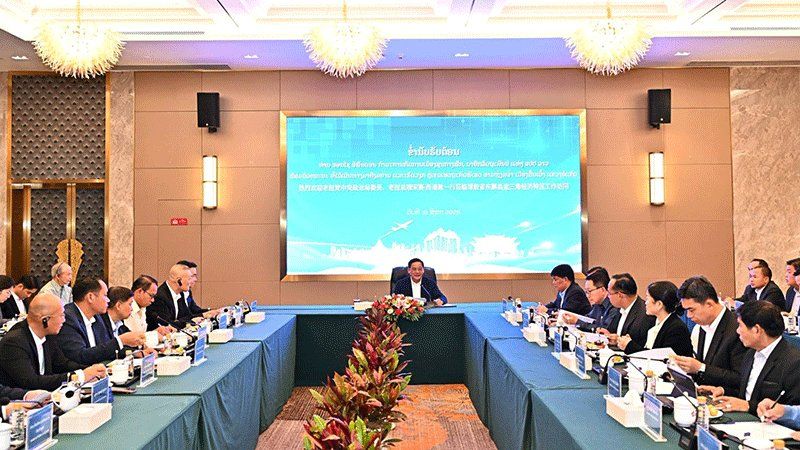
Prime Minister Sonexay Siphandone has issued a call for substantially stricter regulation and oversight of the Golden Triangle Special Economic Zone (GTSEZ) in Bokeo province, signalling growing frustration with the pace and quality of development at one of Southeast Asia's most ambitious cross-border investment projects. During a working visit to the Zone on Tuesday, the Lao leader stressed the need for more disciplined management practices and a sharper focus on genuinely sustainable economic expansion, underscoring concerns that despite nearly two decades of operations and accumulated investments approaching US$10 billion, the project has underperformed against original targets.
The Golden Triangle SEZ, which straddles the banks of the Mekong River in the mountainous Tonpheung district where the borders of Laos, Myanmar and Thailand converge—and within striking distance of China—represents one of the region's most strategically positioned economic enclaves. Established in 2007, the sprawling 10,000-hectare zone was designed as a magnet for cross-border commerce and manufacturing, leveraging its proximity to some of Asia's largest consumer and labour markets. Yet the gap between ambition and execution has become increasingly apparent, with corporate activity across manufacturing, real estate, hospitality, banking, tourism and services sectors achieving only around 60 per cent of contracted commitments over the past 19 years.
Dr Sonexay's directives reveal a leadership determined to reset expectations and tighten operational discipline. His emphasis on improving the investment environment through streamlined one-stop-service mechanisms reflects a broader Southeast Asian trend of administrative simplification to attract capital. However, his simultaneous insistence on stricter enforcement suggests previous regulatory frameworks proved insufficient or poorly implemented. The Prime Minister specifically flagged tourism, manufacturing, processing, transport, education and public health as priority sectors warranting accelerated development, implicitly acknowledging that current investment patterns may be skewed toward lower-value activities or speculative ventures rather than income-generating or employment-intensive enterprises.
A particularly revealing aspect of Dr Sonexay's remarks concerns financial discipline. His directive that all transactions—covering trade, investment, wages and services—must flow through the Lao banking system targets what has long been a challenge in cross-border zones: the prevalence of informal cash economies and inadequately documented transactions that obscure true economic activity and complicate taxation. By insisting on formal banking channels, Laotian authorities appear intent on creating clearer records for monitoring compliance and ensuring the state captures appropriate revenue from Zone activities.
The governance dimension of the visit also signals deeper institutional concerns. Dr Sonexay called for enhanced effectiveness of the Zone's Management and Administration Committee and improved concession agreements aligned with existing legislation—language suggesting that previous governance structures may have lacked sufficient authority or clarity. The presence of more than 400 government officials at the Zone, drawn from various sectors, implies a sizeable bureaucratic footprint, yet the Prime Minister's criticisms hint that coordination among these officials may have been inadequate. For investors and businesses currently operating in the Zone, such structural changes could mean more rigorous compliance checks and slower approval processes in the short term, though potentially more stable, rules-based operations over time.
The human dimension of the Zone's operations merits equal attention. With more than 10,000 registered workers and an additional 10,000-plus investors, business operators, residents and tourists circulating through the Zone, employment and labour standards have emerged as critical policy concerns. Dr Sonexay's call for enhanced cooperation with neighbouring countries—particularly regarding airline links and mechanisms to manage cross-border workers—acknowledges both the Zone's dependence on regional labour mobility and the administrative challenges this creates. Myanmar and Thai nationals, in particular, form a significant portion of the workforce, and managing their legal status, wages and working conditions requires active inter-governmental coordination.
Border management also featured prominently in the Prime Minister's instructions. He ordered authorities to more closely regulate entry and exit flows, a directive that may reflect security concerns, revenue protection, or both. The Golden Triangle's proximity to China and its porous international boundaries create vulnerabilities to smuggling, money laundering and trafficking—issues that have periodically drawn international scrutiny to the broader region. Tightened border protocols could enhance legitimate commerce whilst reducing illicit flows, though implementation challenges in a remote, mountainous terrain are substantial.
For Malaysia and other Southeast Asian economies, the Golden Triangle SEZ's trajectory carries broader implications. The Zone exemplifies the structural challenges that beset megaproject development in the region: ambitious vision, sufficient capital inflows, yet persistent gaps between intended and realised outcomes due to weak institutional capacity, unclear regulatory frameworks, and coordination failures. Investors considering projects in Laos or similar development corridors must contend with these realities, balancing attractive market access against execution risks and evolving regulatory environments. The Prime Minister's interventions suggest that Laotian authorities are attempting to learn from 19 years of experience and recalibrate expectations more realistically.
The Zone's strategic location—bridging Laos, Myanmar, Thailand and China—positions it as a potential linchpin in Belt and Road initiatives and broader pan-Mekong economic integration. However, integration cannot succeed without functional governance. Dr Sonexay's emphasis on transparent banking, stricter compliance and better coordination signals an attempt to strengthen the institutional foundations upon which such integration rests. Whether these reforms will achieve meaningful improvements in the Zone's productivity and sustainability will depend on implementation rigour and sustained political commitment—factors that have historically proven variable across Southeast Asian development initiatives.

