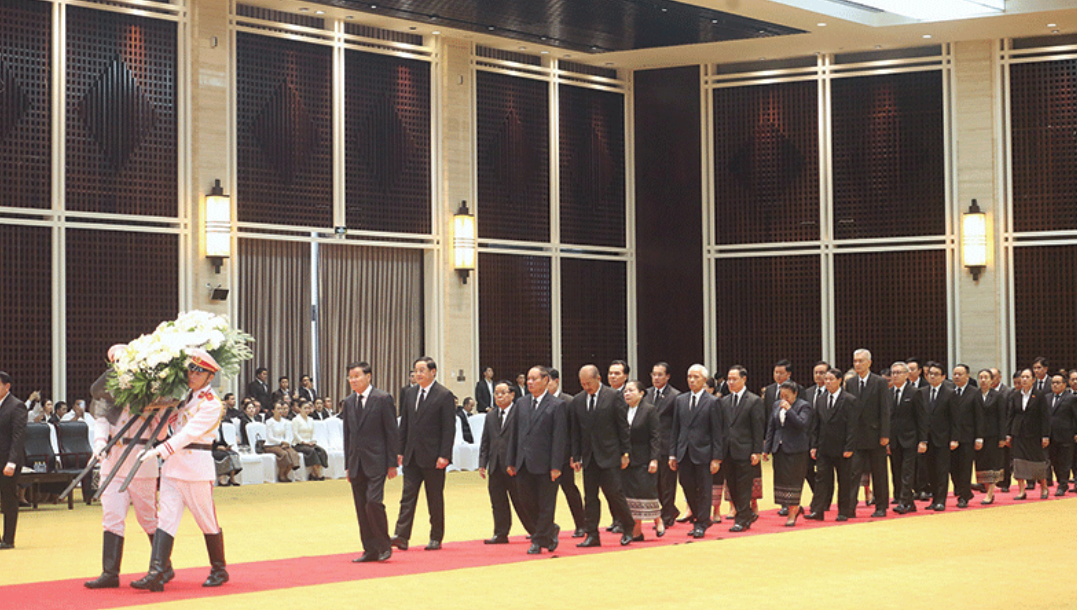
Laos came to a standstill on Sunday as the country's top political leadership assembled at the National Convention Hall in Vientiane to honour National Assembly President Xaysomphone Phomvihane, who died the previous day. Presided over by Party Secretary General and President Thongloun Sisoulith, the solemn wreath-laying ceremony drew together the highest echelons of Lao governance, reflecting the profound respect accorded to a figure who shaped the nation's legislative institutions for decades.
Xaysomphone's death represents a significant turning point for Laos. As a member of the Politburo of the Lao People's Revolutionary Party Central Committee and leader of the National Assembly, he occupied one of the country's most influential positions, wielding considerable authority over the legislative agenda and national development priorities. His passing has been characterised by Lao officials as a grave loss not merely to the party and state apparatus, but to the multiethnic Lao population he represented and served throughout his career.
The ceremony itself unfolded as a carefully orchestrated display of institutional continuity and collective mourning. Prime Minister Dr Sonexay Siphandone led the government delegation, while Sounthone Xayachack, a member of the Party Central Committee's Secretariat and Vice President of the National Assembly, represented the Standing Committee. Deputy Prime Minister Santiphab Phomvihane, who also serves as Minister of Finance, led the Phomvihane family delegation. The parade of wreaths from different state organs, party units, and family groups underscored the interconnected nature of Laos's political establishment, where party, state, and kinship networks remain deeply intertwined.
Xaysomphone's career centred largely on strengthening the National Assembly and channelling legislative action toward national defence and socio-economic development. During his tenure, he worked to enhance the assembly's institutional capacity and effectiveness in advancing the party's political agenda. His contributions to the legislative body extended beyond routine parliamentary functions; he navigated complex policy decisions affecting Laos's integration into regional economic frameworks and its relationships with major neighbours, particularly Vietnam.
The regional dimension of Xaysomphone's passing became evident through Vietnam's formal response. The National Assembly of Vietnam, led by Tran Thanh Man, a Politburo member of the Communist Party of Vietnam Central Committee, dispatched a high-level delegation to lay wreaths at the National Convention Hall. This gesture reflected the enduring strategic partnership between Hanoi and Vientiane, cemented through party-to-party and state-to-state channels. Additionally, delegations from Vietnam's Ministry of Public Security and Ministry of National Defence participated in the ceremony, signalling the depth of security and defence cooperation between the two nations.
The breadth of participation demonstrated how Xaysomphone's influence extended across Laos's institutional landscape. The Lao Front for National Development, a mass organisation led by Professor Dr Kikeo Khaykhamphithoune, sent its own delegation. The Commission for Information and Education of the Party Central Committee, along with other party organs, mobilised to pay respect. Representatives from the Prime Minister's Office, line ministries, government agencies, and the business community filed through the National Convention Hall on both Sunday and Monday, creating a sustained period of official and public mourning.
Born on December 12, 1956, Xaysomphone was the son of former President Kaysone Phomvihane, a foundational figure in modern Lao communist history. He came from a prominent family of six brothers, several of whom occupied senior positions within the party and state hierarchy. His brother Santiphab Phomvihane served as Deputy Prime Minister and Minister of Finance, while Thongsavan Phomvihane held other senior roles. This family prominence illuminated both the advantages and complexities of political succession in a one-party state where lineage and party membership intersect.
The scale of mourning declared by Lao authorities underscored Xaysomphone's standing. The Party Central Committee, National Assembly, Government, and Lao Front for National Development jointly announced five days of national mourning from August 8 to 12, a significant gesture in a country where such declarations remain reserved for figures of considerable national importance. Vietnam reciprocated by declaring two days of national mourning on August 10-11, demonstrating how individual leaders' deaths can ripple across regional political relationships.
For Malaysian and Southeast Asian observers, Xaysomphone's passing offers a window into how one-party communist states manage succession and institutional continuity. Unlike pluralist democracies where leadership transitions trigger open electoral contests, Laos's system relies upon party mechanisms, family networks, and consensus among senior cadres to navigate such moments. The absence of public debate about his successor suggested that internal party discussions had likely already commenced, reflecting a mode of governance where stability and continuity take precedence over contestation.
Foreign diplomats stationed in Vientiane visited the National Convention Hall to express condolences, indicating that Xaysomphone maintained cordial relationships across the international community, despite Laos's alignment with Vietnam and the broader socialist bloc. These visits signalled diplomatic respect for his institutional role and personal stature, even as they acknowledged broader geopolitical alignments.
The cremation ceremony scheduled for August 12 at the That Luang esplanade, Laos's most sacred religious site, represented the final public ritual acknowledging Xaysomphone's contributions. State honours typically accompany such cremations for top officials, providing an opportunity for the party and government to reaffirm institutional values and national identity. For the Lao people, the extended mourning period and continued wreath-laying at the National Convention Hall through August 11 offered a rare moment when citizens could directly engage with state institutions through ceremonial participation.
Xaysomphone's death occurred at a time when Laos faces mounting economic pressures and regional geopolitical shifts. His loss deprives the National Assembly of a senior figure well-versed in navigating complex legislative and policy challenges. Successors will inherit an institution tasked with supporting economic reforms whilst maintaining party supremacy, a balancing act that defines governance across Southeast Asia's remaining communist and socialist-oriented states.
Ultimately, Xaysomphone's legacy reflects the trajectory of Lao politics since the 1975 revolution: institutional consolidation under party leadership, deep integration with Vietnam's strategic sphere, and gradual adaptation to regional economic integration. His passing marks a generational transition within Laos's elite, with implications for how the country manages its competing demands for development, stability, and regional engagement in the years ahead.

